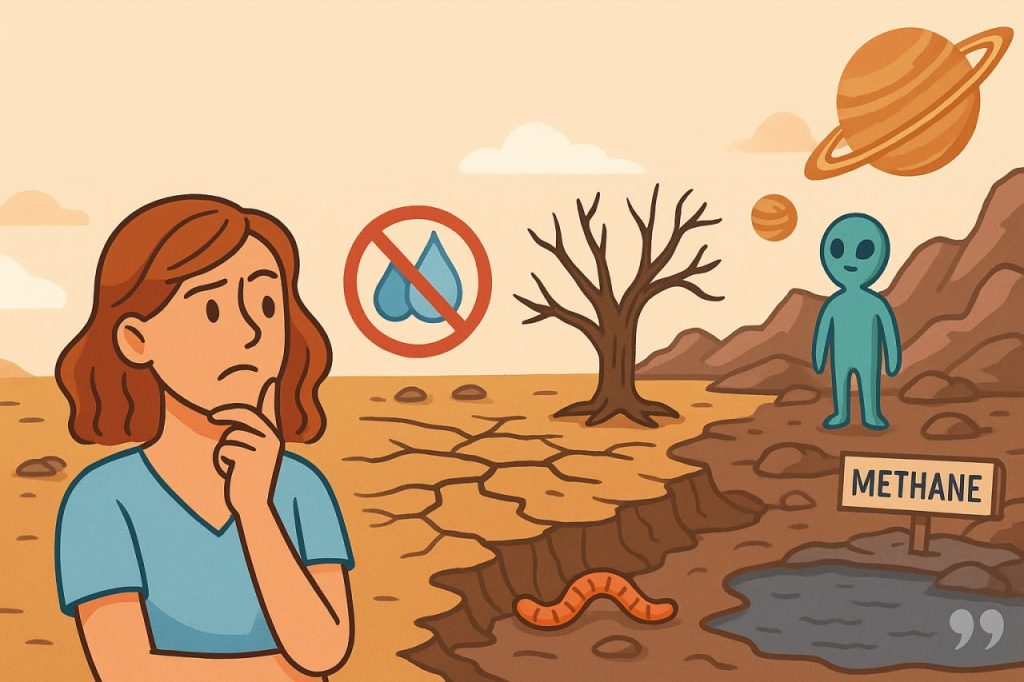
Life on Earth is deeply dependent on air and water, two essential components that sustain nearly all known organisms. Water serves as the foundation for biochemical reactions, nutrient transport, temperature regulation, and cellular structure. Air — particularly oxygen — allows many organisms to extract energy from food and maintain metabolic processes. However, as scientists explore extreme environments on Earth and search for life beyond our planet, the question becomes more complex: Is it possible for life to exist without air and water as we understand them? Research in astrobiology, microbiology, and planetary science suggests that while Earth-like life requires these elements, other life forms might survive under radically different conditions. Studying these possibilities expands our understanding of biology and the potential diversity of life in the universe.
Why Water Is Essential for Life on Earth
On our planet, water is the universal solvent that supports nearly every biochemical process. It allows molecules to move, react, and form the complex structures needed for living systems. Water’s unique chemical properties — such as its ability to dissolve nutrients, stabilize temperature, and enable flexible cellular membranes — make it indispensable for all known organisms. Without water, proteins cannot fold properly, DNA cannot function, and cells cannot survive. According to biochemist Dr. Aisha Morgan:
“Life as we know it is built on water —
without it, the chemistry of biology simply cannot happen.”
Because of this, scientists consider liquid water a primary indicator when searching for habitable environments beyond Earth.
Life Without Air: Anaerobic Organisms
While most complex life requires oxygen, many microorganisms can survive — and even thrive — without air. These organisms, known as anaerobes, obtain energy through chemical reactions that do not involve oxygen. Some live deep underground, in the digestive systems of animals, or in oxygen-free lakes. Certain bacteria even find oxygen toxic. These anaerobic forms of life demonstrate that air is not universally required for biological survival. However, they still rely on water and other chemical compounds for metabolism, showing that while air is optional for some organisms, water remains essential.
Extremophiles and the Search for Alternative Life
Extremophiles — organisms that survive in extreme conditions such as high radiation, intense heat, acidity, or pressure — provide important clues about life’s adaptability. Some live near volcanic vents, where temperatures exceed 100°C, while others survive in Antarctic ice or deep-sea trenches. These organisms challenge our assumptions about the environmental limits of life. However, even extremophiles require some form of liquid water. They show that life can exist without sunlight, oxygen, or moderate climate, but not entirely without hydration. Astrobiologists consider whether extraterrestrial life might use other liquids, such as methane or ammonia, but this remains hypothetical.
Could Life Exist Without Water?
Current scientific understanding suggests that all known life requires water, but theoretical alternatives exist. On Saturn’s moon Titan, for example, lakes of liquid methane and ethane raise the possibility of life with a completely different chemistry. Instead of water-based cells, organisms could theoretically use hydrocarbon membranes. However, there is no direct evidence of such life, and water remains the only proven medium for biological processes. The idea of life without water belongs to the realm of speculation until scientific evidence emerges.
Artificial or Synthetic Life: Breaking the Rules
Advances in synthetic biology suggest that engineered life forms might one day function differently from natural organisms. Scientists are experimenting with artificial cells, alternative genetic systems, and synthetic solvents that mimic water’s properties. While these breakthroughs are promising, they remain experimental and have not yet produced stable life systems. Even artificial cells still rely on water-based environments to maintain structure and perform chemical reactions. True water-free life remains beyond the reach of current technology.
Conclusion: Life Without Air or Water Depends on Definition
Based on everything we know, no natural life can exist without water, and only some simple organisms can survive without air. Theoretical forms of life may operate on different principles, but they have never been observed in nature. As humans search for life beyond Earth, we must be open to unfamiliar chemistries while recognizing that Earth-like life depends on the presence of water and, for complex organisms, oxygen. Life’s potential may be vast, but its proven foundation remains tied to these essential resources.
Interesting Facts
- Some microbes can survive in boiling hydrothermal vents, yet they still require water.
- Certain bacteria die when exposed to oxygen, proving that air is not universally essential.
- Titan’s methane lakes make it one of the most intriguing places for studying non-water-based life.
- Water’s molecular structure gives it unique thermal stability, ideal for life.
- Scientists have discovered microbes trapped in ice that survived in dormant states for thousands of years.
Glossary
- Anaerobe — an organism that can survive without oxygen.
- Extremophile — a life form adapted to extreme environmental conditions.
- Solvent — a liquid that dissolves substances, enabling chemical reactions.
- Hydrocarbon — a molecule made of hydrogen and carbon, potentially used as an alternative solvent.
- Astrobiology — the scientific study of life beyond Earth.