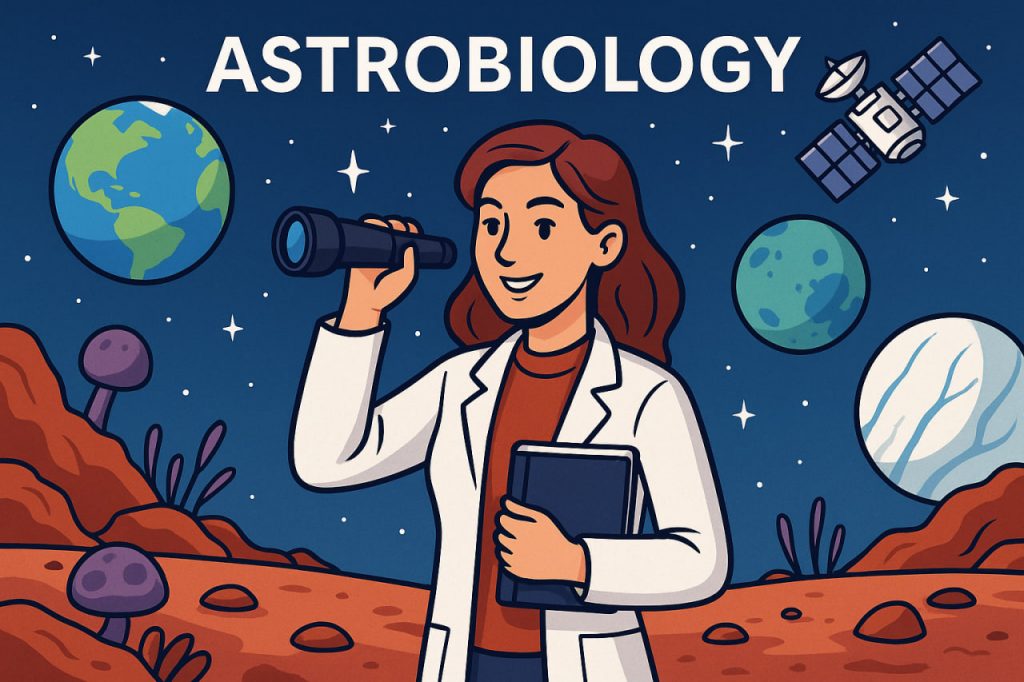
Astrobiology is the scientific discipline that explores one of humanity’s most profound questions: Does life exist elsewhere in the universe? This field combines astronomy, biology, chemistry, geology, and planetary science to investigate how life originates, evolves, survives, and potentially spreads beyond Earth. Astrobiologists study the conditions that allowed life to emerge on our planet and search for similar environments on other worlds. They examine extreme life forms on Earth to understand the boundaries of biological survival, analyze exoplanets for signs of habitability, and explore Mars, icy moons, and deep space for chemical fingerprints of life. Astrobiology does not assume that alien life must resemble life on Earth; instead, it expands the definition of what life could be, from microbial organisms to hypothetical alternative biochemistries. This growing field not only deepens our understanding of the universe but also enriches our knowledge of Earth’s own biosphere.
How Astrobiologists Search for Life Beyond Earth
The search for extraterrestrial life begins with identifying environments that could support biological processes. Scientists look for liquid water, essential chemical ingredients like carbon and nitrogen, and energy sources such as sunlight or geothermal heat. Advanced telescopes analyze distant exoplanet atmospheres for unusual gases that may indicate biological activity. Space missions like NASA’s Perseverance rover and ESA’s JUICE mission explore Mars and icy moons such as Europa and Ganymede for subsurface oceans or organic molecules. According to planetary scientist Dr. Alicia Moran:
“Astrobiology is not just the search for aliens —
it is the search for places where nature has the potential to do chemistry in the direction of life.”
These methods help scientists narrow down the most promising locations for future exploration.
Extremophiles: Earth’s Guide to Alien Life
One of the most fascinating areas of astrobiology involves studying extremophiles, organisms that thrive in environments once thought uninhabitable. These life forms survive in boiling hydrothermal vents, acidic lakes, frozen deserts, and deep underground. Their resilience provides key insights into how life might exist on other worlds. For example, microbes that survive in extreme cold help researchers evaluate the possibility of life beneath the ice crust of Europa, while heat-tolerant organisms inform studies of Venus’s upper atmosphere. Extremophiles demonstrate that life can adapt to incredible extremes, expanding the range of environments astrobiologists consider potentially habitable.
Habitability and the Role of Exoplanets
The discovery of thousands of exoplanets has transformed astrobiology. Researchers now classify planets based on their distance from their star, atmospheric composition, size, and temperature to determine whether they could support life. The concept of the habitable zone — the region around a star where liquid water could exist — helps identify promising worlds. However, astrobiologists also consider planets outside this zone if they possess subsurface oceans, geothermal activity, or protective atmospheres. Advanced observatories such as the James Webb Space Telescope enable scientists to study exoplanet atmospheres for biosignatures, such as oxygen, methane, or unusual chemical imbalances.
The Search for Biosignatures and Technosignatures
Signs of life can take many forms. Biosignatures include biological molecules, patterns in atmospheric gases, or mineral structures created by microscopic life. Technosignatures, on the other hand, are indicators of advanced civilizations, such as artificial radio signals, atmospheric pollutants, or large-scale energy structures. While technosignature research remains speculative, it complements traditional biological searches. Distinguishing natural phenomena from potential life requires careful scientific interpretation, ensuring that discoveries are grounded in solid evidence.
Astrobiology and the Future of Exploration
Astrobiology shapes the direction of modern space exploration. Upcoming missions aim to drill through the icy crust of Europa, return samples from Mars, and study the subsurface oceans of Enceladus. Future telescopes will analyze Earth-like planets in unprecedented detail. These efforts bring astrobiology closer to answering whether life is unique to Earth or common across the cosmos. Whatever the outcome, astrobiology enriches scientific understanding and deepens appreciation for the complexity and fragility of life.
Interesting Facts
- The extremophile Deinococcus radiodurans can survive radiation levels thousands of times higher than humans can.
- Saturn’s moon Enceladus ejects water-rich plumes that may contain organic molecules.
- Scientists have identified more than 5,000 exoplanets, many within potential habitable zones.
- Some astrobiologists study ancient Earth rocks to understand life’s earliest forms.
- Europa’s subsurface ocean may contain twice as much water as all oceans on Earth combined.
Glossary
- Extremophile — an organism that thrives in extreme environmental conditions.
- Biosignature — a chemical, physical, or biological indicator of possible life.
- Exoplanet — a planet outside our solar system.
- Habitable Zone — the region around a star where liquid water can exist.
- Technosignature — evidence of advanced technological activity, such as radio transmissions or artificial structures.