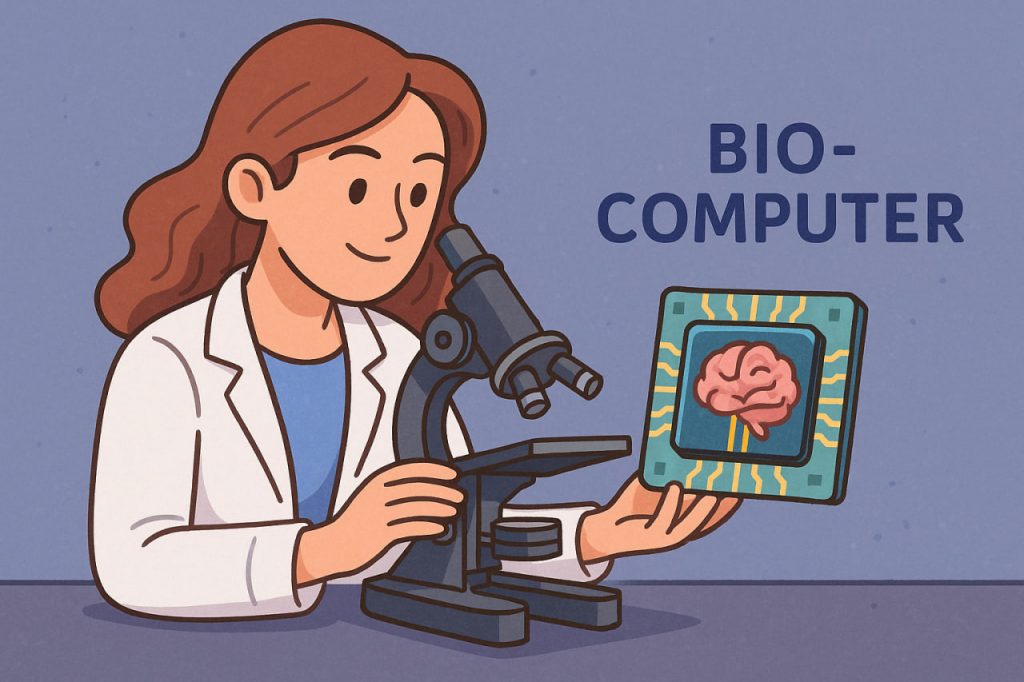
Human-cell processors, sometimes called bio-computers or organoid-based processors, are an emerging technology that uses living human cells as the core of a computing system instead of traditional silicon transistors. In most experimental designs, tiny clusters of brain-like cells are grown in the lab and connected to electronic interfaces that can send signals in and read activity out. These living networks are capable of learning, adapting, and processing information in ways that resemble biological brains rather than conventional computers. The goal is not to replace digital chips completely, but to explore new kinds of computation that are more energy-efficient and better at tasks such as pattern recognition, decision-making, and learning from experience. At the same time, these systems raise important ethical, technical, and safety questions that scientists must address carefully as the field develops.
How a Processor Made From Human Cells Works
At the heart of a human-cell processor is a network of neurons derived from human stem cells. In the lab, these cells are encouraged to grow into small, three-dimensional structures that form synapses and electrical connections with one another. Microelectrode arrays or advanced sensor grids sit beneath or around the tissue, allowing researchers to send electrical pulses into the network and record its responses. Over time, the neural tissue can learn to respond in specific ways to repeated patterns of stimulation, effectively performing computational tasks. According to neural engineering specialist Dr. Karen Li:
“These living networks don’t follow fixed circuits like silicon chips —
they rewire themselves as they learn, giving us a completely different model of computation.”
This adaptability is exactly what makes human-cell processors fascinating: they blur the line between biology and electronics, turning living cells into functional hardware.
Potential Advantages Over Traditional Processors
Traditional processors excel at high-speed arithmetic and logical operations, but they consume large amounts of energy and struggle with tasks that humans find natural, such as recognizing faces in varying light or interpreting ambiguous information. Human-cell processors could, in principle, perform such cognitive-style tasks with far greater efficiency. Biological neurons operate using tiny amounts of energy compared to billions of switching transistors in a modern CPU or GPU. In addition, human-cell networks inherently support parallel processing, as thousands of neurons work simultaneously rather than following strictly linear instructions. This makes them especially promising for fields like robotics, adaptive control systems, and advanced AI where flexibility and learning are crucial.
Current Experiments and Early Prototypes
Today’s human-cell processors are still in the experimental stage, operating on scales far smaller than commercial chips. Research teams have already demonstrated cultured neuron networks that can play simple video games, respond to changing environments, or classify basic patterns of input. These systems are usually housed in carefully controlled laboratory conditions, connected to computers that translate neural activity into understandable data. Scientists are working on improving the stability of these cultures, extending their lifespan, and refining the interfaces that link them to electronic systems. Although these early results are impressive, they represent only the first steps toward practical bio-computers.
Ethical Questions and Responsible Development
Because human-cell processors use cells derived from people — often in the form of brain-like organoids — the technology raises serious ethical questions. Researchers must consider where to draw the line between a simple cell culture and something that might, in theory, develop forms of awareness or sensation. Ethical committees and regulatory bodies stress the importance of informed consent for cell donors, strict limits on the complexity of organoid systems, and transparency around how such technologies are used. Bioethicist Dr. Miguel Álvarez notes:
“We are not just building new machines —
we are working with living human material, and that demands extra care and humility.”
These discussions will shape how human-cell processors are designed, studied, and potentially commercialized in the future.
Challenges and Technical Limitations
Despite the excitement surrounding human-cell processors, they face significant technical challenges. Living tissue is fragile and highly dependent on nutrients, temperature control, and sterile conditions, making it much harder to maintain than solid-state chips. Neural networks can also be unpredictable: their plasticity, while powerful, makes it difficult to guarantee consistent, repeatable performance. Integrating biological components with existing digital infrastructure requires advanced electronics, precise signal translation, and robust software models that can interpret complex neural activity. Until researchers solve these issues, human-cell processors will remain specialized tools for research rather than everyday consumer devices.
Future Possibilities of Bio-Computing
Looking ahead, human-cell processors might become part of hybrid systems where silicon and living tissue work together. Conventional chips could handle precise calculations and data storage, while cell-based units manage adaptive learning and complex pattern recognition. Such systems might aid drug discovery by simulating human neural responses, support advanced prosthetics that adapt to their users, or power research tools that model brain diseases more accurately than current approaches. However, any real-world use will depend on carefully balancing innovation with ethical safeguards, ensuring that the technology respects human dignity and remains under responsible oversight.
Interesting Facts
- Human neurons can operate using orders of magnitude less energy than modern silicon transistors performing comparable tasks.
- Some experimental neuron-based systems have been trained to play simplified video games, learning through feedback.
- Brain-like organoids used in research are typically only a few millimeters in size, yet contain thousands of cells.
- Hybrid bio-electronic systems may one day combine classical computing, AI, and living tissue in a single architecture.
- Ethical guidelines for organoid and cell-based computing are evolving alongside the technology to prevent misuse.
Glossary
- Neuron — a nerve cell that transmits electrical and chemical signals in the nervous system.
- Organoid — a miniature, simplified version of an organ grown from stem cells in the lab.
- Microelectrode Array — a grid of tiny electrodes used to stimulate and record activity from cells.
- Bio-Computer — a computing system that uses biological components, such as cells or DNA, to process information.
- Hybrid System — a technology that combines traditional electronic hardware with biological or other unconventional components.