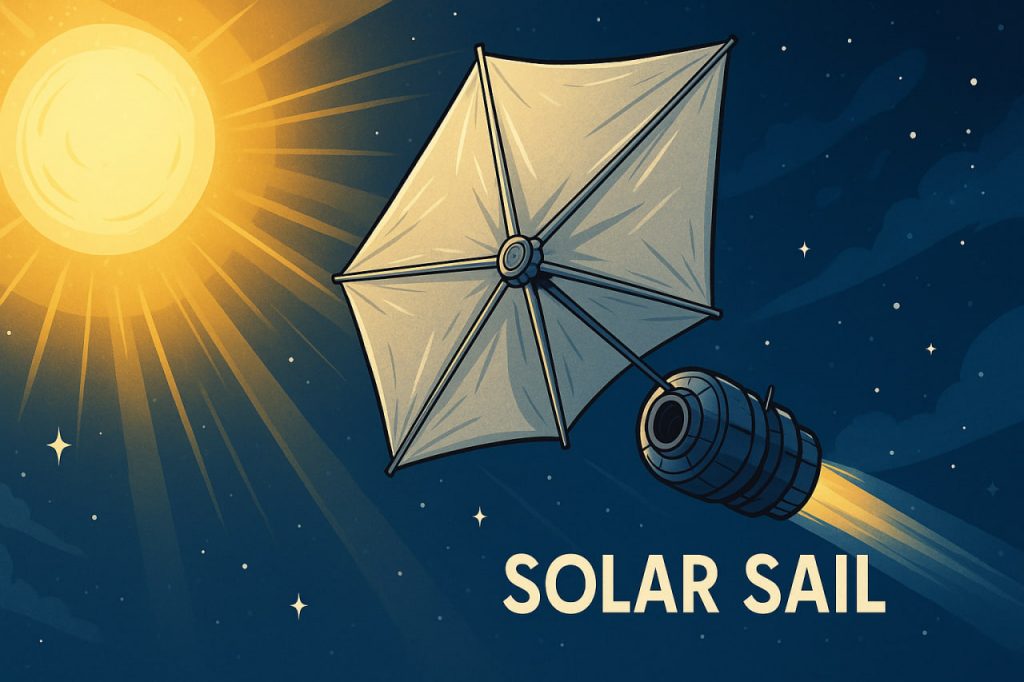
Solar sails are one of the most elegant and futuristic propulsion technologies ever developed, offering a method of space travel that requires no fuel and relies solely on the power of sunlight. Instead of burning propellant, solar sails use photons — tiny particles of light — to generate thrust. When sunlight hits a highly reflective, ultrathin sail, it transfers momentum, gradually pushing the spacecraft forward. Although the acceleration is extremely gentle, it continues indefinitely as long as the sail remains illuminated, allowing solar-sail spacecraft to reach remarkable speeds over time. This makes them ideal for long-duration missions, deep-space exploration, and even travel to other star systems. Solar sails represent a revolutionary shift in how humanity might explore space: not through explosive engines, but through silent, continuous propulsion powered by the universe itself.
How Solar Sails Work
Solar sails rely on the radiation pressure exerted by sunlight. While photons have no mass, they do carry momentum. When they strike and reflect off a large, mirror-like surface, they impart a tiny push. By building massive, lightweight sails from materials such as Mylar, graphene, or reflective polymer films only micrometers thick, engineers can create spacecraft light enough to be moved by this subtle force. Steering is achieved by changing the sail’s angle relative to the Sun or using adjustable panels that alter the direction of photon reflection. According to aerospace physicist Dr. Naomi Sinclair:
“A solar sail is the closest thing we have to riding a beam of light —
the engine is the Sun, and the fuel is endless.”
This method allows continuous acceleration, something traditional rockets cannot achieve.
Advantages of Solar Sail Propulsion
Solar sails provide several unique benefits for space missions. The most significant advantage is that they require no fuel, eliminating the need to carry heavy propellant tanks. This makes solar-sail spacecraft lighter, cheaper, and capable of traveling far longer distances than chemically propelled spacecraft. Because the thrust is constant, a solar sail can eventually reach higher speeds than most ion or chemical engines. Solar sails are also ideal for missions that need gentle but persistent thrust, such as maintaining stable positions, exploring the outer solar system, or maneuvering small scientific probes. Their simplicity makes them attractive for future robotic missions and multi-decade journeys.
Engineering Challenges and Material Requirements
Despite their promise, solar sails pose significant engineering challenges. The sails must be extremely thin yet strong enough to withstand micrometeoroid impacts, temperature extremes, and space radiation. Deploying a sail the size of a football field in microgravity requires precise mechanisms that can unfold large surfaces without tearing. Even small wrinkles can affect performance. Solar sails also lose thrust the farther they travel from the Sun, limiting their usefulness in regions with weak sunlight unless assisted by lasers. Engineers continue developing new materials such as graphene films, which are both durable and extraordinarily light, improving future sail designs.
Solar Sails in Real Missions
Several missions have already demonstrated the feasibility of solar-sail propulsion. The Japanese spacecraft IKAROS became the first to successfully deploy a solar sail in deep space in 2010, using its reflective membrane to navigate toward Venus. The Planetary Society’s LightSail 2 mission proved that sunlight alone could raise a spacecraft’s orbit around Earth. NASA is currently developing advanced solar sails for studying asteroids, monitoring space weather, and exploring distant regions. In the future, massive laser-powered sails could push tiny spacecraft to speeds exceeding 20% of the speed of light, enabling interstellar travel.
Solar Sails and the Future of Interstellar Exploration
Solar sails offer one of the most realistic pathways for reaching nearby star systems within a human lifetime — not through crewed flights, but through fleets of tiny, lightweight probes. By firing powerful ground-based lasers at ultrathin sails, researchers hope to accelerate spacecraft to relativistic speeds. These probes could reach the Alpha Centauri system in just a few decades, capturing images and scientific data from planets outside our solar system. This concept represents a major step toward making interstellar exploration more achievable, expanding humanity’s reach beyond our Sun.
Interesting Facts
- Photons have no mass, but their momentum can push spacecraft forward over time.
- Solar sails can grow as large as several hundred meters across while remaining thinner than paper.
- LightSail 2 successfully increased its orbit using sunlight alone, proving the concept’s viability.
- Laser-boosted solar sails could reach 20–30% of light speed, enabling interstellar missions.
- Solar sails require no fuel, making them ideal for extremely long-duration space missions.
Glossary
- Photon — a particle of light carrying energy and momentum.
- Radiation Pressure — force exerted by light or electromagnetic waves on surfaces.
- Mylar — a lightweight, reflective film used in early solar-sail designs.
- Graphene Film — an ultrathin material made of carbon atoms, ideal for advanced sails.
- Interstellar Travel — traveling between star systems, beyond our solar system.