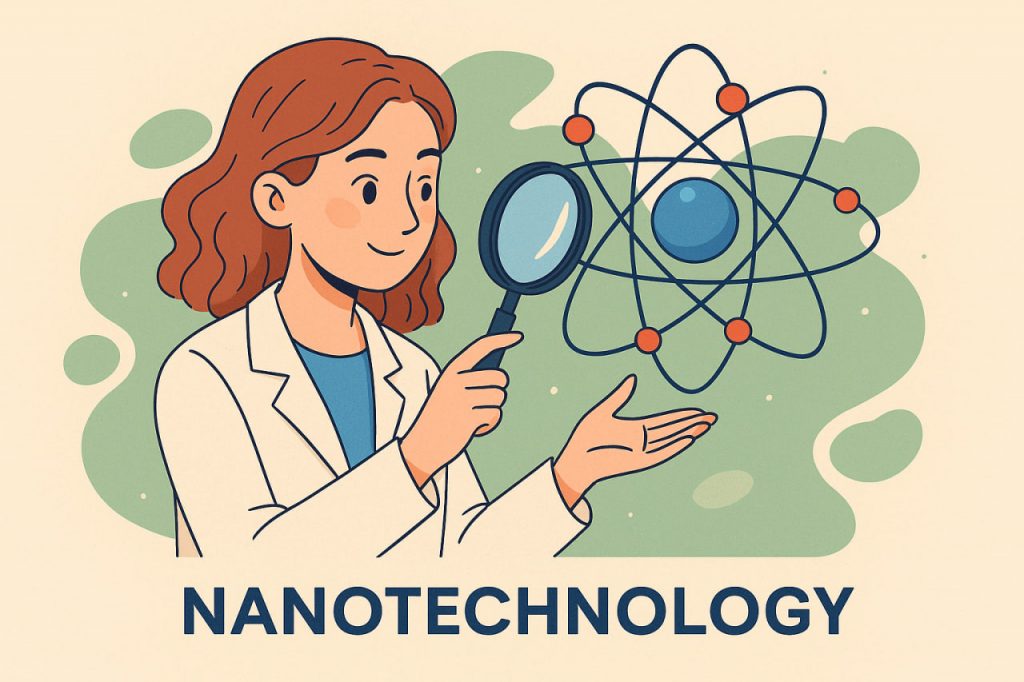
Nanotechnology is the science and engineering of manipulating matter at the scale of atoms and molecules, typically between 1 and 100 nanometers. At this incredibly small scale, materials behave in ways that differ dramatically from their larger counterparts, displaying unique optical, electrical, mechanical, and chemical properties. These unusual behaviors allow scientists to design new materials and devices that revolutionize medicine, electronics, energy production, environmental protection, and manufacturing. Nanotechnology is not a single field but an interdisciplinary fusion of physics, chemistry, biology, and engineering — giving it the power to reshape entire industries. As research accelerates, nanotechnology continues to push the boundaries of what is physically possible, offering groundbreaking opportunities and raising important questions about safety, ethics, and responsible innovation.
How Nanotechnology Works at the Atomic Level
Nanotechnology relies on the ability to build and manipulate structures atom by atom, unlocking behaviors that do not exist at larger scales. At the nanoscale, materials can become dramatically stronger, lighter, more conductive, or more reactive. Carbon nanotubes, for example, are stronger than steel yet extremely lightweight, while quantum dots emit precisely controlled colors depending on their size. These effects arise from quantum physics and surface interactions that dominate the nanoscale world. According to materials scientist Dr. Evelyn Park:
“At the nanoscale, we stop observing nature —
we start engineering it from the ground up.”
This shift enables the creation of devices and materials tailored for maximum performance, efficiency, and functionality.
Medical Breakthroughs Powered by Nanotechnology
Healthcare is one of the most rapidly advancing areas influenced by nanotechnology. Nanoparticles can deliver medication directly to diseased cells, reducing side effects and making treatments more effective. Diagnostic nanodevices may detect cancers or infections at extremely early stages by identifying molecular changes invisible to standard medical tools. Nanostructured implants improve tissue integration, reduce inflammation, and support regenerative medicine. Researchers are also developing nanoscale sensors capable of monitoring vital signs inside the body. These innovations promise a future where treatments are more targeted, less invasive, and personalized to each patient’s biological makeup.
Nanotechnology in Electronics and Computing
Modern electronics depend heavily on nanoscale components. Transistors inside computer processors are now just a few nanometers wide, enabling faster and more energy-efficient devices. Nanotechnology also powers flexible screens, high-capacity batteries, ultra-sensitive sensors, and advanced memory technologies. Quantum dots enhance image quality in displays, while nanoscale circuits support the development of quantum computers — machines that could solve problems impossible for classical systems. As digital technologies become smaller and more powerful, nanotechnology remains at the heart of innovation in computing and telecommunications.
Energy, Environment, and Sustainable Technologies
Nanomaterials are revolutionizing the energy sector by improving solar cells, boosting battery capacity, and enabling hydrogen storage at higher densities. Nanostructured coatings reduce heat loss in buildings, while catalytic nanoparticles help convert carbon dioxide into useful fuels. In environmental applications, nanotechnology enables filters that remove heavy metals, microplastics, and harmful chemicals from water and air. Some nanomaterials break down pollutants or help clean contaminated soil. These sustainable solutions highlight nanotechnology’s role in building a cleaner and more efficient future for cities and industries.
Challenges, Ethics, and Responsible Innovation
Despite its enormous potential, nanotechnology raises important safety and ethical questions. Because nanoparticles can interact with biological systems in unpredictable ways, researchers must carefully study their toxicity, environmental impact, and long-term behavior. Regulations are being developed to ensure safe production, handling, and disposal of nanomaterials. Ethical discussions also examine issues related to privacy, inequality, and the possibility of misuse. As nanotechnology becomes more powerful, experts like Dr. Luis Moreno remind us:
“Innovation must be paired with responsibility —
nanotechnology should serve society, not outpace it.”
Balancing progress with caution ensures that nanotechnology remains a beneficial and sustainable force for humanity.
Interesting Facts
- A nanometer is so small that 100,000 of them equal the width of a human hair.
- Quantum dots glow in different colors depending solely on their size.
- Carbon nanotubes are around 100 times stronger than steel yet extremely lightweight.
- Some sunscreens use nanoparticles of zinc oxide for invisible, highly effective UV protection.
- Nanotechnology plays a key role in developing next-generation batteries and fast-charging materials.
Glossary
- Nanometer — one-billionth of a meter, used to measure nanoscale structures.
- Quantum Dot — a nanoscale semiconductor particle with size-dependent optical properties.
- Carbon Nanotube — a nanoscale cylinder made of carbon atoms with exceptional strength.
- Nanoparticle — a particle between 1–100 nm used in medicine, electronics, and materials science.
- Catalyst — a substance that speeds up chemical reactions, often enhanced by nanotechnology.