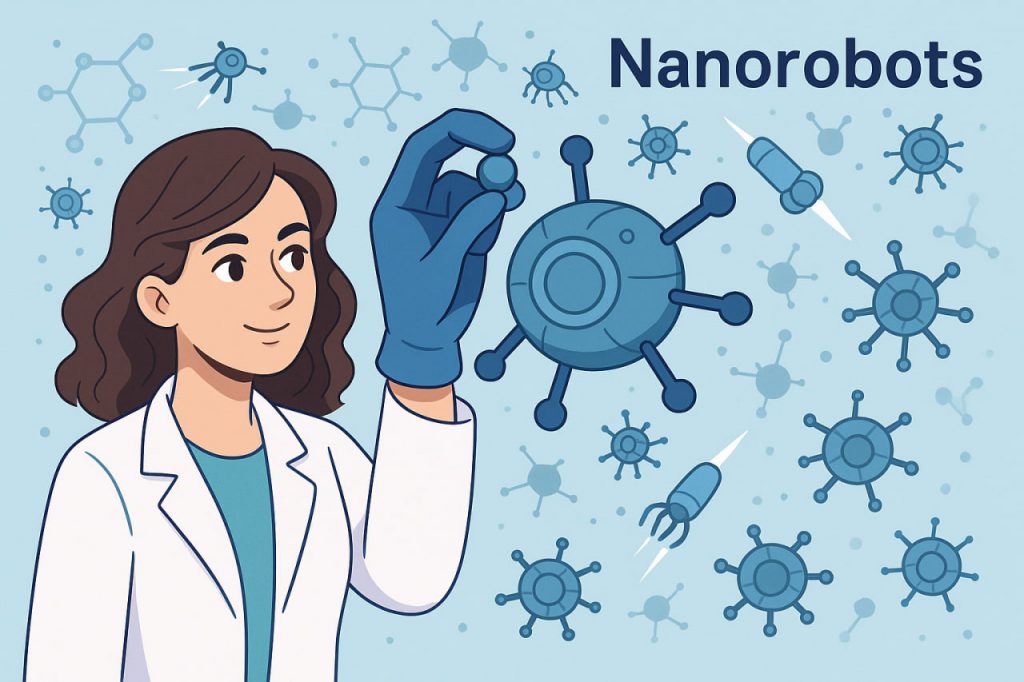
Nanorobots — tiny machines measured in billionths of a meter — represent one of the most revolutionary frontiers in modern science. Operating at scales comparable to molecules and viruses, these microscopic devices have the potential to transform medicine, manufacturing, environmental protection, and even computing. Although many concepts are still experimental, rapid advances in materials science, artificial intelligence, and molecular engineering are bringing the era of practical nanorobotics closer than ever. Nanorobots are designed to perform tasks that are impossible for larger machines, such as navigating inside the human body, assembling structures atom by atom, or detecting pollutants with extreme precision. Their development highlights how innovation can reshape our understanding of technology at the most fundamental level.
What Nanorobots Are and How They Function
Nanorobots are typically built from specialized materials such as carbon nanotubes, DNA structures, or nanoscale metals and polymers. Their movement can be powered by chemical reactions, magnetic fields, light, or even biological processes. Because nanorobots operate in environments with different physical rules — where viscosity dominates and inertia is nearly irrelevant — their design requires unique engineering approaches. Many prototypes resemble molecular machines rather than traditional robots, consisting of moving parts only a few atoms wide. According to nanoengineering researcher Dr. Sofia Patel:
“Nanorobots don’t mimic large robots on a smaller scale —
they follow a completely different physics, demanding entirely new design logic.”
Understanding these principles allows scientists to build machines capable of extraordinary control and precision at the nanoscale.
Nanorobots in Medicine and Healthcare
One of the most promising applications of nanorobots lies in the field of medicine. Nanorobots could one day navigate through the bloodstream to deliver targeted therapies, repair damaged cells, or remove harmful substances. Some prototypes use magnetic guidance to reach specific regions of the body, while others rely on chemical attraction to home in on disease markers. Nanorobots may also help in early diagnostics by detecting cancerous cells or pathogens long before symptoms appear. They could assist surgeons, reduce the need for invasive procedures, and help personalize treatments for individual patients. While clinical nanorobots are still under development, early experiments demonstrate how powerful this technology may become.
Environmental and Industrial Applications
Beyond healthcare, nanorobots could revolutionize environmental protection and industrial processes. Specialized nanodevices may clean polluted water by capturing heavy metals and toxins, or break down microplastics that have contaminated oceans. In manufacturing, nanorobots could assemble products from the bottom up, placing atoms and molecules with precision far beyond what human engineers can achieve. This approach — known as molecular manufacturing — could lead to extremely strong materials, more efficient electronics, and new forms of energy storage. Nanorobots might even monitor infrastructure, detecting microscopic cracks in bridges, ships, or spacecraft before they become hazardous.
Challenges, Ethics, and Future Development
Despite their extraordinary potential, nanorobots raise important scientific, ethical, and safety concerns. Creating reliable nanomachines that function in real-world conditions requires overcoming challenges in durability, power supply, and control. Scientists must ensure that nanorobots can be safely deactivated or removed after performing their tasks. Ethical discussions also address potential misuse, privacy concerns, and the long-term environmental impact of nanoscale devices. Nanotechnology ethicist Dr. Alan Richter notes:
“The power of nanorobots demands responsible oversight —
innovation must move forward, but never without careful evaluation.”
As research progresses, global regulations and transparent scientific standards will play a crucial role in shaping the future of this technology.
The Vision of a Nanotechnology-Driven Future
Nanorobots symbolize the next major leap in technological evolution. Their ability to operate at molecular scales may enable medical breakthroughs once thought impossible, create sustainable industrial systems, and build new tools for exploring both our planet and outer space. While widespread deployment is still years away, the foundation is already being laid by breakthroughs in nanomaterials, quantum engineering, and microscopic robotics. The coming decades may see nanorobots integrated into everyday life in ways that enhance safety, health, and environmental resilience.
Interesting Facts
- A nanometer is one-billionth of a meter, meaning millions of nanorobots could fit on a pinhead.
- Some experimental nanorobots are powered by enzymes, mimicking biological systems.
- DNA-based nanomachines can fold and unfold like tiny origami structures.
- Magnetic nanorobots have been tested in lab settings to remove bacterial biofilms.
- Researchers envision future nanorobots that can self-repair, similar to living cells.
Glossary
- Nanometer — one-billionth of a meter, used to measure nanoscale structures.
- Molecular Machine — a device composed of molecules that performs mechanical tasks.
- Carbon Nanotube — a strong, lightweight material used in nanotechnology.
- Molecular Manufacturing — constructing materials or devices atom by atom.
- Biofilm — a protective layer created by bacteria that nanorobots may help remove.