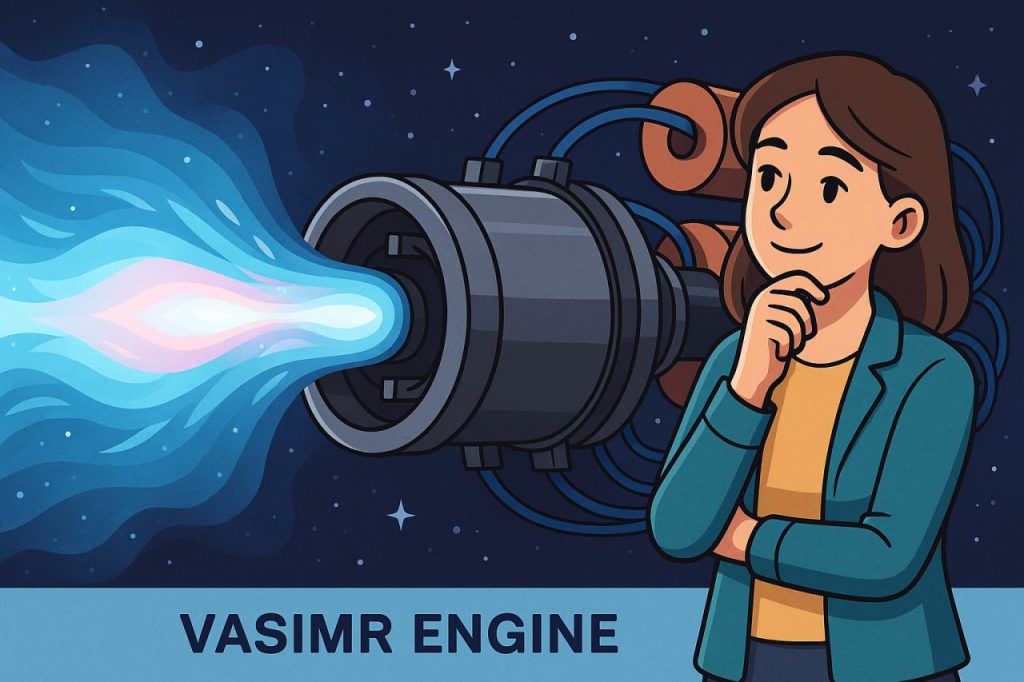
The VASIMR engine, short for Variable Specific Impulse Magnetoplasma Rocket, represents one of the most promising breakthroughs in advanced space propulsion. Unlike traditional chemical rockets, which burn fuel to create high-temperature exhaust, the VASIMR engine uses superheated plasma — an electrically charged gas — controlled by magnetic fields to generate thrust. This technology aims to combine high efficiency with significantly greater power, potentially reducing travel times to distant planets such as Mars. Because it relies on electrical power rather than combustion, the VASIMR engine could operate continuously for weeks or months, gradually accelerating spacecraft to extremely high speeds. As energy generation systems in space improve, this propulsion method may become a foundation for future deep-space missions, orbital transport, and long-duration scientific journeys. Understanding how VASIMR works provides a glimpse into the next generation of spacecraft engineering.
How VASIMR Uses Plasma to Generate Thrust
The VASIMR engine produces thrust by ionizing gas and heating it to extremely high temperatures using radiofrequency waves. Once the gas becomes plasma, powerful magnetic fields shape, contain, and accelerate it out of the engine’s exhaust. Because the plasma never touches the engine walls, the system avoids extreme physical wear common in traditional engines. This makes the technology highly durable and capable of long, continuous operations. Unlike chemical rockets, VASIMR can adjust its specific impulse, allowing the engine to shift between strong thrust for maneuvering and highly efficient thrust for long-distance travel. According to plasma physicist Dr. Arturo Valdez:
“VASIMR is like a dimmable rocket —
it adjusts its power for efficiency, speed, or maneuverability depending on the mission’s needs.”
This flexibility is one of the engine’s strongest advantages, allowing spacecraft to fine-tune performance in real time.
Why Plasma Propulsion Matters
Plasma engines such as VASIMR offer significant benefits over chemical propulsion. They use fuel far more efficiently, which means spacecraft can carry larger payloads or travel much farther with the same amount of propellant. The continuous thrust generated by VASIMR allows a spacecraft to accelerate gradually until it reaches extremely high velocities — something chemical rockets cannot achieve. Because the engine requires electrical power, it can operate using solar arrays in near-Earth space or nuclear power sources for deep-space missions. This adaptability makes plasma propulsion ideal for lunar cargo transport, orbital adjustments, debris removal, and future missions to Mars or beyond. The ability to fine-control thrust also enhances navigation, station-keeping, and autonomous operations.
Engineering Challenges and Power Requirements
Despite its advantages, the VASIMR engine faces major engineering challenges, primarily related to its power demands. To produce meaningful thrust, the engine requires tens or even hundreds of kilowatts of electrical power — far more than what conventional spacecraft power systems can currently provide. While solar panels can support lower-power versions of the engine in orbit, deep-space missions will likely require compact nuclear reactors to unlock VASIMR’s full potential. Engineers must also ensure that magnetic fields, plasma heating systems, and radiofrequency components function reliably over years of continuous operation. Managing heat dissipation in the vacuum of space remains another engineering hurdle, requiring advanced radiators and thermal regulation systems.
Applications for Future Space Missions
VASIMR’s design makes it well suited for a wide range of future missions. In Earth orbit, it could enable rapid cargo delivery between stations, assist in satellite repositioning, or even help remove space debris. For lunar exploration, VASIMR-powered spacecraft could transport supplies and equipment efficiently between Earth and lunar orbit. For Mars missions, the engine’s high-efficiency plasma exhaust could dramatically shorten travel time — potentially reducing it from several months to closer to 90 days, depending on power availability. As advanced reactors and high-output solar technologies emerge, VASIMR may become one of the most powerful tools in humanity’s transition to routine interplanetary travel.
The Future of High-Power Electric Propulsion
VASIMR represents an important step toward the future of electric propulsion, but it is not the only direction researchers are exploring. Concepts such as fusion propulsion, advanced ion engines, and plasma sail technologies could eventually complement or surpass VASIMR for certain missions. However, the engine’s ability to operate continuously at high power gives it a unique advantage for large spacecraft, cargo missions, and rapid interplanetary travel. As technology evolves and power generation in space becomes more efficient, VASIMR may become one of the defining engines of the next century of exploration.
Interesting Facts
- The VASIMR engine can heat plasma to temperatures above 1,000,000°C, hotter than the surface of the Sun.
- Because plasma never touches engine walls, VASIMR experiences minimal physical wear, enabling long-duration operation.
- The engine’s variable mode allows it to switch between high thrust and high efficiency during flight.
- The first VASIMR prototypes operated at 200 kilowatts, far more powerful than most ion engines.
- Researchers propose that a nuclear-powered VASIMR could cut Mars travel time by more than half.
Glossary
- Plasma — an ionized state of matter consisting of charged particles, used as propellant in advanced engines.
- Specific Impulse — a measure of propulsion efficiency, indicating how effectively an engine uses propellant.
- Radiofrequency Heating — a method of energizing plasma using electromagnetic waves.
- Magnetic Confinement — the use of magnetic fields to control and contain hot plasma.
- Electric Propulsion — propulsion systems that use electrical energy to accelerate ions or plasma instead of burning fuel.