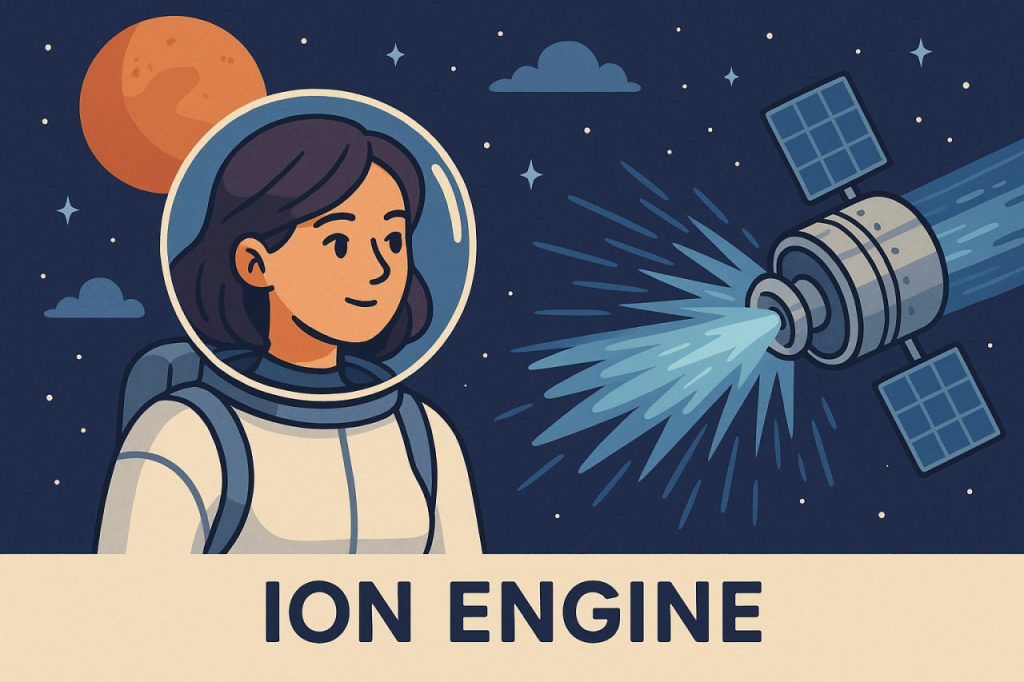
Ion engines represent one of the most advanced propulsion technologies ever developed, enabling spacecraft to travel vast distances using remarkably little fuel. Unlike traditional chemical rocket engines that produce enormous thrust in a short burst, ion engines create a steady, gentle push by accelerating electrically charged particles — ions — to extremely high speeds. This slow but continuous acceleration allows spacecraft to reach extraordinary velocities over long periods, making ion engines ideal for deep-space missions where efficiency is more important than raw power. Their ability to operate for months or even years without refueling has reshaped modern space exploration and opened new possibilities for scientific discovery across the solar system. Understanding how ion engines work highlights humanity’s growing capability to explore space sustainably and intelligently.
How Ion Engines Generate Thrust
Ion engines operate on a principle similar to all rocket systems: ejecting mass to create thrust. However, instead of burning fuel, they rely on electric fields to accelerate ions. First, a neutral gas — typically xenon — is ionized by stripping electrons from its atoms. The positively charged ions are then accelerated through a set of electric grids at speeds that can exceed 40 km/s, far faster than chemical rocket exhaust. When these ions shoot out of the engine, they create thrust in the opposite direction. According to propulsion specialist Dr. Elena Morales:
“Ion propulsion trades brute force for elegance —
tiny pushes, delivered continuously, become unstoppable over time.”
Because ion engines use energy rather than combustion, they produce extremely efficient thrust, making them invaluable for long-duration missions.
The Advantages of Ion Propulsion
Ion engines offer several significant advantages over chemical rockets. Their primary strength is fuel efficiency: a spacecraft equipped with ion propulsion needs only a fraction of the propellant required by conventional engines. This efficiency allows missions to carry more scientific instruments or travel farther into space without resupply. Ion engines also generate very stable, controllable thrust, allowing spacecraft to perform delicate maneuvers with high precision. Their long operational lifespan — sometimes lasting tens of thousands of hours — makes them ideal for missions that explore asteroids, distant planets, or interplanetary space. Although their thrust is too low to lift a spacecraft from Earth’s surface, once in orbit, ion engines become one of the most efficient propulsion systems available.
Types of Ion Engines and Their Technologies
There are several types of ion propulsion systems, each with unique engineering characteristics. Gridded ion thrusters use electrostatic acceleration to propel ions at extremely high speeds and are among the most proven designs. Hall-effect thrusters, widely used on satellites, rely on magnetic fields to trap electrons and ionize propellant efficiently. Colloid thrusters, which use charged droplets instead of ions, provide ultralow thrust levels ideal for controlling sensitive scientific spacecraft. Each of these systems reflects decades of research in plasma physics, electromagnetism, and high-efficiency propulsion. Engineers continue to refine these technologies, exploring alternative fuels, stronger magnetic fields, and improved ionization methods.
Challenges and Engineering Limitations
Despite their advantages, ion engines also face important limitations. Their low thrust means they cannot be used for rapid acceleration or launching spacecraft from Earth. They also require substantial electrical power, which typically comes from large solar panels or, in future missions, nuclear power sources. The delicate grids and plasma components must withstand erosion over thousands of hours, demanding highly durable materials. Engineers must balance thrust efficiency, structural longevity, and power consumption to create engines capable of surviving long missions. These challenges underscore why ion engines complement rather than replace chemical rockets.
Ion Engines in Modern and Future Missions
Ion engines have already proven their value in several landmark missions. NASA’s Dawn spacecraft used ion propulsion to visit both Vesta and Ceres — the first mission to orbit two celestial bodies in one journey. The European Space Agency’s satellites frequently use Hall-effect thrusters for station-keeping and maneuvering, reducing fuel mass and extending operational life. Future missions may rely on more powerful ion engines for cargo transport to the Moon, voyages to Mars, or exploration of the outer solar system. Researchers are also experimenting with next-generation concepts such as VASIMR engines, which could drastically reduce travel time by generating higher thrust while retaining ion propulsion efficiency.
Interesting Facts
- Ion engine exhaust can reach speeds of 10 to 40 times faster than chemical rocket exhaust.
- Some ion thrusters can operate for over 20,000 continuous hours without failure.
- Xenon is commonly used as propellant because it is heavy, stable, and easy to ionize.
- The Dawn spacecraft achieved the largest velocity change of any mission using ion propulsion.
- Hall-effect thrusters are widely used on commercial satellites for precise orbital adjustments.
Glossary
- Ionization — the process of removing electrons from atoms to create charged particles.
- Xenon — a heavy inert gas commonly used as propellant in ion engines.
- Thrust — the force produced when ions are expelled from the engine at high speed.
- Hall-Effect Thruster — an ion propulsion system that uses magnetic fields to ionize and accelerate propellant.
- VASIMR Engine — an experimental propulsion system that uses plasma and radio waves for higher-thrust ion propulsion.