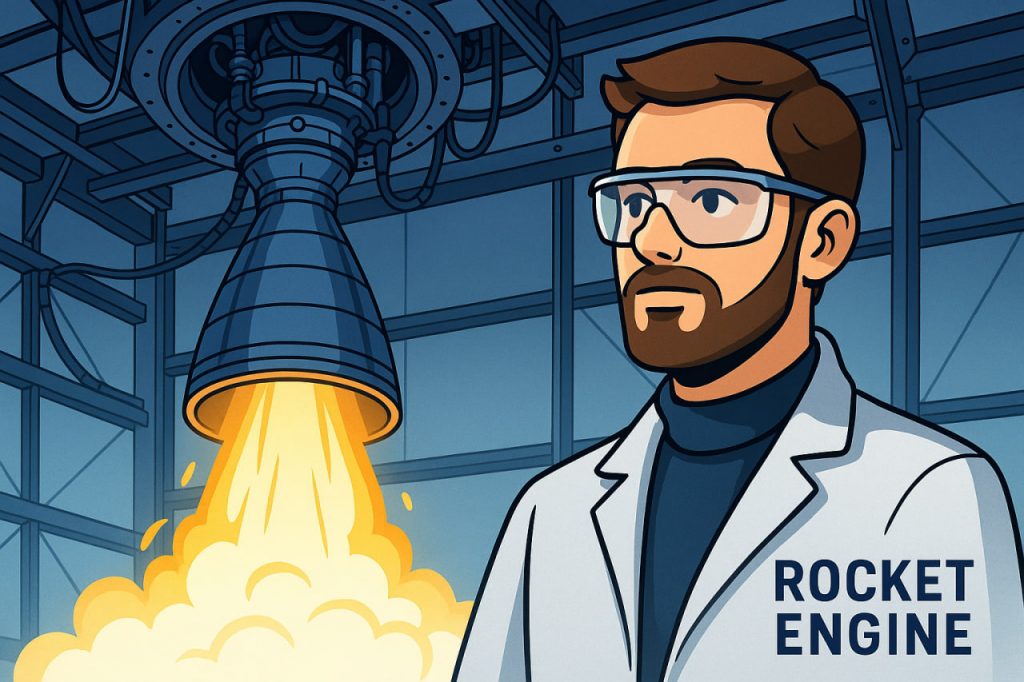
Rocket engines are the fundamental technology that makes space travel possible, enabling spacecraft to break free from Earth’s gravity and operate in the vacuum of space. Unlike aircraft engines that rely on atmospheric oxygen, rocket engines carry both fuel and oxidizer, allowing them to function in environments with no air at all. This makes them uniquely powerful and efficient for reaching orbit, traveling to other planets, and conducting scientific missions deep into the cosmos. Modern rocket engines combine precise engineering, advanced materials, and complex thermodynamics to generate extraordinary amounts of thrust. Despite their incredible power, they remain highly sensitive systems that require exact control and deep scientific understanding. As space agencies and private companies push toward new frontiers, rocket engine technology continues to evolve, shaping the future of exploration and transportation beyond Earth.
How Rocket Engines Produce Thrust
Rocket engines work on a simple physical principle: Newton’s Third Law, which states that every action produces an equal and opposite reaction. When fuel and oxidizer burn inside the engine’s combustion chamber, they create extremely hot gases that expand and shoot out of the nozzle at high speed. This high-speed exhaust creates an opposite force — thrust — pushing the rocket forward. Rocket engines must withstand extreme temperatures, pressures, and vibrations, as combustion can reach thousands of degrees. According to aerospace engineer Dr. Marcus Hale:
“A rocket engine is controlled fury —
a perfectly timed explosion that must repeat itself millions of times per second.”
This delicate balance of power and precision is what separates successful launches from catastrophic failure.
Types of Rocket Engines and Their Applications
There are several types of rocket engines, each suited for different missions. Chemical rocket engines, the most common type, use liquid or solid propellants. Liquid engines provide fine control and can be restarted in space, while solid engines deliver immense power for rapid acceleration but cannot be shut off once ignited. Hybrid engines combine elements of both systems, offering improved safety and flexibility. More advanced designs include ion engines and electric propulsion systems, which use charged particles to produce thrust with remarkable efficiency, ideal for long-duration missions where speed builds gradually over time. Nuclear thermal engines, still experimental, promise higher efficiency by heating hydrogen with nuclear energy, potentially reducing travel time to distant planets.
Materials and Engineering Challenges
Building a rocket engine requires materials capable of surviving extreme operational conditions. Components such as the combustion chamber and nozzle must endure temperatures hotter than molten lava, forces comparable to earthquakes, and pressure levels that would crush most metals. Engineers use superalloys, ceramic composites, and regenerative cooling systems, where cold propellant circulates through engine walls to prevent overheating. These innovations allow engines to run longer, burn cleaner, and produce more thrust. However, even with advanced materials, small imperfections or miscalculations can lead to significant risks, making testing and quality control vital aspects of rocket development.
Reusable Rocket Engines and Modern Innovation
In recent years, the space industry has shifted toward reusability, dramatically reducing the cost of launches. Companies like SpaceX and Blue Origin have developed engines designed to survive multiple flights, landings, and relaunches. This marks a major shift in space technology, similar to moving from disposable aircraft to reusable ones. Reusable engines require reinforced structures, advanced cooling, and precise landing control systems. Visionaries believe this new era of reusability could make space travel more accessible, supporting projects such as lunar bases, Mars missions, and space tourism. Reusable rocket engines demonstrate how innovation continues to reshape the limits of what humanity can achieve.
Future Possibilities in Rocket Propulsion
Future rocket engines may rely on technologies far more advanced than those available today. Concepts like fusion propulsion, antimatter engines, and light-sail propulsion are being studied for deep-space missions where current engine types would be too slow or inefficient. These futuristic ideas could one day enable travel to other star systems, reduce travel time to distant planets, or allow spacecraft to reach speeds previously thought impossible. While still theoretical, these concepts reflect humanity’s ambition to push beyond the boundaries of our solar system.
Interesting Facts
- The Saturn V rocket engines used during the Apollo missions produced over 34 million newtons of thrust at liftoff.
- Rocket nozzles are shaped to expand exhaust gases optimally, reaching speeds greater than Mach 10.
- Ion engines use so little propellant that a few kilograms can power spacecraft for years.
- Reusable engines have reduced launch costs by more than 50% in recent years.
- The first liquid-fueled rocket was launched by Robert Goddard in 1926, marking the beginning of modern astronautics.
Glossary
- Thrust — the force that propels a rocket forward by expelling exhaust gases.
- Oxidizer — a substance that supplies oxygen for fuel combustion in rocket engines.
- Ion Engine — a propulsion system that uses charged particles to produce efficient, low-thrust acceleration.
- Regenerative Cooling — a system where cold propellant cools engine parts before entering combustion.
- Hybrid Engine — a rocket engine that uses a combination of solid and liquid propellants.