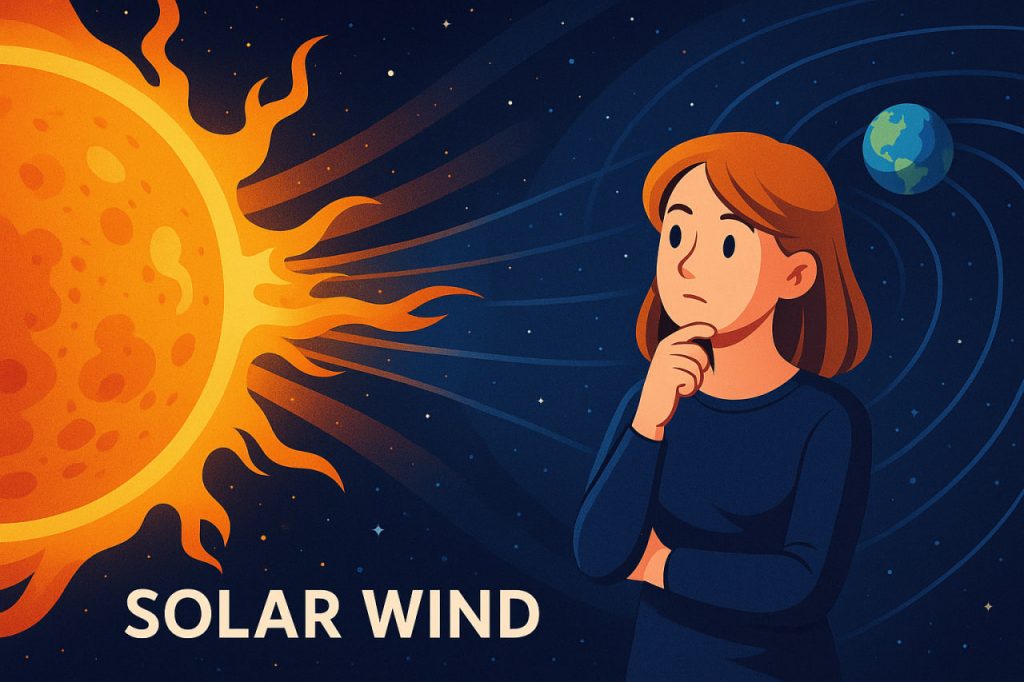
The solar wind is a continuous stream of charged particles — mainly electrons and protons — that flows outward from the Sun at incredible speeds. This invisible but powerful force shapes the space environment throughout the entire Solar System. As it travels across space, the solar wind interacts with planetary atmospheres, magnetic fields, and even technological systems on Earth. Although it cannot be felt directly, the solar wind plays a crucial role in creating auroras, driving space weather, and influencing long-term planetary evolution. Understanding how the solar wind behaves helps scientists protect satellites, forecast geomagnetic storms, and study the dynamic relationship between the Sun and Earth.
How the Solar Wind Forms
The solar wind originates in the Sun’s outer atmosphere, known as the corona, where temperatures reach millions of degrees Celsius. At such extreme temperatures, atoms become ionized, creating a highly energetic plasma. This plasma expands into space due to pressure differences and the Sun’s magnetic forces. As the particles accelerate outward, they form the solar wind, which travels at speeds from 300 to 800 km/s, depending on solar conditions. According to solar physicist Dr. Helena Strauss:
“The solar wind is the breath of the Sun —
a constant outflow of energy that fills the Solar System with plasma.”
Its strength varies depending on solar activity, sunspots, and magnetic storms on the Sun.
Types of Solar Wind
There are two primary forms of solar wind:
- Slow Solar Wind — travels at about 300–500 km/s and originates from the Sun’s equatorial regions.
- Fast Solar Wind — travels at 700–800 km/s and is emitted from coronal holes near the Sun’s poles.
These two winds interact and create complex structures in space, influencing magnetic fields, satellite conditions, and the behavior of charged particles.
How the Solar Wind Interacts With Earth
When the solar wind reaches Earth, it collides with the planet’s magnetosphere, a protective magnetic shield that deflects most of the incoming particles. This interaction compresses the magnetosphere on the day side and stretches it into a long tail on the night side. Some particles enter near the polar regions, energizing atmospheric gases and producing the spectacular auroras — the Northern and Southern Lights.
If the solar wind becomes unusually strong, especially during solar storms or coronal mass ejections (CMEs), it can disturb Earth’s magnetic field, causing geomagnetic storms. These storms can disrupt communication systems, GPS networks, and power grids.
Solar Wind and Space Weather
Solar wind is the main driver of space weather, a field of study focused on understanding how solar activity affects planets and technological systems. Strong solar wind streams can:
- increase radiation exposure for astronauts,
- damage satellite electronics,
- affect airplane navigation at high latitudes,
- disturb radio communication.
Space agencies monitor the Sun constantly to predict these events and protect infrastructure.
Effects on Other Planets
The solar wind interacts differently with each planet, depending on the planet’s atmosphere and magnetic field. For example:
- Mars, which lost its magnetic field billions of years ago, has had its atmosphere gradually stripped away by the solar wind.
- Venus, lacking a magnetic field but with a dense atmosphere, forms a large induced magnetotail.
- Jupiter, with a very strong magnetic field, creates enormous auroras far larger than Earth’s.
Studying these differences helps researchers understand how the solar wind has shaped planetary evolution.
Interesting Facts
- The solar wind can reach speeds of up to 800 km/s during high solar activity.
- Auroras occur when solar wind particles energize oxygen and nitrogen in Earth’s atmosphere.
- Solar storms can generate geomagnetic disturbances strong enough to cause power outages.
- Mars continues to lose its atmosphere due to solar wind exposure.
- The solar wind forms a protective “bubble” around the Solar System called the heliosphere.
Glossary
- Plasma — a hot, ionized gas composed of charged particles.
- Magnetosphere — Earth’s magnetic shield that protects the planet from solar wind.
- Coronal Mass Ejection (CME) — a large eruption of plasma from the Sun that intensifies the solar wind.
- Aurora — light displays produced when solar particles interact with Earth’s atmosphere.
- Heliosphere — the vast bubble formed by the solar wind around the Solar System.