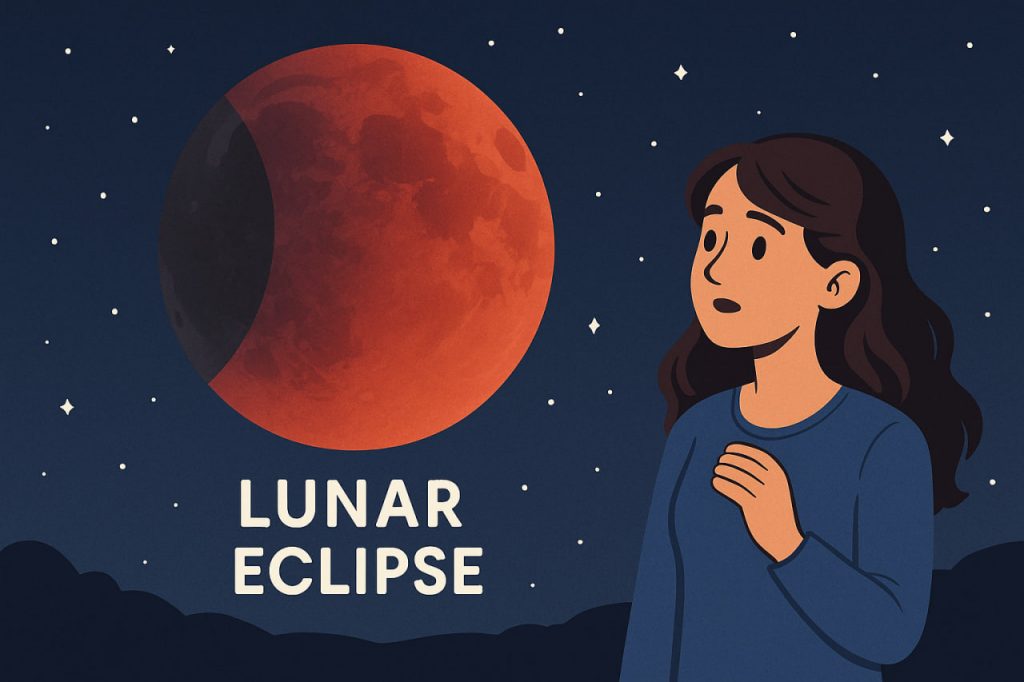
A lunar eclipse is one of the most captivating celestial events visible from Earth, occurring when the Earth passes directly between the Sun and the Moon, casting its shadow across the lunar surface. Unlike solar eclipses, which require special eye protection and are visible only from narrow paths, lunar eclipses can be observed safely with the naked eye and are visible from entire continents. Throughout history, lunar eclipses have inspired myths, scientific discoveries, and cultural traditions. Today, they offer astronomers a valuable opportunity to study Earth’s atmosphere and the Moon’s surface under unique lighting conditions. Understanding how lunar eclipses form reveals both the elegance of celestial mechanics and the interconnected motions of our planet and its natural satellite.
How a Lunar Eclipse Occurs
A lunar eclipse happens during the full Moon phase, when the Sun, Earth, and Moon align perfectly or nearly perfectly in a straight line. The Earth’s shadow consists of two parts: the umbra, where direct sunlight is completely blocked, and the penumbra, where sunlight is partially filtered. When the Moon enters these regions, we see different types of eclipses. According to astrophysicist Dr. Lena Everett:
“A lunar eclipse is Earth’s shadow painted across the Moon —
a cosmic reminder of our place in the celestial dance.”
This alignment occurs only a few times each year because the Moon’s orbit is slightly tilted relative to Earth’s orbital plane.
Types of Lunar Eclipses
There are three main types of lunar eclipses, each with its own unique appearance:
- Penumbral Eclipse — the Moon passes through the penumbra, causing a subtle darkening.
- Partial Eclipse — only part of the Moon enters the umbra, creating a dramatic “bite” effect.
- Total Eclipse — the entire Moon enters the umbra, glowing red due to sunlight refracted through Earth’s atmosphere.
Total eclipses, often called Blood Moons, are the most visually striking. The reddish color comes from Earth’s atmosphere scattering blue light more strongly than red, allowing red wavelengths to bend into the shadow and illuminate the Moon.
Why Lunar Eclipses Appear Red
The Moon turns red during a total lunar eclipse because of a process called Rayleigh scattering, the same effect responsible for red sunsets. As sunlight passes through Earth’s atmosphere, shorter wavelengths (blue, violet) scatter outward, while longer red wavelengths pass through and bend around Earth’s edges. This refracted red light illuminates the Moon, giving it a coppery glow. The exact shade depends on atmospheric conditions — volcanic eruptions or dust storms, for example, can make the Moon appear darker or deeper red.
How Often Lunar Eclipses Occur
Lunar eclipses occur several times a year, but total eclipses are less common. The Moon’s orbit is tilted by about 5 degrees relative to Earth’s orbit, so perfect alignment happens only during specific periods known as eclipse seasons. Each season lasts about 34 days, during which at least one solar or lunar eclipse will occur. This predictable cycle allows astronomers to calculate future eclipses far in advance.
Scientific Importance of Lunar Eclipses
Lunar eclipses provide valuable opportunities for scientific research. During the event, astronomers can:
- Study Earth’s atmosphere by analyzing refracted sunlight.
- Observe temperature changes across the lunar surface.
- Track the Moon’s motion with high precision.
- Test optical instruments and detect surface composition variations.
The darkened lighting also enhances visibility of lunar features, helping researchers examine craters, basalt plains, and other geological structures.
Interesting Facts
- A total lunar eclipse can last over 100 minutes, much longer than a solar eclipse.
- The Moon does not disappear during an eclipse — it glows red from refracted sunlight.
- Lunar eclipses are visible from anywhere on Earth where the Moon is above the horizon.
- Ancient civilizations used eclipses to develop early astronomical calendars.
- The next major total lunar eclipse will be visible across large parts of the world, depending on location and timing.
Glossary
- Umbra — the darkest part of Earth’s shadow where full blockage occurs.
- Penumbra — the outer shadow where only partial sunlight is filtered.
- Rayleigh Scattering — the process that makes the Moon turn red during an eclipse.
- Eclipse Season — a period when alignments allow eclipses to occur.
- Blood Moon — the reddish appearance of the Moon during a total lunar eclipse.