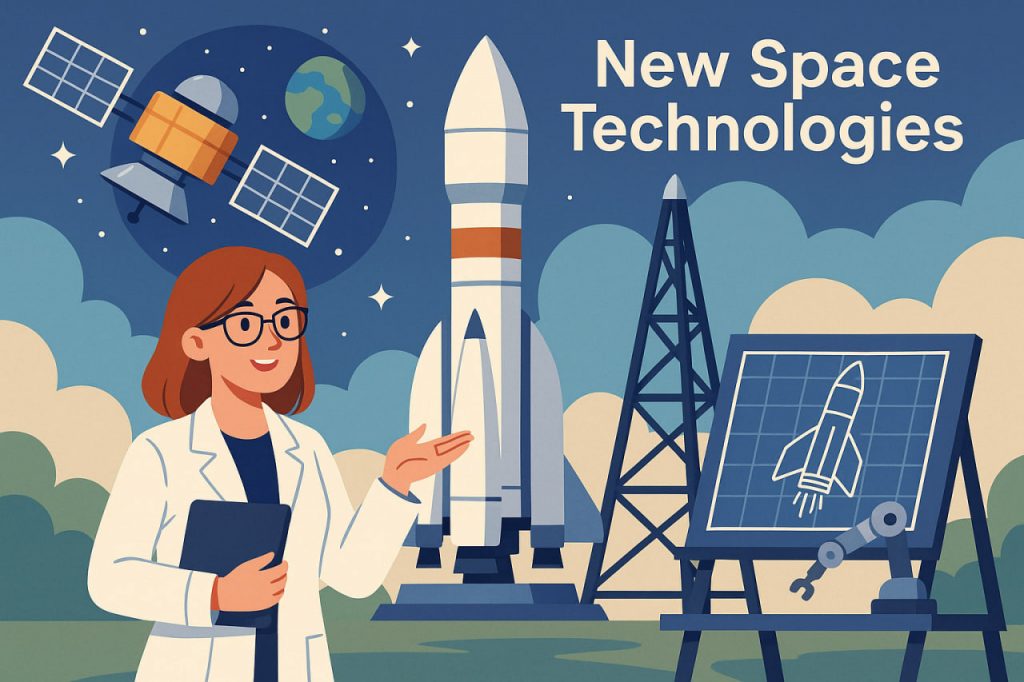
Modern space technology is evolving faster than ever before, driven by international missions, private industry, and groundbreaking scientific research. Today’s innovations go far beyond traditional rockets or satellites — they include reusable launch systems, advanced propulsion engines, deep-space habitats, autonomous robots, and next-generation telescopes capable of seeing further into the universe than any previous instrument. These technologies aim to make space travel more affordable, safer, and more capable of supporting long-term human presence beyond Earth. As global interest in the Moon, Mars, and near-Earth asteroids grows, the newest developments in space engineering are shaping the roadmap for the next century of exploration. Understanding these advances reveals how humanity is preparing to push deeper into space than ever before.
Reusable Launch Systems and Rapid Space Access
One of the most significant breakthroughs in modern spaceflight is the creation of reusable rockets, which drastically reduce launch costs and increase flight frequency. Unlike traditional single-use rockets, reusable systems can land autonomously and fly again, making space more accessible for scientific, commercial, and defense missions. Companies around the world are experimenting with new vertical-landing boosters, fully reusable spacecraft, and rapid turnaround operations similar to commercial aviation. According to aerospace engineer Dr. Michael Greene:
“Reusability marks the transition from rare missions to routine space operations —
it changes space travel from extraordinary to achievable.”
This shift allows agencies to plan more ambitious missions with greater flexibility.
Next-Generation Propulsion: Nuclear, Plasma, and Solar Technologies
Propulsion systems are undergoing a revolution as scientists develop engines that provide faster, longer-lasting, and more efficient space travel. Nuclear thermal engines promise significantly shorter travel times to Mars. Ion and plasma engines, such as Hall-effect thrusters and VASIMR designs, provide continuous thrust ideal for deep-space missions. Solar sails enable propulsion without fuel by harnessing the pressure of sunlight. These technologies could allow spacecraft to reach outer planets faster and explore previously unreachable regions of the solar system. Their efficiency and reliability make them perfect candidates for scientific missions to asteroids, icy moons, and interstellar space.
Robots, Drones, and Autonomous Exploration
Modern space missions rely heavily on robotic systems that can operate in extreme conditions. New robots and drones can fly through the thin atmospheres of other planets, navigate caves or lava tubes, and map complex terrains. NASA’s Ingenuity helicopter on Mars proved that powered flight on another world is possible, inspiring future aerial explorers for Mars, Titan, and Venus. Autonomous rovers use advanced AI to analyze samples, avoid hazards, and make independent scientific decisions. These robotic explorers extend the reach of human missions, performing tasks too dangerous or remote for astronauts.
Advanced Space Habitats and Life Support Technologies
Creating sustainable environments for astronauts is a major priority for future long-duration missions. Engineers are developing inflatable habitats, radiation-shielded structures, and closed-loop life support systems that recycle air, water, and waste. These technologies are vital for lunar bases, Mars expeditions, and deep-space scientific stations. 3D printing using local materials — such as lunar or Martian regolith — could enable astronauts to build shelters, tools, or infrastructure without relying on Earth-based supply chains. Sustainable habitats represent a major step toward establishing a permanent human presence beyond Earth.
Powerful Space Telescopes and Deep-Space Observatories
The newest generation of space observatories is transforming our understanding of the universe. Telescopes equipped with infrared sensors, segmented mirrors, and advanced detectors can observe distant galaxies, exoplanets, and cosmic phenomena with unprecedented precision. Space-based interferometers and gravitational-wave observatories are being designed to study black holes, dark matter, and the origins of the universe. These observatories expand human knowledge and guide future missions, offering deeper insight into the structure of the cosmos.
Interesting Facts
- Reusable rockets can reduce launch costs by up to 70%.
- New ion engines can operate continuously for over 20,000 hours in deep space.
- Ingenuity became the first aircraft to fly on another planet in 2021.
- Some planned lunar bases may use 3D-printed regolith bricks for construction.
- Solar sail missions can reach speeds of tens of thousands of kilometers per hour without using fuel.
Glossary
- Reusable Rocket — a launch vehicle designed to return safely and be used again.
- Ion Engine — a highly efficient propulsion system that uses charged particles for thrust.
- Solar Sail — a propulsion device that uses sunlight pressure to accelerate a spacecraft.
- Regolith — loose soil and rock covering the surface of the Moon or Mars.
- Interferometer — a telescope system that combines signals from multiple sources to create high-resolution images.