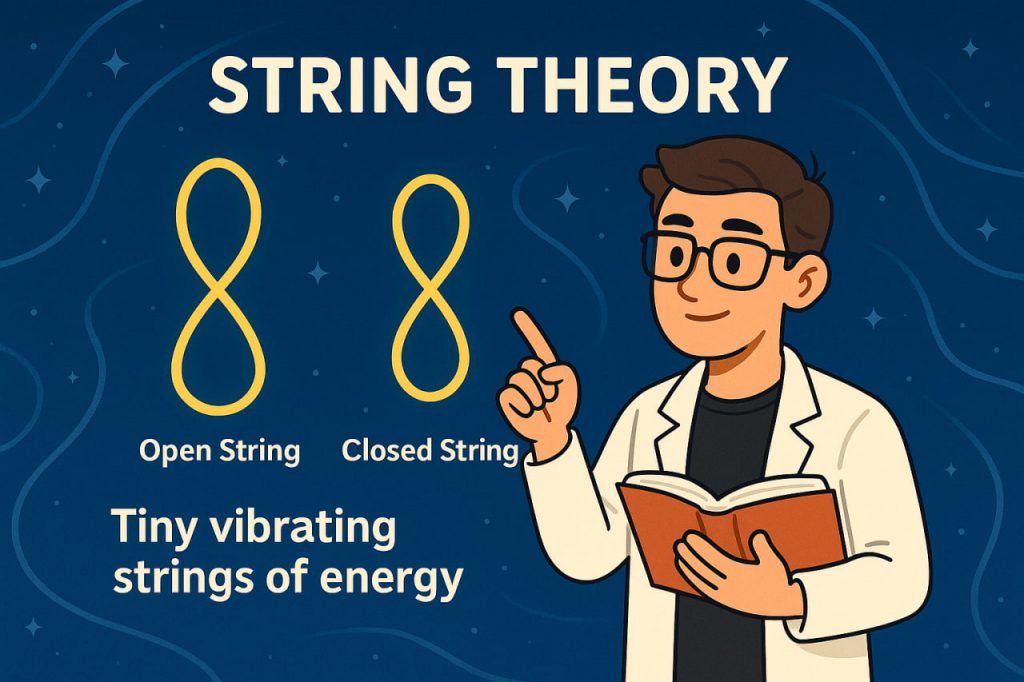
String theory is one of the most ambitious and mathematically rich ideas in modern physics. It proposes that the fundamental building blocks of the universe are not point-like particles but tiny vibrating strings of energy. These strings can vibrate in different modes, and each mode corresponds to a different particle — much like how different vibrations of a guitar string produce different musical notes. String theory aims to unify all the forces of nature, including gravity, into a single coherent framework. By doing so, it attempts to bridge the long-standing gap between quantum mechanics and general relativity, two pillars of physics that traditionally resist reconciliation. Although still theoretical, string theory has inspired breakthroughs in mathematics, cosmology, and high-energy physics.
String theory also suggests that the universe contains more dimensions than the three of space and one of time that we experience daily. These extra dimensions are compact and hidden, curled up at scales far smaller than atoms. The theory’s complex mathematical structure provides fresh ways to think about black holes, early cosmology, and the underlying architecture of reality. Even though it lacks direct experimental confirmation, string theory remains a leading candidate for describing the deepest levels of physical law.
Vibrating Strings as the Foundation of Reality
At the core of string theory is the idea that particles such as electrons, quarks, and photons are actually tiny vibrating threads. The vibration pattern determines a particle’s mass, charge, and behavior. Strings can be open (like a segment) or closed (forming a loop), with closed strings often associated with gravity. This elegant concept replaces dozens of fundamental particles with one unifying object. According to theoretical physicist Dr. Evelyn Rhodes:
“String theory doesn’t just describe particles —
it describes the music of the universe itself.”
This analogy helps explain why string theory is considered a potential “theory of everything.”
Extra Dimensions and the Fabric of Spacetime
A striking feature of string theory is that it requires additional spatial dimensions for the mathematics to function. In many versions, the universe has 10 or 11 dimensions, with the extra ones tightly compacted in shapes known as Calabi–Yau manifolds. These hidden dimensions influence particle properties and physical constants, potentially explaining why the universe behaves the way it does. Although invisible to everyday experience, extra dimensions are essential for string theory’s consistency.
Unifying the Forces of Nature
One of the greatest successes of string theory is its natural inclusion of gravity, something most quantum theories fail to achieve. Closed strings can behave like gravitons, the hypothetical quantum particles that carry the force of gravity. This makes string theory one of the few frameworks capable of unifying gravity with electromagnetism, the strong nuclear force, and the weak nuclear force. Such unification remains a major goal in physics, as it could reveal deeper truths about the origins of space, time, and energy.
String Theory Variants and M-Theory
Over time, researchers discovered that several versions of string theory exist, each describing different types of strings or dimensions. In the 1990s, physicist Edward Witten proposed M-theory, a unifying framework that suggests all string theories are different perspectives of one underlying structure. M-theory introduces membranes (branes) — higher-dimensional objects that may play a key role in cosmic evolution, black hole physics, and the nature of the multiverse.
Challenges and Criticisms
Despite its elegance, string theory faces important challenges. Because strings are incredibly small — near the Planck length — testing the theory directly is extremely difficult. Some critics argue that its lack of experimental evidence limits its scientific value. Others point out that the huge number of possible solutions (the “string landscape”) makes predictions difficult. Even so, string theory drives progress by inspiring new mathematical tools and offering insights into quantum gravity, entanglement, and holography.
The Future of String Theory
String theory remains at the frontier of theoretical physics. As experimental tools improve — such as gravitational-wave detectors and high-energy particle colliders — scientists hope to find indirect evidence supporting or challenging string-based ideas. Meanwhile, string theory continues to provide frameworks for studying black holes, quantum information, and the origins of the universe. Whether or not it becomes the ultimate explanation of reality, it has already transformed how physicists think about the cosmos.
Interesting Facts
- String theory requires 10 or 11 dimensions to work mathematically.
- The strings in string theory are thought to be 10⁻³⁵ meters long — far too small to observe.
- The theory naturally includes gravity, making it unique among quantum frameworks.
- Calabi–Yau spaces — the shapes of extra dimensions — have inspired modern geometry.
- M-theory suggests the universe may be built from vibrating membranes, not only strings.
Glossary
- Quantum Mechanics — the physics of particles at extremely small scales.
- General Relativity — Einstein’s theory describing gravity as the curvature of spacetime.
- Graviton — the hypothetical quantum particle that carries gravitational force.
- Calabi–Yau Manifold — a complex geometric shape representing extra dimensions in string theory.
- M-Theory — an overarching framework that unifies multiple versions of string theory.