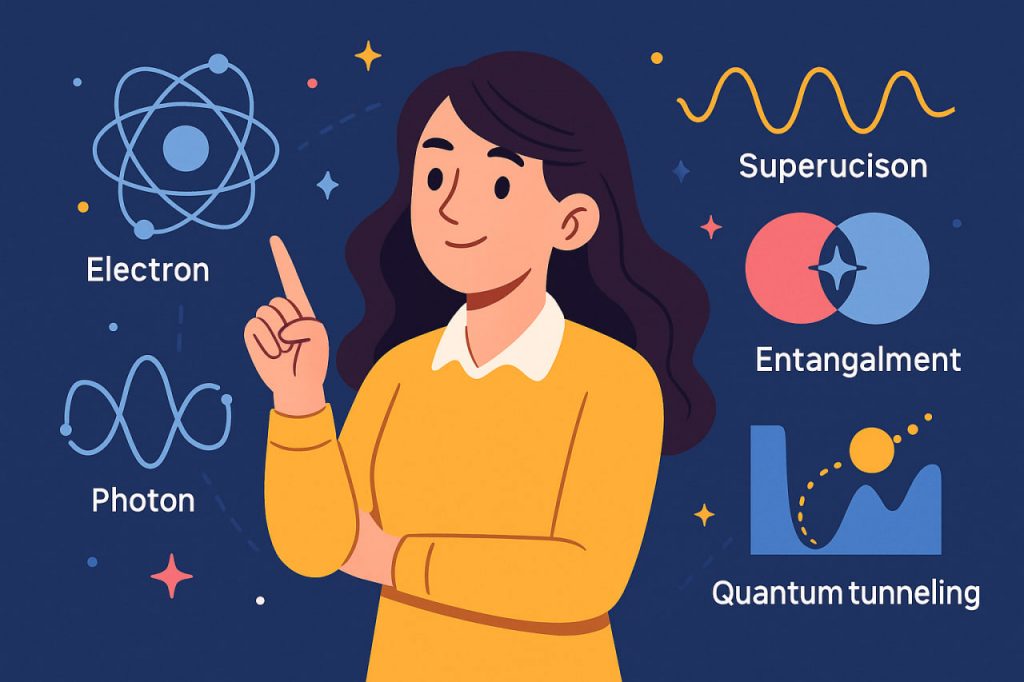
Quantum mechanics is the branch of physics that describes how the universe works at the smallest scales — the level of atoms, electrons, photons, and other subatomic particles. Unlike classical physics, which explains everyday objects like cars, planets, and falling apples, quantum mechanics reveals a world where particles can exist in multiple places at once, teleport information, behave like both waves and particles, and interact in ways that seem impossible from a common-sense point of view. Although the topic is often seen as complicated, understanding the fundamentals of quantum mechanics is both fascinating and achievable, even for beginners. The key is to look at its core ideas clearly and without unnecessary math.
Quantum mechanics matters because it explains the structure of atoms, the chemistry of life, the behavior of light, the technology behind computers, lasers, MRI machines, and even modern quantum computing. It provides the rules that govern nearly everything around us — rules that often challenge intuition but have been confirmed by thousands of experiments.
1. Wave–Particle Duality: Everything Is Both a Particle and a Wave
One of the first surprises of quantum mechanics is that tiny particles can behave like waves. Light, which seems like a wave, can also act like a particle called a photon. Meanwhile, electrons — usually thought of as particles — can create interference patterns like waves. This dual nature is best revealed in the famous double-slit experiment.
According to physicist Dr. Julia Bennett:
“Quantum particles do not choose to be waves or particles —
they are both, until we force a choice by measuring them.”
Wave–particle duality shows that nature at small scales works very differently from everyday experience.
2. Quantum Superposition: Being in Many States at Once
Quantum objects do not have one definite state before measurement. An electron can be in multiple places simultaneously, and a photon can travel along several paths at once. This is called superposition, and it is central to quantum theory. When measured, the many possibilities “collapse” to a single outcome.
Superposition makes quantum mechanics powerful but also puzzling. It enables quantum computers to perform many calculations at the same time — something classical devices cannot do.
3. Entanglement: A Connection Beyond Distance
Quantum entanglement is one of the most famous and strange quantum effects. When two particles become entangled, the state of one instantly relates to the state of the other, even if they are separated by great distances. Changing one immediately influences the other — a phenomenon Albert Einstein once called “spooky action at a distance.”
Entanglement is now used in quantum communication, quantum sensors, and foundational research in quantum computing.
4. Uncertainty Principle: Limits to What We Can Know
Werner Heisenberg discovered that certain pairs of physical properties — like position and momentum — cannot both be known with perfect accuracy at the same time. This is the uncertainty principle. It does not mean our tools are imperfect; rather, nature itself prevents perfect knowledge at quantum scales.
The uncertainty principle explains:
- why electrons never sit still
- why atoms are stable
- why quantum behavior seems “fuzzy”
It is a natural and fundamental part of how the universe works.
5. Quantum Tunneling: Passing Through Barriers
Quantum tunneling allows particles to “tunnel” through obstacles they cannot cross classically. This effect enables:
- radioactive decay
- fusion in stars
- modern electronic devices
- quantum sensors and microscopes
Tunneling is a direct consequence of wave-like behavior at quantum scales.
Why Quantum Mechanics Matters Today
Quantum mechanics is no longer just theoretical. It powers modern technologies, including:
- semiconductors and computer chips
- lasers and LED lights
- GPS atomic clocks
- MRI medical imaging
- quantum computers
- quantum cryptography
Understanding quantum mechanics helps explain the most advanced technologies shaping the future.
Interesting Facts
- Quantum particles can pass through barriers via tunneling, even when classical physics forbids it.
- Entanglement experiments have confirmed correlations across distances of over 1,000 km.
- Electrons in atoms do not orbit like planets — they exist in probability clouds.
- Quantum behavior appears not only in tiny particles but also in large molecules with thousands of atoms.
- Schrödinger’s cat was invented to illustrate the paradox of superposition on larger scales.
Glossary
- Wave–Particle Duality — the idea that quantum objects behave like both waves and particles.
- Superposition — a state where a particle has multiple possibilities simultaneously.
- Entanglement — a quantum link between two particles that connects their states.
- Uncertainty Principle — the rule that some properties cannot be known precisely at the same time.
- Quantum Tunneling — a process where particles pass through barriers by quantum effects.