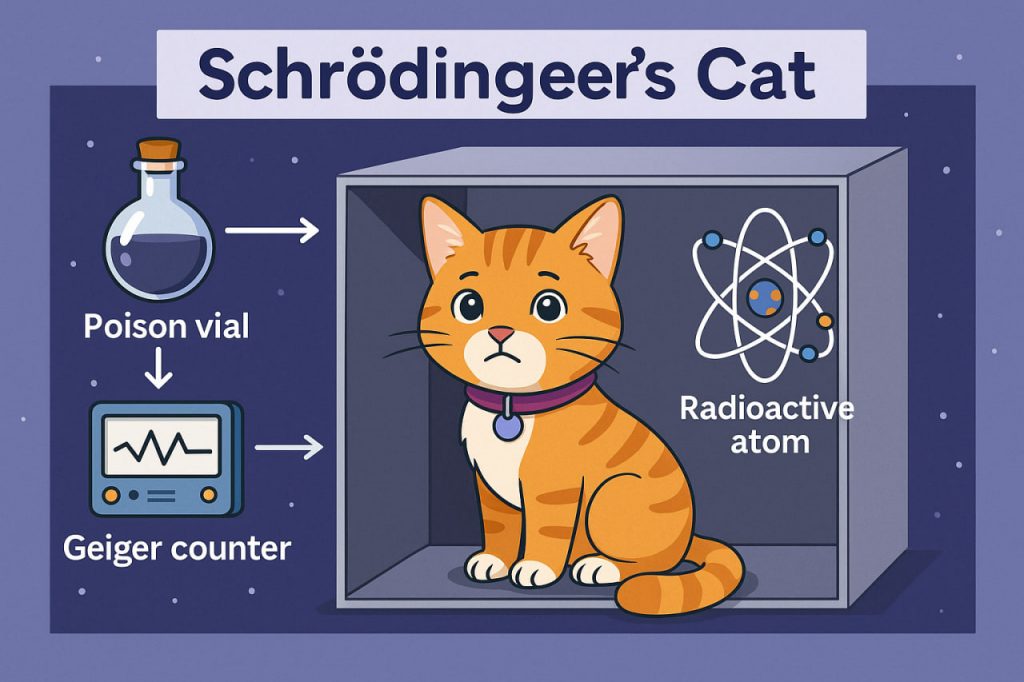
Schrödinger’s Cat is one of the most iconic and widely discussed thought experiments in the history of physics. Proposed in 1935 by Austrian physicist Erwin Schrödinger, it was designed not to explain quantum mechanics, but to criticize the way quantum rules were being interpreted at the time. The scenario imagines a cat placed in a sealed box with a radioactive atom, a detector, and a vial of poison. If the atom decays, the poison is released and the cat dies; if not, the cat lives. According to some interpretations of quantum mechanics, until the box is opened and the system is observed, the cat exists in a superposition of both alive and dead states simultaneously. Schrödinger intended this paradox to highlight the absurdity of applying quantum rules—designed for subatomic particles—to large everyday objects.
Over time, Schrödinger’s Cat became a central symbol of quantum weirdness. It raises profound questions about measurement, reality, and the boundary between the quantum and classical worlds. While the experiment is imaginary, the ideas behind it shape modern quantum theory and influence cutting-edge fields such as quantum computing, entanglement research, and the philosophy of physics.
Schrödinger’s goal was not to suggest that a real cat could be both alive and dead, but to demonstrate that quantum theory, if taken literally, leads to paradoxes that challenge our understanding of reality.
The Setup of Schrödinger’s Experiment
In the thought experiment, a cat is placed in a sealed box along with:
- a radioactive atom with a 50% chance of decaying
- a Geiger counter to detect decay
- a hammer mechanism
- a vial of poison that is released if decay is detected
If the atom decays → the poison is released → the cat dies.
If the atom does not decay → the cat lives.
But according to the quantum rules governing atomic decay, the atom can exist in a superposition of decayed and not decayed. This means that, mathematically, the entire system — including the cat — also enters a superposition of alive and dead.
As quantum physicist Dr. Miriam Harris explains:
“Schrödinger’s Cat is not about literal cats —
it is about how the quantum world refuses to conform to classical logic.”
This highlights the divide between microscopic quantum states and macroscopic reality.
The Measurement Problem
Schrödinger’s Cat exposes the measurement problem — the question of how and when a quantum system transitions from a superposition of possibilities to one definite outcome. In quantum mechanics:
- particles exist in multiple states simultaneously
- measurement forces them into one state (wavefunction collapse)
- but it is unclear how measurement triggers collapse
This puzzle remains one of the deepest mysteries in physics.
Modern Interpretations
Scientists and philosophers have proposed many interpretations of what the cat paradox means:
- Copenhagen Interpretation — the cat is in superposition until observed.
- Many-Worlds Interpretation — the universe splits; in one world the cat lives, in another it dies.
- Decoherence Theory — interaction with the environment destroys superposition before observation.
- Objective Collapse Models — superposition spontaneously collapses at large scales.
These interpretations attempt to explain how the quantum world transitions into the classical world we experience.
Experiments Inspired by Schrödinger’s Cat
Although no one is placing real cats into quantum experiments, scientists have created Schrödinger cat states using:
- superconducting circuits
- photons
- vibrating membranes
- ultracold atoms
- large molecules in interference experiments
These experiments explore superposition in increasingly large systems and help scientists understand the quantum–classical boundary.
Why Schrödinger’s Cat Still Matters
Schrödinger’s Cat remains relevant because it illustrates:
- the strangeness of quantum mechanics
- the role of the observer in measurement
- how reality may differ from intuition
- the unresolved nature of quantum theory
- the conceptual foundation of quantum computing
It serves as a bridge between deep philosophical questions and cutting-edge physics.
Interesting Facts
- Schrödinger designed the cat paradox to criticize the Copenhagen interpretation, not support it.
- Some interpretations propose that both outcomes occur in parallel universes.
- Experiments have created “cat states” using superconducting qubits.
- The paradox is often misinterpreted — Schrödinger never believed a cat literally becomes both alive and dead.
- Schrödinger introduced the thought experiment in a letter to Einstein, who also doubted the completeness of quantum mechanics.
Glossary
- Superposition — a quantum state where a particle exists in multiple states simultaneously.
- Wavefunction Collapse — the reduction of a superposition to a single outcome during measurement.
- Decoherence — the process by which quantum superposition breaks down due to environmental interaction.
- Copenhagen Interpretation — a traditional view of quantum mechanics where measurement defines reality.
- Cat State — a large-scale superposition created in laboratory quantum systems.