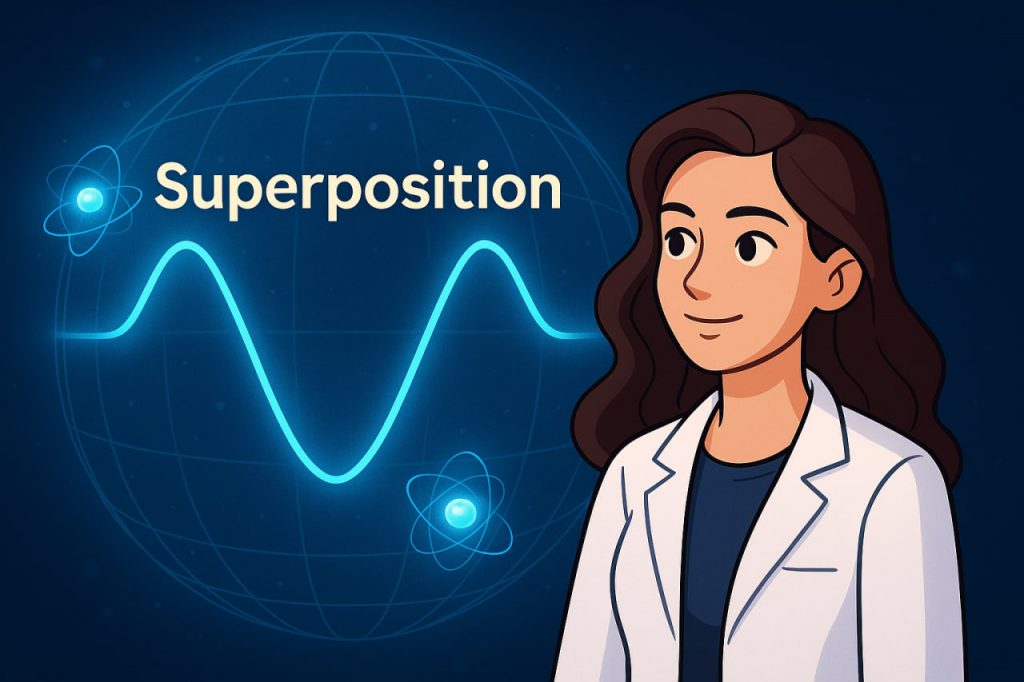
Quantum superposition is one of the most surprising and essential concepts in quantum mechanics. It states that a quantum system — such as an electron, photon, or atom — can exist in multiple states at the same time until it is measured. This defies classical intuition, where objects always have a definite position, energy, or state. Instead, in the quantum world, particles behave like overlapping probability waves that contain all possible outcomes simultaneously. Only when a measurement takes place does the system “collapse” into a single observable state. Understanding superposition is crucial for interpreting modern physics, explaining quantum technology, and exploring the mysteries of reality itself.
Superposition is not just a bizarre idea — it has been experimentally verified countless times. It forms the foundation of quantum computing, quantum cryptography, interference experiments, and our understanding of atomic behavior. Without superposition, the universe would behave in profoundly different ways, and many technologies we rely on today would not function.
How Superposition Works
Quantum particles are described by a wavefunction, a mathematical expression containing all possible states the particle can occupy. When a particle is not observed, its wavefunction evolves smoothly, representing a blend of possible outcomes. When a measurement occurs, the wavefunction collapses, and the particle assumes a single definite state.
A classic example is an electron that can be in multiple positions or spin states at once. According to quantum theorist Dr. Yasmine Clarke:
“Superposition is not a particle splitting in half —
it is a particle existing in all possible versions of itself until observed.”
This makes superposition fundamentally different from anything in classical physics.
The Double-Slit Demonstration of Superposition
The famous double-slit experiment illustrates superposition. When electrons or photons pass through two slits without being observed:
- they behave like waves
- they pass through both slits at once
- they form an interference pattern on the screen
But if detectors observe which slit the particle passes through, superposition collapses, and the interference disappears. This experiment shows that superposition depends on the absence of which-path information.
Schrödinger’s Cat: A Thought Experiment
Erwin Schrödinger proposed a now-famous thought experiment to illustrate the strangeness of superposition. A sealed box contains:
- a cat
- a quantum trigger
- a radioactive atom
- a poison vial
If the atom decays, the poison is released and the cat dies; if not, the cat lives. Quantum mechanics suggests that until the box is opened, the cat is in a superposition of alive and dead. While the cat itself is not truly quantum, the analogy highlights how measurement bridges the quantum and classical worlds.
Superposition in Quantum Computing
Quantum computers use qubits — quantum bits that exploit superposition. Unlike classical bits (0 or 1), qubits can be:
- 0,
- 1,
- or both at the same time.
This allows quantum computers to process many calculations simultaneously, enabling enormous computational power for certain tasks. Superposition, combined with entanglement, is why quantum computing has such transformative potential.
Why Superposition Matters
Superposition allows scientists to understand:
- atomic orbitals
- chemical bonding
- tunneling in semiconductors
- laser technology
- superconductivity
- quantum sensors and clocks
- quantum teleportation
- the structure of molecules and particles
It is a cornerstone of both theoretical and applied physics.
Can Superposition Be Seen in Large Objects?
Superposition is easiest to observe in small particles, but experiments have demonstrated it in:
- molecules with hundreds or thousands of atoms
- superconducting circuits
- vibrating membranes
- ultra-cold mechanical systems
The boundary between quantum and classical behavior remains an active area of research, known as the quantum-to-classical transition.
Interesting Facts
- Electrons in atoms exist in superposition of energy states until measured.
- Quantum computers exploit superposition to evaluate millions of states simultaneously.
- The largest object ever placed in superposition contains thousands of atoms.
- Even time and paths can enter superposition in advanced experiments.
- Without superposition, lasers, MRI scanners, and transistors would not work.
Glossary
- Wavefunction — the mathematical description of a quantum system’s possible states.
- State Collapse — the reduction of a superposition to a single outcome during measurement.
- Qubit — a quantum version of a computer bit that can be both 0 and 1.
- Interference — the pattern created when wave-like states overlap.
- Quantum-to-Classical Transition — the process by which quantum effects disappear as systems grow larger.