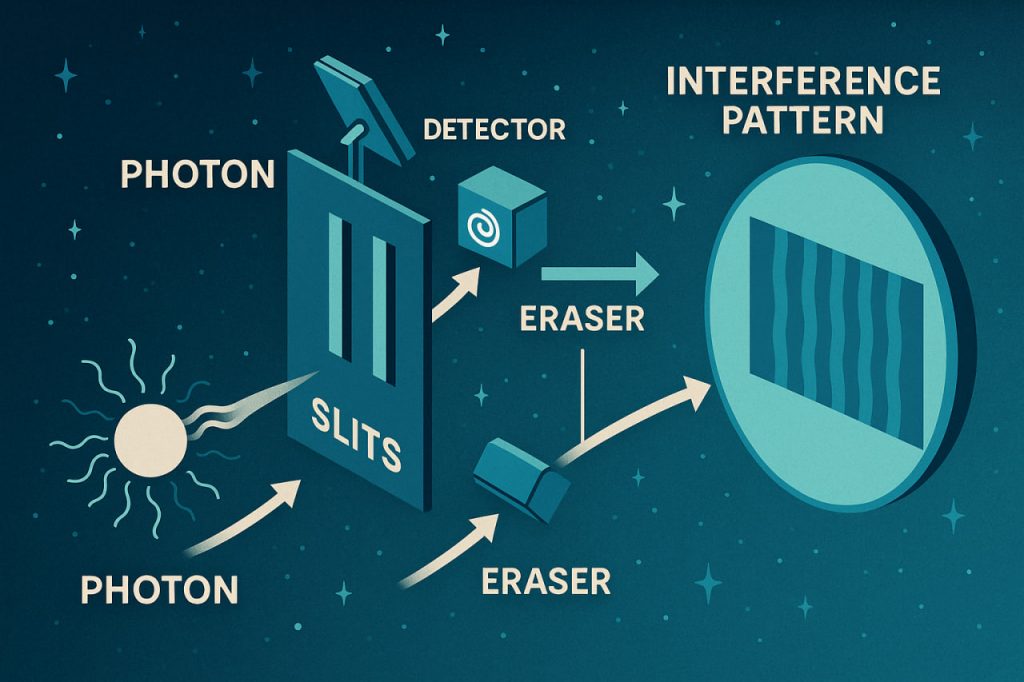
The quantum eraser experiment is one of the most surprising and mind-bending demonstrations in quantum mechanics. It expands upon the famous double-slit experiment by showing that information itself determines whether particles behave like waves or particles. In a quantum eraser setup, the interference pattern created by photons or electrons can disappear — and then reappear — depending on whether information about the particle’s path is available or has been “erased.” Even more astonishing is the delayed-choice quantum eraser, where the decision to erase or keep the information can be made after the particle has already passed through the slits, yet the outcome still changes. This challenges classical logic and reveals how deeply quantum mechanics intertwines information, measurement, and physical reality.
The quantum eraser experiment is not about human consciousness or time travel. Instead, it highlights how quantum systems behave differently depending on what information could be known about them. This concept has powerful implications for quantum computing, encryption, and our understanding of the fundamental nature of reality.
How the Quantum Eraser Works
The experiment begins with a standard double-slit setup where photons are fired one at a time toward two narrow slits. Without measurement, these photons produce a wave-like interference pattern. When detectors are placed at the slits to observe which path each photon takes, the interference pattern disappears — the photons behave as particles.
In a quantum eraser setup:
- The photons pass through the slits.
- Then they are split into pairs via spontaneous parametric down-conversion.
- One photon is sent to a detector that may record or erase path information.
- The other photon hits an interference screen.
Crucially, the interference pattern only appears when the path information has been erased.
According to quantum physicist Dr. Melissa Kaplan:
“The quantum eraser shows that it is not the measurement itself,
but the availability of information, that shapes quantum outcomes.”
This means the mere possibility of knowing the path controls how the system behaves.
The Delayed-Choice Quantum Eraser
A more dramatic version, developed by Yoon-Ho Kim and colleagues in 1999, delays the decision to erase or preserve path information until after the partner photon reaches the detection screen. Despite this delay, the results still reflect whether the path information was kept or erased.
This suggests:
- quantum systems do not commit to a definite history until information becomes available
- measurement does not retroactively change the past, but determines correlations between events
- quantum behavior depends on what is knowable, not just what is measured physically
This is consistent with modern interpretations of quantum mechanics but defies everyday intuition.
Why the Interference Reappears
When path information is erased:
- the system returns to a state of superposition
- the photons act as if they traveled through both slits
- interference patterns emerge in correlated subgroups of the data
Interestingly, the full dataset never shows interference. Only when photons are sorted according to whether their partners had erased path information does the interference pattern emerge.
This phenomenon illustrates the profound role of entanglement and information in quantum physics.
What the Experiment Does Not Mean
The quantum eraser does not suggest:
- that consciousness changes reality
- that effects travel backward in time
- that particles “know the future”
- that quantum behavior violates causality
It simply shows that the structure of information determines how quantum systems manifest their wave-like or particle-like behavior.
Why the Quantum Eraser Matters
This experiment has far-reaching implications:
- Quantum Computing: controlling information allows control over quantum states.
- Quantum Encryption: revealing or hiding information changes measurable outcomes.
- Foundations of Physics: challenges classical assumptions about reality.
- Entanglement Research: deepens understanding of quantum correlations.
It remains one of the clearest examples of how strange and beautiful quantum mechanics truly is.
Interesting Facts
- The first quantum eraser experiment was proposed in 1982, and demonstrated in the 1990s.
- Interference patterns only appear when data is correlated, not in the full dataset.
- Delayed-choice experiments confirm that information, not timing, determines outcomes.
- Entangled photons behave consistently even when separated by large distances.
- Quantum erasers help scientists test the limits of wave–particle duality.
Glossary
- Quantum Eraser — an experiment where removing path information restores interference.
- Entanglement — a quantum connection between particles that links their states.
- Superposition — the ability of quantum particles to exist in multiple states at once.
- Down-Conversion — a process where one photon splits into two lower-energy entangled photons.
- Delayed-Choice Experiment — a setup where the decision to measure or erase information is made after the particle has passed the slits.