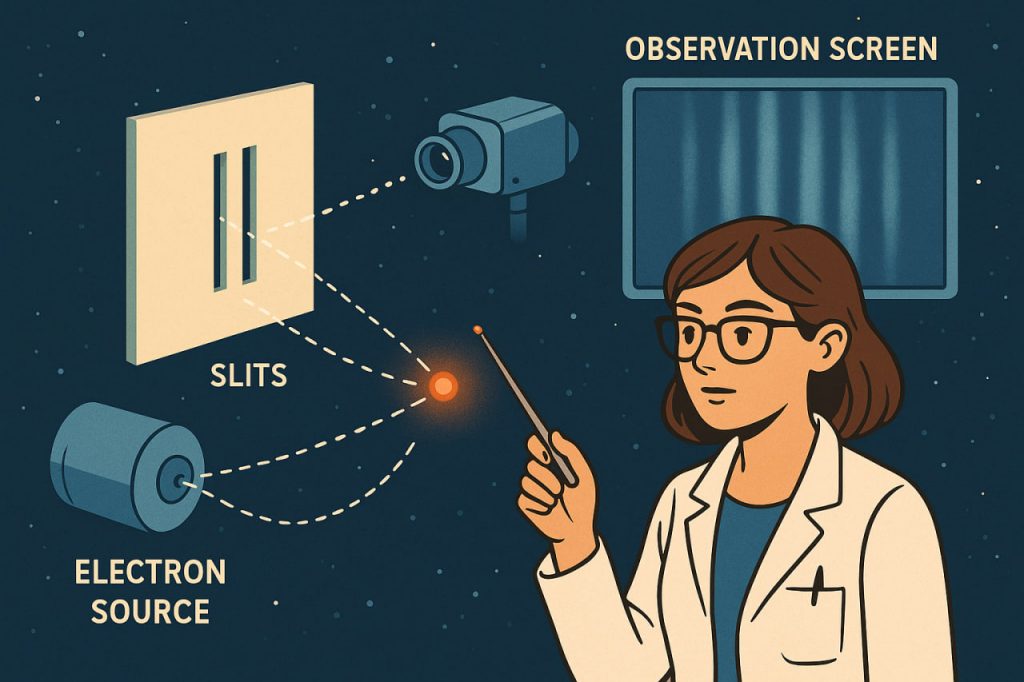
The double-slit experiment is one of the most mysterious and important experiments in the history of physics. First demonstrated with light and later with electrons and other particles, it reveals deep truths about the nature of matter, observation, and reality itself. When electrons pass through two narrow slits and are not observed, they behave like waves, creating an interference pattern on the screen behind them. But when scientists observe which slit an electron passes through, the interference disappears — the electron behaves like a particle instead. This strange shift, triggered simply by observing the electron, challenges classical logic and lies at the foundation of quantum mechanics.
The experiment suggests that electrons — and, in fact, all quantum particles — possess both wave-like and particle-like properties. Which behavior appears depends on how the experiment is measured. Understanding the double-slit experiment helps explain quantum superposition, wave–particle duality, and the role of measurement in shaping physical outcomes.
How the Double-Slit Experiment Works
The setup consists of:
- a source that emits individual electrons
- two narrow slits in a barrier
- a screen that records the electrons that pass through
When the electrons are fired one at a time, something extraordinary happens: even single electrons form a wave-like interference pattern, as if each electron passes through both slits simultaneously.
This led physicists to conclude that electrons exist as probability waves until measured. According to quantum theorist Dr. Helena Armitage:
“The electron does not choose a path until we force it to —
measurement collapses its wave of possibilities into a single outcome.”
This phenomenon is called wavefunction collapse.
What Happens When the Electron Is Observed?
If detectors are placed at the slits to see “which way” the electron goes, the interference pattern disappears entirely. Instead, electrons behave like tiny particles, forming two clusters behind the slits.
This means:
- Observation changes the outcome
- The electron no longer acts as a wave passing through both slits
- The act of measurement forces the electron into one definite state
This effect has nothing to do with human consciousness — but with any interaction that extracts information from the system. Even a weak measurement can alter the pattern.
Why Does Observation Change the Result?
In quantum mechanics, measuring a particle requires interacting with it (for example, detecting light bouncing off it). This interaction disturbs the wave-like behavior of the electron. The measurement destroys the delicate superposition of paths, leaving only one definite state.
This leads to key principles:
- Wave–particle duality
- Quantum superposition
- Measurement affects the system
- Probabilities describe reality at the smallest scales
The experiment does not imply that reality depends on human awareness — only that quantum systems behave differently when information about them becomes available.
Modern Variants of the Double-Slit Experiment
Scientists have repeated the experiment with:
- photons
- electrons
- neutrons
- atoms
- large molecules like buckyballs (C₆₀)
- even small biological molecules
All show the same result: quantum objects behave as waves until measured.
Advanced versions use:
- delayed-choice experiments, showing that measurement can influence past behavior
- quantum erasers, demonstrating that erasing information restores interference
- weak measurements, offering partial information without fully collapsing the wavefunction
These experiments continue to challenge our understanding of time, information, and reality.
Why the Experiment Matters
The double-slit experiment is a cornerstone of quantum mechanics because it:
- demonstrates the dual nature of matter
- shows that measurement affects physical systems
- supports the theory of quantum superposition
- lays the foundation for quantum computing and quantum encryption
- challenges classical assumptions about reality
It suggests that at the smallest scales, nature behaves according to laws far more strange and subtle than everyday experience would allow.
Interesting Facts
- Electrons form an interference pattern even when fired one at a time, meaning they interfere with themselves.
- If the information about which slit an electron passes through is erased, the interference pattern returns.
- Richard Feynman said the double-slit experiment contains “the only mystery” of quantum mechanics.
- Molecules containing over 2,000 atoms have shown double-slit interference, proving quantum effects scale upwards.
- Delayed-choice experiments suggest measurement can influence a particle’s behavior after it passes the slits.
Glossary
- Wavefunction — a mathematical description of the probabilities of a quantum system.
- Superposition — the ability of particles to exist in multiple states at once.
- Wave–Particle Duality — the idea that quantum objects behave as both waves and particles.
- Quantum Eraser — an experiment showing that removing information restores wave-like behavior.
- Interference Pattern — a wave-generated pattern of bright and dark stripes.