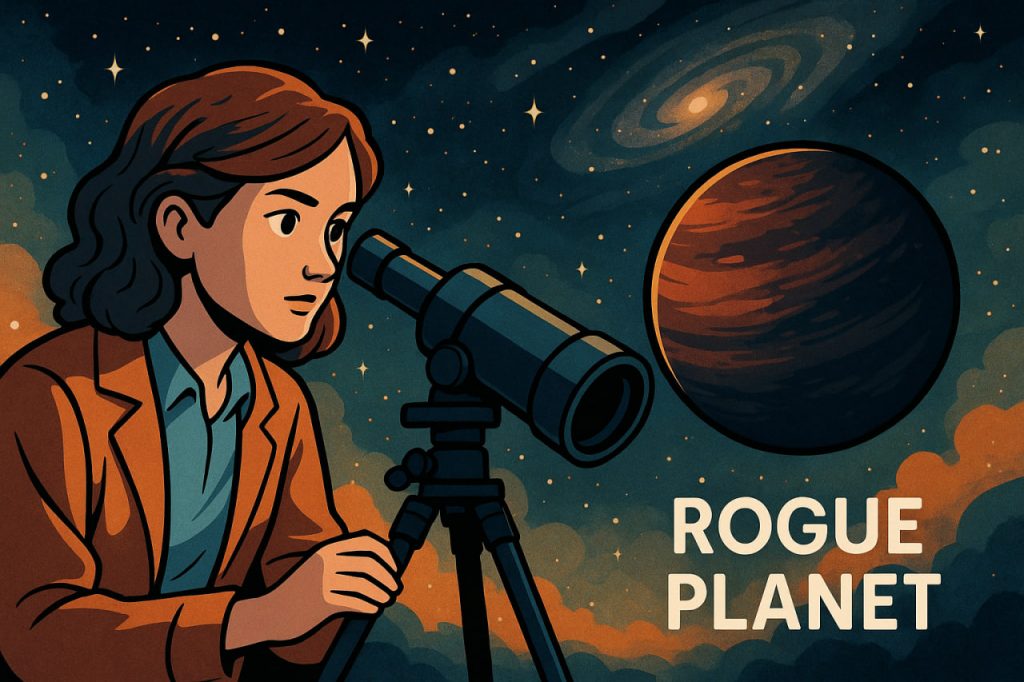
Rogue planets, also known as free-floating planets or orphan planets, are planetary-mass objects that travel through space without orbiting a star. Unlike Earth, Jupiter, or other planets bound to a solar system, rogue planets drift alone in the darkness of interstellar space. Their existence challenges traditional ideas about how planetary systems form and evolve. Some rogue planets may have been violently ejected from their home systems; others may have formed independently, similar to small brown dwarfs. These worlds offer a fascinating glimpse into the chaotic processes that shape the universe and raise profound questions about how common—and how unusual—planetary environments can be.
Because rogue planets emit no light of their own and do not reflect starlight, they are extremely difficult to detect. However, advances in infrared astronomy, gravitational microlensing, and large-scale sky surveys have revealed the presence of many such planets in the Milky Way. Some estimates even suggest that rogue planets may outnumber stars, making them one of the most widespread yet invisible populations in the galaxy.
How Rogue Planets Form
There are two primary theories for the origin of rogue planets:
- Ejection from a Young Solar System — During early planet formation, gravitational interactions between giant planets can destabilize orbits and eject smaller worlds into interstellar space.
- Direct Formation from Gas Clouds — Some rogue planets may form directly from collapsing clouds of gas and dust, similar to stars but without accumulating enough mass to ignite nuclear fusion.
According to astrophysicist Dr. Renata Silva:
“Rogue planets show us that planetary systems are not stable, orderly structures—
they are dynamic, violent, and constantly changing.”
This perspective reshapes our understanding of how common planetary chaos truly is.
How Scientists Detect Rogue Planets
Since rogue planets are invisible in normal optical wavelengths, astronomers rely on indirect methods:
- Gravitational Microlensing: Rogue planets act as lenses, briefly magnifying the light of background stars as they pass in front of them.
- Infrared Surveys: Large rogue planets still emit faint heat signatures detectable in infrared wavelengths.
- Observations of Star Clusters: Newly formed clusters sometimes reveal free-floating planetary-mass objects drifting between stars.
Microlensing has been the most successful technique, allowing scientists to detect rogue planets as small as Mars in distant regions of the galaxy.
What Are Rogue Planets Like?
Rogue planets vary widely in size, composition, and temperature:
- Some are gas giants similar to Jupiter.
- Others are rocky like Earth or Mars.
- Many are extremely cold, with surface temperatures near absolute zero.
- Some may have molten interiors due to radioactive heating or residual formation energy.
- Large rogue planets with thick atmospheres could even maintain liquid oceans beneath insulating layers of gas or ice.
These exotic environments challenge the idea that sunlight is necessary for habitability.
Could Rogue Planets Host Life?
While traditional life as we know it depends on starlight, some scientists believe rogue planets could harbor subsurface oceans, similar to Europa or Enceladus. If a rogue planet has:
- a thick hydrogen atmosphere,
- geothermal heating,
- and internal radioactive decay,
then stable liquid water might exist beneath the surface. This makes rogue planets an intriguing possibility for exotic forms of life.
How Many Rogue Planets Exist?
The exact number is unknown, but research suggests:
- there may be billions of rogue planets in the Milky Way,
- possibly several per star,
- and some regions may have massive clusters of free-floating planets.
This means rogue planets could be among the most common planetary objects in the galaxy.
Future Missions and Research
The Nancy Grace Roman Space Telescope, Euclid, and future infrared observatories will dramatically increase our ability to detect rogue planets through microlensing. New data may reveal even smaller rogue worlds, improve estimates of their abundance, and help determine how often planetary systems eject their planets.
Interesting Facts
- Some estimates suggest the Milky Way may contain more rogue planets than stars.
- Rogue planets can drift for billions of years without encountering another star.
- A Jupiter-sized rogue planet still emits faint heat due to its internal cooling.
- Microlensing events caused by rogue planets can last seconds to hours, requiring precise monitoring.
- Some theories propose that early Earth could have been temporarily ejected before settling into a stable orbit.
Glossary
- Gravitational Microlensing — a method of detecting planets by observing how they bend the light of background stars.
- Free-Floating Planet — a planet that travels through space without orbiting a star.
- Brown Dwarf — an object too large to be a planet but too small to sustain hydrogen fusion.
- Infrared Astronomy — observing celestial objects at wavelengths invisible to the human eye.
- Subsurface Ocean — a hidden ocean beneath ice or atmospheric layers, warmed by internal heat.