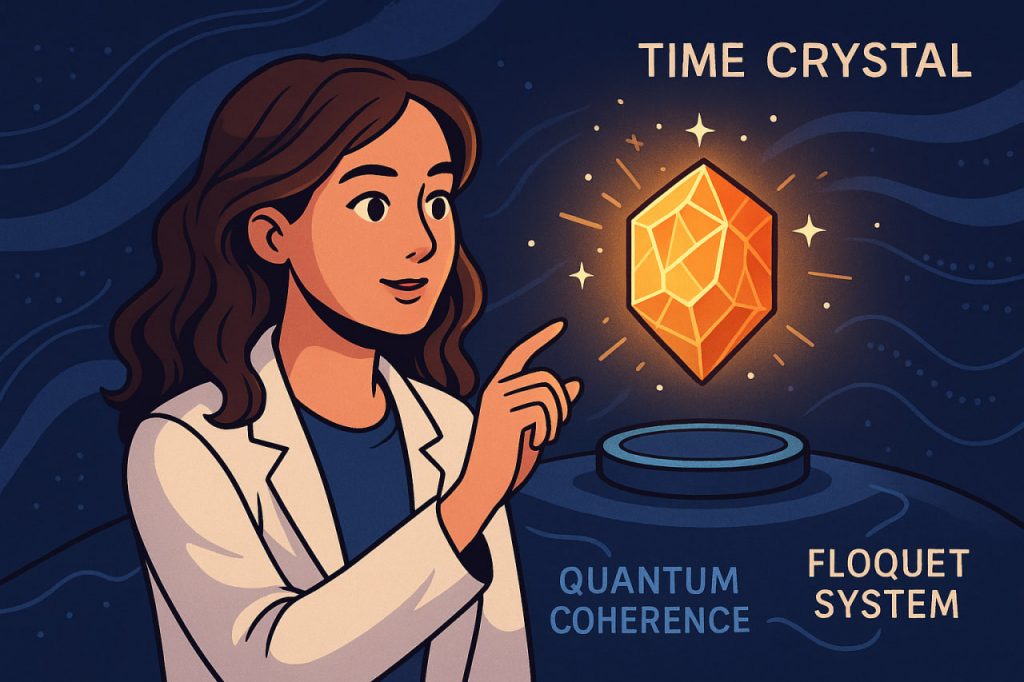
Time crystals are one of the most astonishing scientific discoveries of the 21st century — a completely new state of matter that behaves in ways once thought impossible. Unlike ordinary crystals, which repeat their structure in space, time crystals repeat their structure in time. They oscillate, switch, or “tick” at regular intervals without consuming energy, seemingly defying the fundamental laws of thermodynamics. First proposed by Nobel laureate Frank Wilczek in 2012 and experimentally realized several years later, time crystals challenge long-standing assumptions about stability, order, and motion at the quantum level. Their unique properties open the door to next-generation quantum technologies, ultra-stable memory systems, and deeper understanding of non-equilibrium physics.
Time crystals belong to a family of materials known as non-equilibrium phases, meaning they exist in states that traditional physics cannot describe using classical equilibrium rules. Instead of settling into stillness, time crystals maintain perpetual oscillations due to quantum interactions that prevent energy loss. This continuous, repeating motion mirrors the periodic structure of ordinary crystals — but through time rather than space.
How Time Crystals Work
In typical physical systems, perpetual motion without energy input is impossible: friction, heat, and disorder always slow things down. Time crystals circumvent this by operating within quantum mechanics, where many-body interactions can prevent systems from absorbing or releasing energy. These systems are often driven by periodic forces — a process known as Floquet engineering — which helps stabilize the repeating behavior.
Scientists create time crystals using trapped ions, superconducting qubits, ultracold atoms, and quantum processors. When these particles interact under precisely controlled conditions, they settle into cycles of motion that repeat at fixed intervals. According to quantum physicist Dr. Lydia Chen:
“A time crystal doesn’t move through time —
it repeats in time, forming a rhythm that never fades.”
This property makes time crystals fundamentally different from any material found in nature.
Breaking Time-Translation Symmetry
In physics, symmetry describes what stays the same when you shift something in space or time. Ordinary crystals break spatial symmetry by having repeating patterns. Time crystals break time-translation symmetry, meaning their state repeats even when time moves forward. This allows them to maintain movement that does not degrade — something no traditional material can do.
Why Time Crystals Matter
Time crystals are not just theoretical curiosities. They have potential applications in several cutting-edge fields:
- Quantum computing — time crystals can store quantum information more stably.
- Quantum sensors — their repeating structure enhances precision.
- Error-resistant qubits — reducing noise in quantum circuits.
- Understanding new phases of matter — reshaping condensed-matter physics.
Because their oscillations are stable and predictable, time crystals could become essential components in future quantum devices.
How Scientists Created Time Crystals
The first experimental time crystals were realized using:
- chains of trapped ions, where laser pulses triggered stable oscillations
- superconducting qubits inside quantum processors
- Bose–Einstein condensates, where atoms behave as a single quantum object
- spin systems driven by electromagnetic fields
Notably, in 2021, researchers observed time-crystal behavior on a Google quantum processor, demonstrating that the phenomenon can exist in programmable quantum machines.
Open Questions and Future Research
Although time crystals have been proven to exist, many mysteries remain. Researchers continue investigating:
- how many types of time crystals exist,
- how they interact with their environment,
- how stable they can be over long periods,
- whether they can be scaled for practical technology.
Their discovery has already transformed our understanding of quantum matter, and future breakthroughs may reveal even stranger forms of temporal order.
Interesting Facts
- Time crystals were theorized in 2012 and experimentally confirmed in 2016–2017.
- They repeat in time with no energy loss, unlike any classical system.
- Quantum computers have successfully demonstrated programmable time-crystal states.
- Time crystals break time-translation symmetry, a fundamental rule of physics.
- Some time crystals oscillate at exact multiples of the driving frequency — a hallmark of their unique behavior.
Glossary
- Time Crystal — a phase of matter that repeats in time without energy consumption.
- Floquet System — a system driven by periodic external forces, used to create time crystals.
- Quantum Coherence — the property that keeps quantum states stable and synchronized.
- Trapped Ions — charged atoms controlled with electromagnetic fields for quantum experiments.
- Time-Translation Symmetry — a physical rule stating that systems behave the same at any point in time.