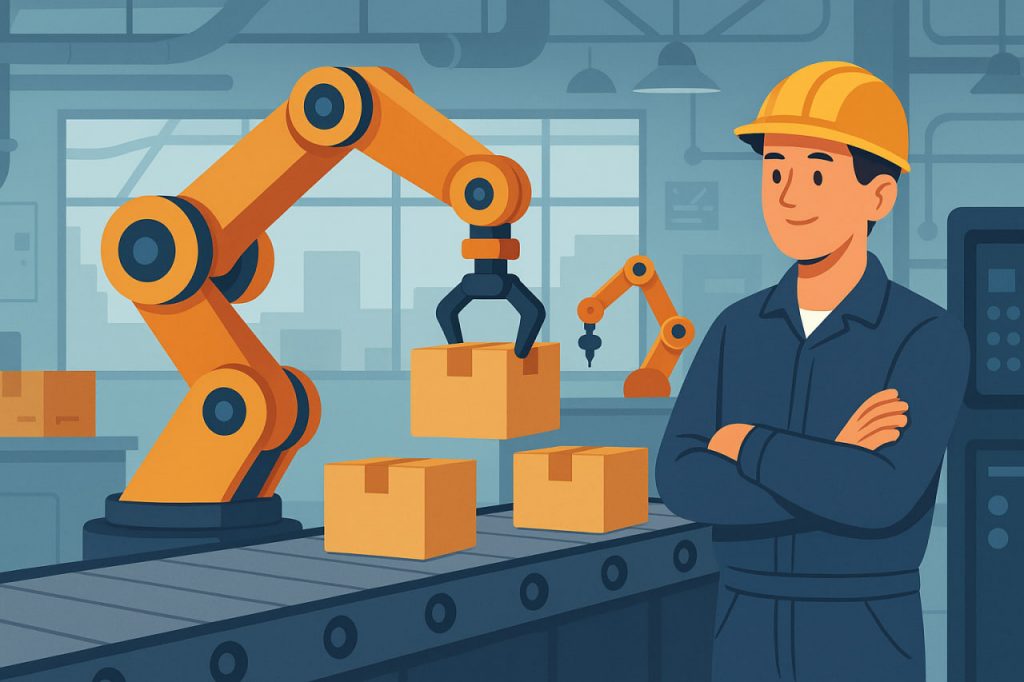
Robots are becoming an increasingly important part of modern industry, transforming everything from manufacturing and logistics to medicine and agriculture. Their speed, precision, and ability to work without fatigue make them valuable tools for improving efficiency and reducing human error. But as automation advances, an important question emerges: Will robots eventually replace humans in industrial work? The answer is complex. While robots are excellent at performing repetitive, dangerous, and highly technical tasks, they cannot replace the creativity, judgment, and adaptability that humans bring to the workplace. Understanding the balance between automation and human labor helps predict how industries will evolve and what skills will be most essential for the future.
Automation is not new — machines have replaced certain types of manual labor for centuries. However, today’s robots are more capable than ever due to AI integration, advanced sensors, and improvements in mechanical design. Industries use robots to assemble products, transport goods, inspect materials, and even work alongside humans. These developments raise both opportunities and concerns for workers and employers.
Where Robots Excel
Robots are particularly effective in environments requiring repetitive actions, extreme precision, or high-risk conditions. Their advantages include:
- consistent accuracy
- the ability to work 24/7
- resistance to hazardous environments
- fewer errors and lower waste
- high speed in assembly and packaging operations
In manufacturing, robots handle welding, painting, heavy lifting, and delicate assembly. In logistics, autonomous systems sort, transport, and track packages. According to industrial engineer Dr. Martin Hayes:
“Robots replace tasks, not people —
and the tasks they replace are those humans were never meant to do safely or efficiently.”
This distinction is essential for understanding the future of work.
Jobs Most Likely to Be Automated
Certain tasks are more vulnerable to automation because of their predictable nature. These include:
- repetitive assembly-line operations
- packaging and palletizing
- warehouse sorting and movement
- basic quality control checks
- machine monitoring and routine inspection
Automation typically replaces the task, not the entire job. Human workers remain essential for supervision, troubleshooting, planning, and creative decision-making.
Jobs That Require Humans
Many roles cannot be automated due to the need for critical thinking, adaptability, creativity, or emotional intelligence. These include:
- complex engineering and system design
- leadership and team coordination
- maintenance of robotic equipment
- creative problem-solving roles
- healthcare, education, and communication-based jobs
Robots struggle with ambiguity, human nuance, and unexpected situations — areas where humans excel.
Human–Robot Collaboration (Cobots)
A growing trend in industry is the use of collaborative robots, or cobots. Unlike fully autonomous machines, cobots work side by side with human employees, assisting rather than replacing them. Cobots can take over repetitive or physically demanding tasks while humans focus on higher-level problem-solving, safety monitoring, and quality control. This collaborative approach improves workplace safety, reduces fatigue, and increases job satisfaction.
Economic and Social Considerations
The biggest concern surrounding automation is job displacement. While robots may reduce the need for certain manual roles, they also create new opportunities in:
- programming and maintenance
- system optimization
- robotics engineering
- data analysis
- operational management
Workers benefit from retraining and acquiring skills that allow them to supervise or collaborate with robotic systems. Economies that invest in education and technological adaptation tend to experience higher productivity and better job growth.
The Future of Robots in Industry
Robots will continue to expand their role in industrial work, especially as AI becomes more advanced. However, a complete replacement of human workers is unlikely. Instead, industries will move toward hybrid environments, where humans and robots complement each other’s strengths. The most successful companies will be those that embrace automation while investing in their workforce, ensuring that technological progress benefits society rather than displacing it.
Interesting Facts
- The first industrial robot, Unimate, began working in a factory in 1961.
- Collaborative robots can be trained by simply moving their arms, without programming.
- Robots now handle over 50% of manufacturing tasks in some industries.
- The global robotics market is expected to surpass $200 billion within the next decade.
- Studies show that automation often creates new jobs in engineering, safety, and technology.
Glossary
- Automation — the use of machines and software to perform tasks with minimal human input.
- Cobots — collaborative robots designed to work safely with humans.
- Industrial Robotics — machines programmed to perform manufacturing or logistical tasks.
- Task Displacement — when automation replaces specific human tasks but not entire jobs.
- AI Integration — the use of artificial intelligence to enhance robotic decision-making.