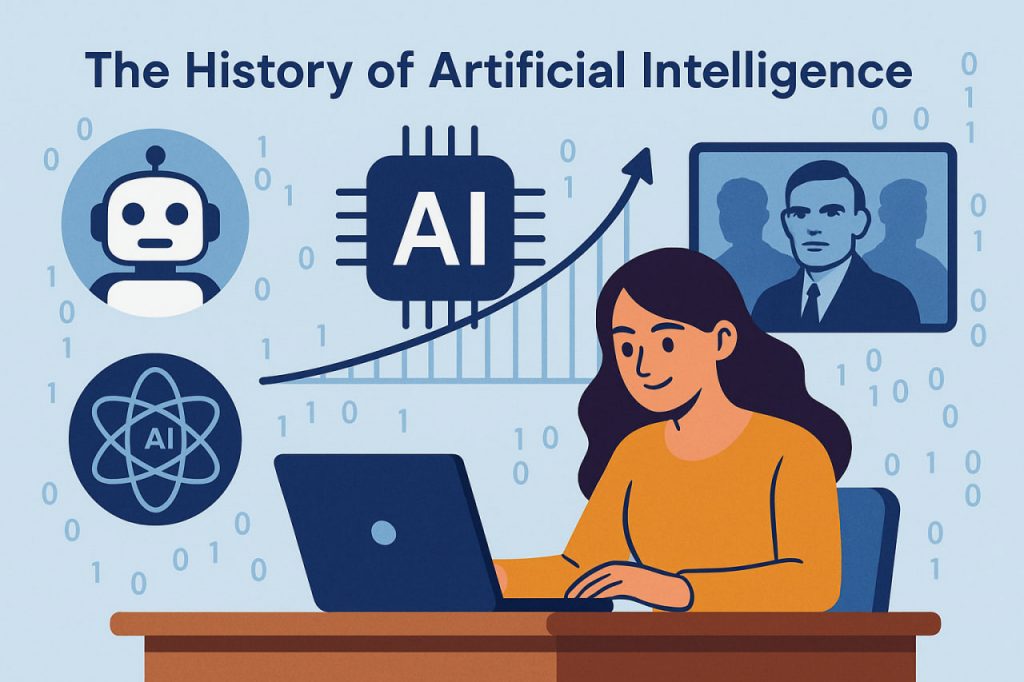
Artificial intelligence (AI) has evolved from a philosophical dream into one of the most transformative technologies of the 21st century. Though AI may feel like a modern invention, its conceptual roots stretch back thousands of years. Ancient myths described mechanical beings with human-like abilities, while mathematicians and philosophers explored the nature of logic, reasoning, and computation long before the first computer existed. Today, AI powers search engines, digital assistants, medical diagnostics, autonomous vehicles, and vast scientific discoveries. Tracing the history of AI reveals how human curiosity, imagination, and engineering have steadily shaped intelligent machines.
The development of AI has been marked by cycles of enthusiasm, disappointment, and breakthrough innovation. Early successes fueled optimism, but technological limitations often slowed progress. Only in recent decades have advances in computing power, data availability, and neural networks allowed AI to flourish in practical applications across industries and daily life.
Ancient and Early Foundations
The idea of artificial intelligence predates modern science. In Greek mythology, Hephaestus created mechanical servants, while ancient automata — such as programmable water clocks — demonstrated early attempts to imitate life. Philosophers like Aristotle explored formal logic, laying conceptual groundwork that later became essential for computational reasoning. These early ideas did not create true AI, but they shaped humanity’s desire to build thinking machines.
The Birth of Computer Science and Early AI Concepts
In the 19th century, mathematician Ada Lovelace suggested that machines could manipulate symbols and process information beyond pure calculation — a visionary idea that foreshadowed AI. Later, Alan Turing developed the concept of a universal machine and proposed the famous Turing Test, arguing that a machine could be considered intelligent if it could convincingly imitate human responses.
The invention of programmable computers in the 1940s and 1950s provided the first practical platform for AI research. According to historian of computing Dr. Caroline Hughes:
“The moment machines could store and modify instructions,
the idea of artificial intelligence shifted from philosophy to engineering.”
This marked the beginning of true AI science.
The Dartmouth Conference and the Official Birth of AI
In 1956, the Dartmouth Workshop brought together pioneers including John McCarthy, Marvin Minsky, Herbert Simon, and Allen Newell. They coined the term Artificial Intelligence and predicted rapid progress. Early achievements followed:
- programs that solved algebra problems
- basic language translation attempts
- simple game-playing machines
These successes fueled optimism, suggesting that human-level AI might be achieved quickly.
AI Winters: When Progress Slowed
The initial enthusiasm was followed by periods known as AI winters, when funding and interest declined. Reasons included:
- limited computing power
- overly optimistic predictions
- disappointing real-world performance
- difficulty scaling early algorithms
Despite setbacks, researchers continued to refine neural networks, symbolic logic, and machine learning models that later became essential.
Machine Learning and the Rise of Data-Driven AI
By the 1990s and 2000s, machine learning shifted AI from rule-based systems to models that learned patterns from data. Key breakthroughs included:
- support vector machines
- probabilistic models
- neural network revival
- large-scale data collection
Computers began outperforming humans in narrow tasks, such as handwriting recognition and optimization problems.
Deep Learning and the Modern AI Revolution
The 2010s marked a dramatic transformation in AI capabilities. Deep neural networks, fueled by powerful GPUs and massive datasets, achieved unprecedented success in:
- image and speech recognition
- natural language processing
- translation
- robotics
- scientific simulations
Milestones included:
- AlphaGo defeating world champions
- self-driving vehicle prototypes
- large language models capable of generating human-like text
- medical AI systems identifying diseases with expert-level accuracy
Modern AI now integrates multimodal data, reasoning abilities, and large-scale neural architectures.
The Future of AI
AI continues to evolve rapidly. Future developments may include:
- more reliable autonomous systems
- personalized medicine
- advanced robotics
- scientific discovery acceleration
- ethical and transparent AI decision-making
- hybrid human–AI collaboration
The challenge now is not only technological but ethical: ensuring AI is used responsibly and benefits society.
Interesting Facts
- The term “artificial intelligence” was coined in 1956 at the Dartmouth Conference.
- Early AI programs could solve math problems long before computers could display images.
- Neural networks were inspired by biological neurons, but work very differently in practice.
- AI has experienced multiple winters, yet each revival brought major breakthroughs.
- Today’s AI models train on datasets containing billions of examples, unimaginable in the 20th century.
Glossary
- Machine Learning — algorithms that learn patterns from data instead of following fixed rules.
- Neural Network — a computational model inspired by brain structure, used for pattern recognition.
- Turing Test — a benchmark for evaluating machine intelligence through conversation.
- Deep Learning — advanced machine learning using multi-layer neural networks.
- AI Winter — periods when AI progress slowed due to limited funding and technological challenges.