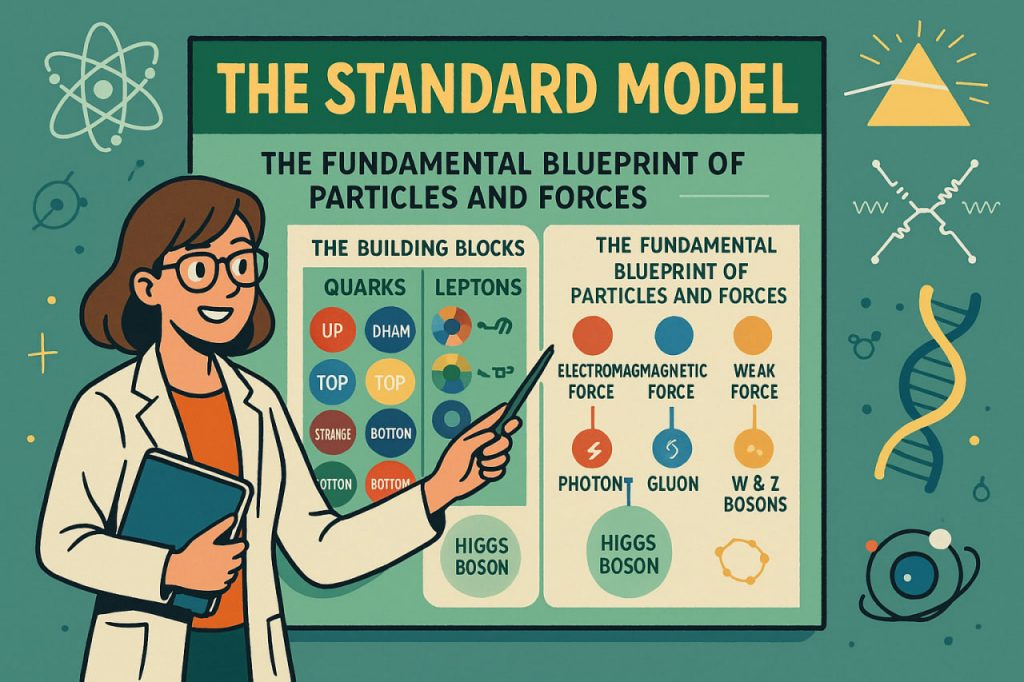
The Standard Model of particle physics is the most successful scientific theory describing the basic building blocks of the universe. It explains how all known fundamental particles interact through three of the four fundamental forces: the electromagnetic, weak, and strong forces. Although gravity is not included in the Standard Model, this framework has accurately predicted particle behavior for decades and remains the foundation of modern physics. It helps scientists understand everything from the structure of atoms to the fusion powering the Sun.
The Standard Model is essentially a map of nature’s smallest components. It includes matter particles, force carriers, and the famous Higgs boson — the particle responsible for giving mass to others. Despite its success, physicists know it is incomplete. Dark matter, dark energy, gravity, and the early universe still require deeper explanations, indicating that a more general theory must one day extend beyond the Standard Model.
The Building Blocks of the Standard Model
The Standard Model includes 17 known particles, divided into three major groups:
1. Fermions (matter particles)
These particles make up all visible matter and are divided into:
- Quarks: up, down, charm, strange, top, bottom
- Leptons: electron, muon, tau + their neutrinos
Quarks combine to form protons and neutrons, while leptons include the electron and neutrinos.
2. Bosons (force carriers)
These particles transmit forces:
- Photon — electromagnetic force
- Gluon — strong nuclear force
- W and Z bosons — weak nuclear force
Each force works differently at the quantum level.
3. The Higgs Boson
Discovered in 2012, the Higgs boson interacts with particles to give them mass.
This discovery confirmed the last missing piece of the Standard Model.
According to CERN physicist Dr. Amelia Rhodes:
“The Standard Model is the periodic table of the quantum world —
it organizes nature’s ingredients with remarkable precision.”
The Three Forces Explained
Electromagnetic Force
Acts between charged particles.
Responsible for electricity, magnetism, light, chemistry, and atomic structure.
Strong Nuclear Force
Holds quarks together to form protons and neutrons.
Also binds these particles inside atomic nuclei.
Weak Nuclear Force
Responsible for radioactive decay and processes inside the Sun.
Allows particles to change type (flavor).
What the Standard Model Does Well
The theory successfully explains:
- atomic structure
- nuclear fusion in stars
- particle collisions in accelerators
- radioactive decay
- electromagnetic waves
- fundamental particle interactions
Every experiment so far matches the predictions with extraordinary accuracy.
What the Standard Model Cannot Explain
Despite its success, it leaves major questions unanswered:
- gravity — no quantum theory of gravity included
- dark matter — invisible mass making up 27% of the universe
- dark energy — force driving cosmic expansion
- neutrino masses — not originally predicted
- matter–antimatter asymmetry — why the universe contains more matter
- unification — forces not fully unified under one theory
Scientists continue exploring theories like supersymmetry, string theory, and quantum gravity to fill these gaps.
Why the Standard Model Is Important
It provides the foundation for:
- particle accelerators
- nuclear medicine
- semiconductor technology
- astrophysics
- cosmology
- theoretical physics
It shapes our understanding of the universe at its most fundamental level.
Interesting Facts
- The Standard Model correctly predicted the Higgs boson 48 years before it was discovered.
- Quarks are never found alone — they always exist in groups due to the strong force.
- Particles in the Standard Model come in three generations, each heavier than the last.
- The photon is massless, while the W and Z bosons are extremely heavy.
- Only 5% of the universe is made of Standard Model matter; the rest remains unknown.
Glossary
- Quark — a fundamental particle that forms protons and neutrons.
- Lepton — a family of particles including electrons and neutrinos.
- Boson — a force-carrying particle in quantum physics.
- Higgs Field — a field giving particles mass through interaction.
- Dark Matter — an invisible form of matter not explained by the Standard Model.