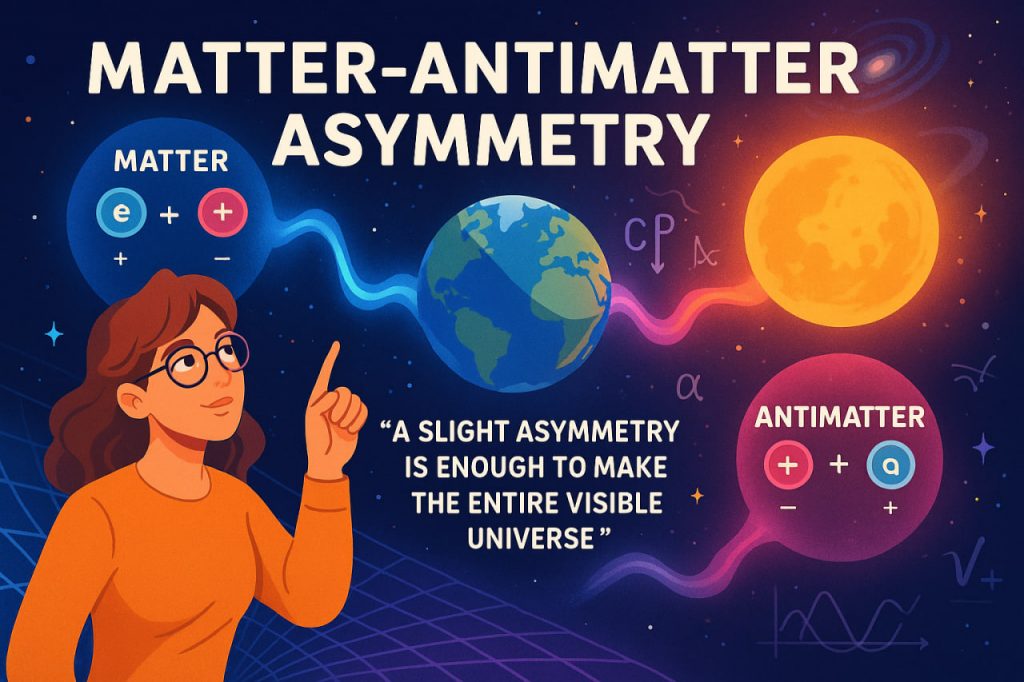
The matter–antimatter asymmetry is one of the deepest and most fascinating mysteries in modern physics. According to the known laws of particle physics, the Big Bang should have produced equal amounts of matter and antimatter. But if that had happened, matter and antimatter would have instantly annihilated each other, leaving behind nothing but light. Instead, our universe contains galaxies, planets, humans — all made of matter. Antimatter, by contrast, is almost completely absent. This imbalance, known as baryon asymmetry, remains one of the most important unsolved problems in cosmology and particle physics.
Understanding why matter survived requires exploring the early universe, the properties of particles, and subtle violations of symmetry in fundamental forces. Solving this mystery would not only explain our existence but also reveal new physics beyond the Standard Model.
The fact that “something” exists rather than “nothing” indicates that some tiny asymmetry in nature favored matter over antimatter in the first fractions of a second after the Big Bang.
What Are Matter and Antimatter?
Every particle of matter has a corresponding antiparticle:
- electron → positron
- proton → antiproton
- neutron → antineutron
- quarks → antiquarks
Antiparticles have the same mass but opposite charge. When matter and antimatter meet, they annihilate in a burst of energy.
Antimatter is real — it is produced in particle accelerators and cosmic rays — but it is extremely rare in the natural universe.
Why the Symmetry Should Have Been Perfect
According to the Standard Model, physical laws treat matter and antimatter almost identically. When the universe formed:
- particle–antiparticle pairs popped into existence
- they collided and annihilated
- energy converted back into pairs
This process should have produced nothing but radiation. Yet something tipped the balance.
As physicist Dr. Rafael Monteiro explains:
“A slight asymmetry — about one extra matter particle for every billion —
is enough to make the entire visible universe.”
This means the imbalance was extremely tiny, but enormously important.
CP Violation: Imperfect Symmetry
One of the few known sources of matter–antimatter imbalance is CP violation:
- C (charge conjugation): swapping particles with antiparticles
- P (parity): flipping spatial coordinates, like a mirror image
If CP symmetry were perfect, matter and antimatter would behave identically.
However, experiments show small but real violations of this symmetry.
These violations have been observed in:
- kaons
- B-mesons
- D-mesons
But the amount of CP violation in the Standard Model is far too small to explain the universe’s imbalance.
Theories That Attempt to Explain the Asymmetry
Scientists propose several mechanisms:
1. Baryogenesis
A family of theories describing processes that created excess matter in the early universe. These require:
- CP violation
- interactions that change matter/antimatter number
- conditions far from equilibrium
No single model is confirmed yet.
2. Leptogenesis
A promising theory where asymmetry begins in neutrinos, which then create a matter imbalance via particle interactions.
This is supported by the discovery that neutrinos have mass.
3. Physics Beyond the Standard Model
New particles or interactions may exist, such as:
- supersymmetry
- new Higgs-like fields
- right-handed neutrinos
- grand unified theories
The absence of antimatter galaxies strongly suggests something non-standard occurred.
What Modern Experiments Are Investigating
Large international experiments are searching for clues:
- CERN’s LHCb experiment studies CP violation in heavy quarks
- Super-Kamiokande and DUNE analyze neutrino oscillations
- ALPHA experiment at CERN compares matter and antimatter properties
- Belle II in Japan studies rare particle decays
These experiments aim to detect even tiny differences between matter and antimatter.
Why the Asymmetry Matters
Without matter–antimatter asymmetry:
- no stars
- no galaxies
- no planets
- no chemistry
- no life
The entire visible universe is the result of a microscopic imbalance in the early cosmos — a tiny “mistake” that allowed everything to exist.
Interesting Facts
- Only one matter particle in a billion survived annihilation after the Big Bang — and that became all visible matter.
- Antimatter can be created in hospitals for medical imaging (PET scans).
- Earth is constantly hit by natural antimatter from cosmic rays.
- The universe has no detectable antimatter galaxies, suggesting the asymmetry is universal.
- Experiments have trapped antimatter for over 1,000 seconds without it touching matter.
Glossary
- Antimatter — particles with the same mass as matter but opposite charge.
- CP Violation — a phenomenon where matter and antimatter behave differently.
- Baryogenesis — theoretical processes that created more matter than antimatter.
- Leptogenesis — theory linking neutrino physics to matter dominance.
- Annihilation — the process where matter and antimatter destroy each other, releasing energy.