Quantum Key Distribution (QKD) is one of the most groundbreaking technologies in quantum communication, offering an entirely new level of security based on the principles of quantum physics. Unlike traditional cryptographic systems—which rely on mathematical complexity—QKD uses the behavior of quantum particles to create encryption keys that cannot be intercepted or copied without detection. This makes QKD an essential tool for protecting sensitive information in finance, government, medicine, and global communications. As cyber threats grow and classical systems face the future challenge of quantum computers, QKD stands out as a powerful and future-proof solution for secure digital exchange.
How QKD Works: The Role of Quantum Particles
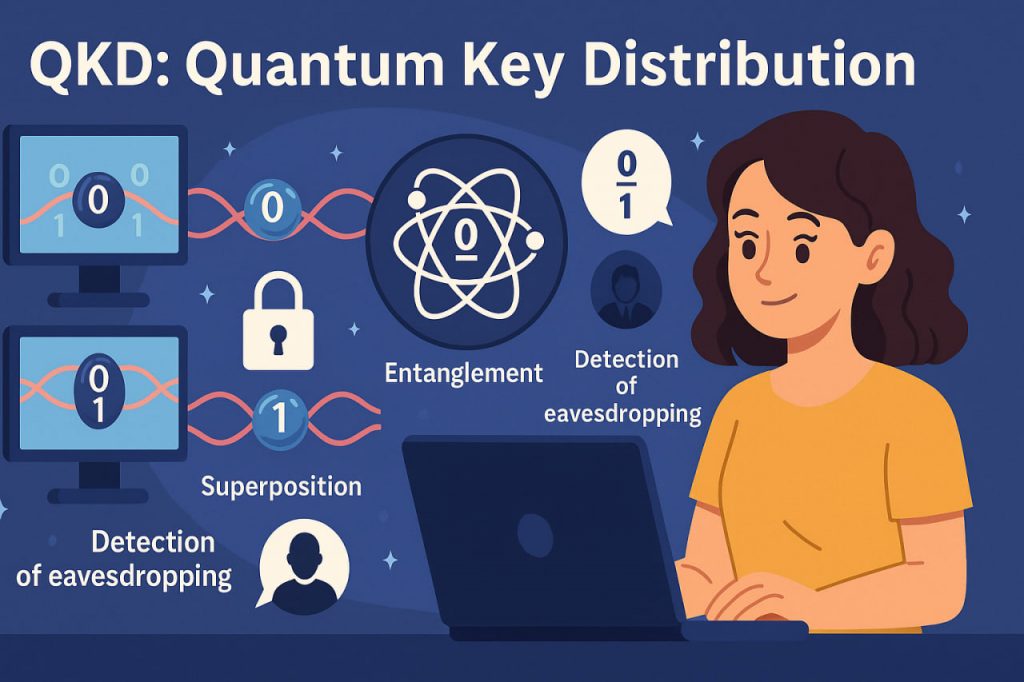
QKD uses individual quantum particles—typically photons—to transmit encryption keys between two parties. These photons are encoded with quantum states that represent the bits of a cryptographic key. What makes QKD unique is that any attempt to observe or intercept these photons changes their state, revealing the presence of an eavesdropper. This principle, known as the quantum no-cloning theorem, ensures that the key remains secure. Quantum communication specialist Dr. Adrian Moss explains:
“QKD doesn’t prevent eavesdropping attempts —
it makes them immediately visible, ensuring the integrity of the communication channel.”
This built-in detection mechanism distinguishes QKD from classical encryption systems.
Types of QKD Protocols
Several QKD protocols exist, each using slightly different quantum principles. The most famous, BB84, uses polarized photons to encode key information. E91 relies on quantum entanglement, linking particles so closely that measuring one affects the other instantly. Decoy-state QKD improves security by detecting certain types of attacks on photon sources. These protocols all share a common goal: generate secure cryptographic keys with guaranteed detection of interception.
Why QKD Is Important for Cybersecurity
As computing power increases and quantum computers continue to advance, traditional encryption algorithms may eventually become vulnerable. QKD provides a long-term solution, as its security does not depend on computational difficulty but on physical laws. This makes QKD especially valuable for protecting long-term sensitive data, including health records, classified government information, and financial transactions. Once a secure key is shared through QKD, it can be used to encrypt messages with classical methods such as one-time pads.
Infrastructure and Real-World Implementation
Implementing QKD requires specialized hardware, such as single-photon emitters, detectors, and quantum-compatible optical fibers. Some systems use free-space communication, allowing QKD between satellites and ground stations. Several countries have already demonstrated large-scale QKD networks, including China’s Beijing–Shanghai quantum backbone and Europe’s Quantum Flagship initiatives. These real-world deployments show that QKD is moving from theory to practical application.
Challenges and Future Development
Although promising, QKD faces challenges such as limited transmission range, high equipment costs, and sensitivity to environmental disturbances. Researchers are developing quantum repeaters, advanced photon sources, and satellite-based systems to extend the reach of quantum communication. As the technology matures, QKD is expected to become more affordable and widely integrated into global communication networks. According to quantum engineer Dr. Livia Chen:
“QKD is not just a future technology —
it is already reshaping how nations and industries think about digital security.”
Its long-term impact will likely be profound.
Interesting Facts
- The first QKD protocol, BB84, was proposed in 1984 and is still widely used today.
- QKD can detect eavesdropping instantly because measuring a quantum particle always disturbs its state.
- China’s quantum satellite Micius achieved QKD over thousands of kilometers.
- Quantum keys can be combined with classical encryption methods to reach near-perfect security.
- QKD networks are already being tested for banking, elections, and medical data protection.
Glossary
- QKD (Quantum Key Distribution) — secure key exchange using quantum physics.
- BB84 Protocol — the first and most widely used quantum key distribution method.
- Quantum Entanglement — a link between particles where changing one affects the other instantly.
- Photon — a particle of light used to transmit quantum information.
- Quantum No-Cloning Theorem — a principle stating that quantum states cannot be copied without alteration.