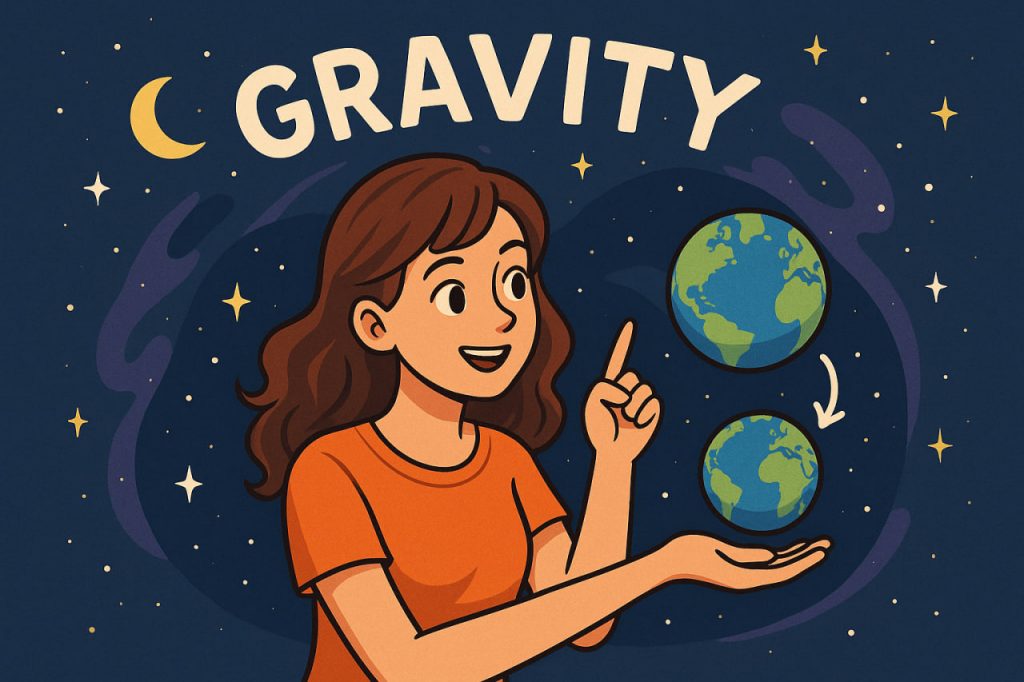
Gravity is one of the four fundamental forces of nature, yet it is the one most deeply woven into everyday experience and the structure of the Universe itself. From keeping our feet on the ground to governing the motion of galaxies, gravity acts across vast distances and immense scales. Unlike other forces, gravity affects all objects with mass or energy, making it truly universal. For centuries, scientists have sought to understand its nature, from classical descriptions to modern theories that connect gravity with space and time. Although gravity appears weak compared to other forces, its cumulative effects dominate the architecture of the cosmos. Understanding gravity is essential for explaining how the Universe formed, how it evolves, and how it may ultimately end.
Gravity in Classical Physics
The first comprehensive explanation of gravity was provided by Isaac Newton in the 17th century. Newton described gravity as an attractive force acting between any two masses, proportional to their masses and inversely proportional to the square of the distance between them. This framework successfully explained the motion of planets, moons, and falling objects on Earth. For everyday phenomena, Newtonian gravity remains extremely accurate and useful. According to physicist Dr. Leonard Brooks:
“Newton’s law of gravity revealed that the same force pulling an apple downward
also governs the motion of the planets.”
This insight unified celestial and terrestrial physics for the first time in human history.
Einstein’s View: Gravity as Curved Space-Time
In the 20th century, Albert Einstein transformed our understanding of gravity with his theory of general relativity. Instead of viewing gravity as a force, Einstein described it as the curvature of space-time caused by mass and energy. Massive objects like stars and planets bend space-time, and other objects move along these curves. This theory accurately predicts phenomena that Newton’s model cannot, such as gravitational lensing, time dilation near massive objects, and the behavior of black holes. General relativity has been confirmed repeatedly through observations and experiments, making it one of the most successful theories in physics.
Gravity on Cosmic Scales
Gravity is the primary force shaping the large-scale structure of the Universe. It causes gas and dust to collapse into stars, stars to form galaxies, and galaxies to cluster into vast cosmic networks. Without gravity, the Universe would be a nearly uniform cloud of particles with no structure. Gravity also governs the life cycles of stars, from their birth in nebulae to their death as white dwarfs, neutron stars, or black holes. On the largest scales, gravity influences the expansion of the Universe itself, interacting with dark energy in complex ways that scientists are still working to understand.
Gravity, Motion, and Everyday Life
On Earth, gravity determines how objects fall, how oceans form tides, and how the atmosphere is held close to the planet. It shapes mountain ranges through tectonic processes and influences weather by driving convection and pressure differences. Even biological systems have evolved under constant gravitational influence, affecting bone structure, circulation, and movement. Experiments conducted in microgravity environments, such as aboard space stations, show how deeply life is adapted to Earth’s gravitational pull. Gravity is so familiar that it often goes unnoticed, yet it underlies nearly every physical process we experience.
Unanswered Questions About Gravity
Despite its central role, gravity remains the least understood fundamental force. Scientists have yet to fully reconcile general relativity with quantum mechanics, the theory governing the microscopic world. Efforts to develop a theory of quantum gravity aim to explain gravity at the smallest scales and extreme conditions, such as inside black holes or during the early moments of the Universe. Discoveries like gravitational waves have opened new ways to study gravity directly, offering insights into cosmic events billions of light-years away. Gravity continues to challenge and inspire physicists, reminding us that even the most familiar forces can hide profound mysteries.
Interesting Facts
- Gravity travels at the speed of light, according to general relativity.
- Black holes have such strong gravity that not even light can escape.
- The Moon causes ocean tides through gravitational interaction with Earth.
- Astronauts experience weightlessness due to continuous free fall, not the absence of gravity.
- Gravitational waves were first detected in 2015, confirming a key prediction of Einstein’s theory.
Glossary
- Gravity — a fundamental interaction that attracts objects with mass or energy.
- General Relativity — Einstein’s theory describing gravity as the curvature of space-time.
- Space-Time — the combined framework of space and time affected by mass and energy.
- Gravitational Waves — ripples in space-time caused by accelerating massive objects.
- Quantum Gravity — a theoretical framework aiming to unify gravity with quantum mechanics.