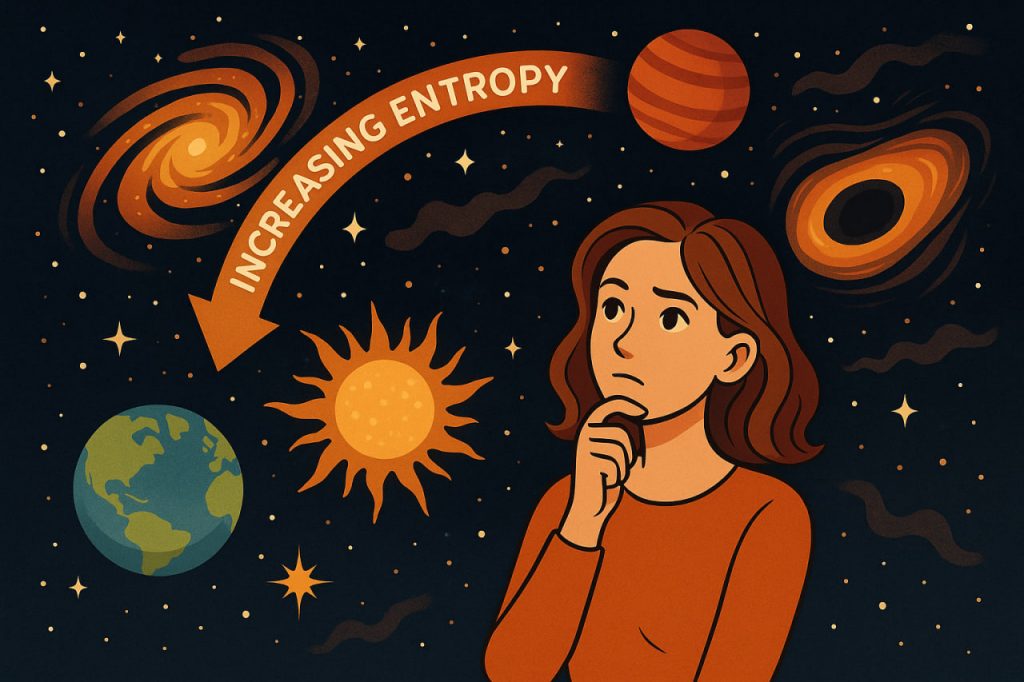
The second law of thermodynamics is one of the most fundamental principles in physics, shaping how energy flows and how the Universe evolves over time. At its core, this law describes the natural tendency of systems to move toward disorder, a concept measured by entropy. From melting ice to the life cycle of stars, the second law governs processes on every scale, from microscopic particles to the entire cosmos. It explains why time appears to move in one direction and why certain events cannot be reversed. Understanding this law is essential for grasping how the Universe began, how it functions today, and how it may ultimately end. Far from being an abstract rule, the second law is deeply woven into the structure of reality itself.
What the Second Law of Thermodynamics States
The second law of thermodynamics states that in an isolated system, total entropy can never decrease; it can only increase or remain constant. Entropy is often described as a measure of disorder, but more precisely, it represents the number of possible microscopic arrangements of a system. When energy spreads out and becomes less concentrated, entropy rises. This is why heat flows naturally from hot objects to cold ones and not the other way around. According to physicist Dr. Andrew Collins:
“The second law is not about chaos alone.
It is about probability and the overwhelming tendency of systems to evolve toward the most likely states.”
This principle applies universally, regardless of scale or complexity.
Entropy and the Arrow of Time
One of the most profound implications of the second law is its connection to the arrow of time. While the fundamental laws of physics often work the same forward and backward in time, entropy does not. Processes with increasing entropy define a clear direction—from past to future. A broken cup does not spontaneously reassemble because that would require a decrease in entropy, which is statistically improbable. On a cosmic level, this explains why the Universe evolves from simpler, more ordered initial conditions toward increasingly complex and dispersed states. The second law, therefore, provides a physical explanation for why we remember the past but not the future.
The Second Law in a Cosmic Context
The Universe itself can be viewed as a vast thermodynamic system. After the Big Bang, the Universe began in an extremely low-entropy state, despite its immense energy. As space expanded and structures formed, entropy increased through processes such as star formation, nuclear fusion, and radiation emission. Black holes, in particular, play a crucial role in cosmic entropy, as they contain enormous amounts of entropy compared to ordinary matter. Physicist Dr. Elena Novak notes:
“When we include gravity and black holes,
the second law becomes a guide to understanding the Universe’s long-term evolution.”
This perspective links thermodynamics directly to cosmology.
Entropy, Life, and Local Order
At first glance, life appears to contradict the second law by creating order from disorder. However, living systems are not isolated; they maintain internal order by increasing entropy in their surroundings. Organisms consume energy, release heat, and produce waste, contributing to a net increase in entropy overall. Stars provide the energy gradients that make life possible, while planets act as open systems exchanging energy with space. In this way, life exists not in defiance of the second law, but because of it. The flow of energy through the Universe enables pockets of complexity to emerge temporarily.
The Ultimate Fate of the Universe
The second law also shapes theories about the future of the Universe. As entropy continues to increase, energy becomes more evenly distributed, reducing the ability to perform useful work. This leads to the concept of heat death, a state in which the Universe reaches maximum entropy and no significant processes remain. Stars burn out, matter decays, and temperature differences disappear. While this scenario lies trillions of years in the future, it represents a logical consequence of the second law applied on a cosmic scale. Scientists continue to explore alternative models, but entropy remains central to all predictions.
Interesting Facts
- Entropy was originally introduced to describe steam engines, not the Universe.
- Black holes have more entropy than any other known objects of the same size.
- The early Universe was extremely hot yet remarkably low in entropy.
- The second law explains why perpetual motion machines are impossible.
- Time’s direction in everyday experience is closely linked to entropy increase.
Glossary
- Second Law of Thermodynamics — a principle stating that total entropy in an isolated system never decreases.
- Entropy — a measure of energy dispersion and the number of possible microscopic states.
- Arrow of Time — the one-way direction of time defined by increasing entropy.
- Isolated System — a system that does not exchange energy or matter with its surroundings.
- Heat Death — a hypothetical future state of the Universe at maximum entropy.