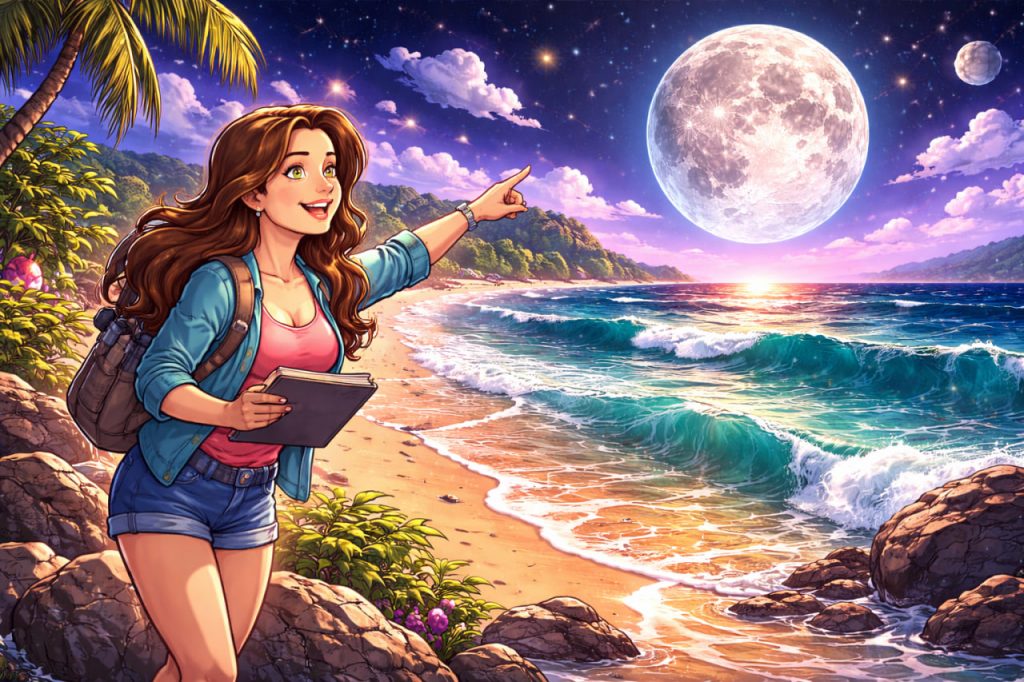
Tides and ebbs are one of the most visible and rhythmic natural phenomena on Earth, shaping coastlines and influencing life in the oceans. Every day, sea levels rise and fall in a predictable pattern, affecting navigation, marine ecosystems, and human activity near coasts. While tides may seem simple at first glance, they are the result of complex gravitational interactions between Earth, the Moon, and the Sun. Understanding tides helps scientists better predict ocean behavior and reveals how celestial mechanics directly affect daily life on our planet. These regular movements of water connect Earth’s oceans to the dynamics of the wider Solar System.
The Gravitational Role of the Moon
The primary driver of tides is the Moon’s gravitational pull on Earth. Although the Sun is much more massive, the Moon is far closer, making its gravitational influence on Earth’s oceans stronger. As the Moon pulls on Earth, it creates a bulge of water on the side facing the Moon, known as a high tide. At the same time, a second high tide forms on the opposite side due to Earth’s rotation and inertia. Oceanographer Dr. Helen Wright explains:
“The Moon’s gravity stretches Earth’s oceans,
creating rhythmic rises and falls that repeat day after day.”
This interaction produces two high tides and two low tides in most coastal regions each lunar day.
The Sun’s Influence and Tidal Variations
While the Moon dominates tidal forces, the Sun also plays an important role. When the Sun, Moon, and Earth align during full and new moons, their gravitational forces combine to produce spring tides, which are higher high tides and lower low tides. Conversely, when the Sun and Moon are at right angles relative to Earth, neap tides occur, resulting in smaller tidal differences. These variations demonstrate how multiple celestial bodies work together to shape ocean behavior. The combined gravitational effects add subtle complexity to otherwise regular tidal cycles.
How Tides Affect Marine Life and Ecosystems
Tides have a profound impact on coastal and marine ecosystems. Many organisms living in intertidal zones depend on tides to bring nutrients, oxygen, and food. Tidal movements shape habitats such as tidal flats, mangroves, and coral reefs. Some species time their feeding, reproduction, or migration cycles with tidal rhythms. Changes in tidal patterns can significantly influence biodiversity and ecosystem health, making tides a key factor in marine biology.
Tides and Human Activity
For humans, tides have influenced navigation, fishing, and coastal settlement for thousands of years. Ancient civilizations observed tidal cycles to plan travel and trade, while modern ports rely on precise tidal predictions for safe shipping. Tidal energy is also explored as a renewable power source, using the predictable movement of water to generate electricity. Understanding tides is essential for coastal engineering, flood prevention, and environmental management. These practical applications highlight how closely human societies remain connected to natural rhythms.
Tides as a Planetary Phenomenon
Tides are not unique to Earth. Similar gravitational interactions occur on other planetary bodies, such as moons orbiting giant planets. On Earth, tidal forces have even slowed the planet’s rotation over billions of years, gradually lengthening the day. This shows that tides are not only daily events but also long-term drivers of planetary evolution. Studying tides deepens scientific understanding of how gravity shapes worlds across the universe.
Interesting Facts
- Most coastal areas experience two high tides and two low tides each day.
- Tides helped slow Earth’s rotation, making days longer over geological time.
- Spring tides are not related to the season of spring.
- Some marine animals synchronize spawning with tidal cycles.
- Tidal forces operate on planets, moons, and even stars.
Glossary
- Tide — the regular rise and fall of sea levels caused by gravitational forces.
- Spring Tide — tides with the greatest difference between high and low water levels.
- Neap Tide — tides with the smallest difference between high and low water levels.
- Intertidal Zone — the coastal area exposed at low tide and submerged at high tide.
- Gravitational Pull — the force by which objects attract one another.