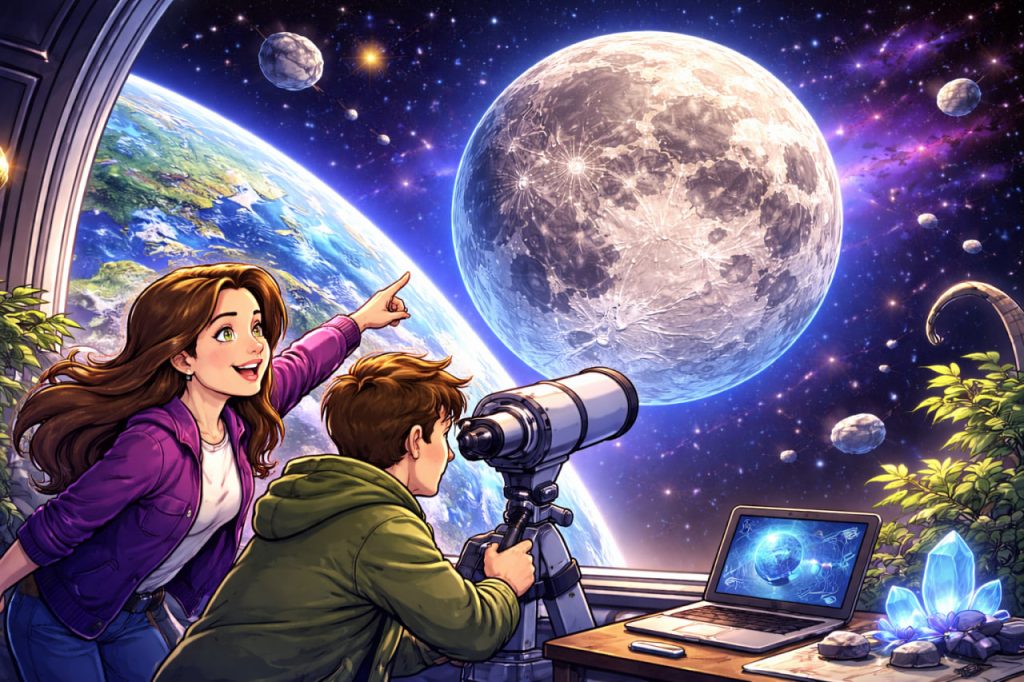
The Moon has captivated humanity since the earliest days of civilization, serving as a constant presence in the night sky and a powerful symbol in culture, science, and imagination. As Earth’s only natural satellite, it influences natural processes, inspires exploration, and offers unique opportunities for scientific discovery. Unlike distant planets, the Moon is close enough to study in great detail, making it a natural laboratory for understanding planetary evolution. Its surface preserves records of cosmic events that Earth has long erased through weather and tectonics. For modern humanity, the Moon is not only an object of curiosity but also a gateway to future space exploration and technological progress.
The Moon’s Influence on Earth
One of the most important reasons the Moon matters to Earth is its gravitational influence. The Moon drives ocean tides, shaping coastal ecosystems and influencing marine life cycles. Over geological timescales, this tidal interaction has also slowed Earth’s rotation and stabilized its axial tilt. This stabilization helps maintain relatively consistent seasons, which has been crucial for the development of life. According to planetary scientist Dr. Laura McIntyre:
“The Moon acts as a cosmic stabilizer,
quietly shaping Earth’s environment in ways we often overlook.”
Without the Moon, Earth’s climate and rotation would likely be far more chaotic.
A Window into the Early Solar System
The Moon’s surface is a historical archive of the early Solar System. Unlike Earth, the Moon lacks an atmosphere and active geology, meaning impact craters and surface features remain preserved for billions of years. By studying lunar rocks and craters, scientists can reconstruct the history of asteroid impacts and planetary formation. Samples brought back by lunar missions revealed details about the Moon’s origin and provided clues about the violent early history of Earth itself. In this way, the Moon serves as a time capsule that helps scientists understand how planets evolve.
Scientific and Technological Opportunities
The Moon offers unique conditions for scientific research that are difficult or impossible to replicate on Earth. Its low gravity allows experiments in physics, materials science, and biology under reduced gravitational stress. Certain regions of the Moon, especially near the poles, contain water ice, which could support future research stations. The far side of the Moon is shielded from Earth’s radio noise, making it an ideal location for sensitive astronomical observations. These characteristics make the Moon a valuable platform for advancing science and technology.
The Moon and Human Exploration
For humanity, the Moon represents the next step in long-term space exploration. Its proximity makes it an ideal testing ground for life-support systems, habitats, and technologies needed for deeper space missions. Many space agencies view the Moon as a staging point for future exploration of Mars and beyond. Living and working on the Moon would help humans learn how to adapt to harsh extraterrestrial environments. The Moon thus plays a central role in shaping humanity’s future beyond Earth.
Cultural, Psychological, and Inspirational Value
Beyond science, the Moon has deep cultural and emotional significance. It has inspired myths, art, calendars, and timekeeping systems across civilizations. Even today, the Moon influences human creativity and provides a shared point of wonder visible from nearly everywhere on Earth. Its presence reminds people of their connection to the universe and fuels curiosity about what lies beyond our planet. This inspirational role continues to motivate exploration and scientific discovery.
Interesting Facts
- The Moon always shows the same side to Earth due to tidal locking.
- Lunar gravity is about one-sixth of Earth’s, enabling higher jumps and slower movement.
- The Moon drifts away from Earth by about 3.8 centimeters per year.
- Water ice has been detected in permanently shadowed lunar craters.
- The Moon plays a key role in stabilizing Earth’s axial tilt.
Glossary
- Tidal Locking — a state in which one side of a celestial body always faces another.
- Axial Tilt — the angle between a planet’s rotational axis and its orbital plane.
- Lunar Regolith — the layer of loose dust and rock covering the Moon’s surface.
- Low Gravity Environment — conditions where gravitational force is weaker than on Earth.
- Time Capsule (Scientific) — preserved physical evidence that records ancient events.