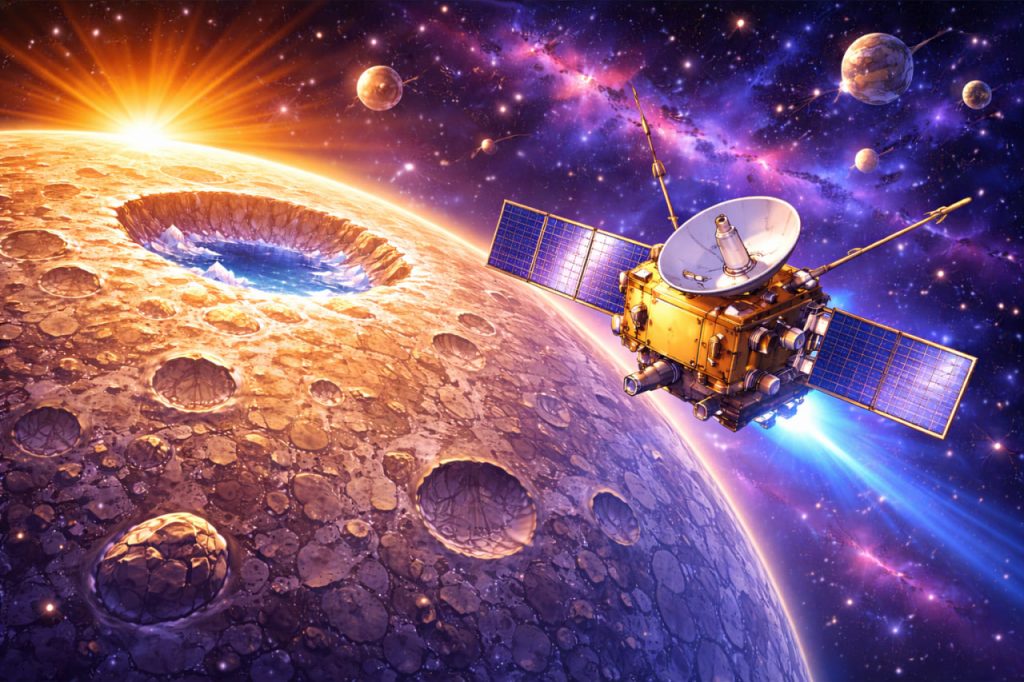
The MESSENGER mission marked a turning point in humanity’s understanding of Mercury, the smallest and innermost planet of the Solar System. For decades, Mercury remained one of the least explored planets due to its proximity to the Sun and the extreme conditions surrounding it. Launched by NASA, MESSENGER provided the first long-term orbital study of Mercury, delivering unprecedented data about its surface, composition, magnetic field, and geological history. The mission revealed that Mercury is far more complex and dynamic than scientists once believed. By studying this harsh environment, researchers gained valuable insights into how rocky planets form and evolve near their parent stars.
Mission Goals and Scientific Objectives
The primary objective of the MESSENGER (MErcury Surface, Space ENvironment, GEochemistry, and Ranging) mission was to understand Mercury’s structure, composition, and environment. Scientists aimed to determine the planet’s surface chemistry, internal structure, and magnetic properties. Another key goal was to investigate Mercury’s thin exosphere and its interaction with solar radiation. Because Mercury experiences extreme temperature variations, the mission also focused on how such conditions shape planetary surfaces over billions of years. According to planetary scientist Dr. Sean Wallace:
“MESSENGER was designed to answer fundamental questions
about how a planet so close to the Sun could survive and evolve.”
These goals shaped the mission’s advanced instrumentation and long-duration orbital strategy.
Journey to Mercury and Orbital Challenges
Reaching Mercury is far more difficult than traveling to distant planets because a spacecraft must shed enormous orbital energy to avoid falling into the Sun. MESSENGER followed a complex trajectory involving multiple gravity assists from Earth, Venus, and Mercury itself. This journey took several years and required precise navigation. Once in orbit, the spacecraft had to endure intense solar radiation and extreme heat. Engineers designed special heat-resistant materials and a large sunshade to protect sensitive instruments, allowing the spacecraft to function reliably in one of the harshest environments ever explored.
Key Discoveries and Breakthroughs
MESSENGER delivered numerous groundbreaking discoveries. It confirmed the presence of water ice in permanently shadowed polar craters, reshaping scientific assumptions about Mercury’s surface. The mission also revealed that Mercury’s crust is rich in volatile elements, challenging traditional models of planetary formation. High-resolution images showed evidence of ancient volcanic activity and widespread tectonic features. Scientists also discovered that Mercury’s magnetic field is offset from the planet’s center, an unusual characteristic among rocky planets. These findings demonstrated that Mercury is geologically and chemically unique.
Mercury’s Magnetic Field and Interior
One of MESSENGER’s most surprising results was detailed mapping of Mercury’s magnetic field. Despite its small size, Mercury generates a global magnetic field, suggesting a partially molten core. Data collected by the mission indicated that Mercury’s core occupies a much larger fraction of the planet’s volume than previously thought. This helped scientists better understand how planetary dynamos function under extreme conditions. The findings also offered new perspectives on the internal evolution of terrestrial planets.
The Mission’s Legacy
MESSENGER completed its mission in 2015 after exhausting its fuel and intentionally impacting Mercury’s surface. Its legacy continues to shape planetary science and inform future missions, including international efforts to further explore Mercury. The data collected remains a cornerstone for understanding how planets form close to stars and how extreme environments influence planetary evolution. MESSENGER proved that even the most hostile worlds can preserve scientific treasures waiting to be uncovered.
Interesting Facts
- MESSENGER was the first spacecraft to orbit Mercury.
- The mission discovered water ice in regions that never receive sunlight.
- Mercury’s core makes up about 85% of the planet’s radius.
- The spacecraft completed over 4,000 orbits around Mercury.
- MESSENGER survived temperatures exceeding 350°C near the Sun.
Glossary
- MESSENGER Mission — NASA’s spacecraft mission dedicated to studying Mercury from orbit.
- Exosphere — an extremely thin atmosphere where particles rarely collide.
- Gravity Assist — a maneuver using a planet’s gravity to change spacecraft speed and direction.
- Planetary Dynamo — the process that generates a planet’s magnetic field.
- Volatile Elements — chemical elements that easily evaporate at relatively low temperatures.