At first glance, Mercury seems like the last place in the Solar System where ice could exist. As the planet closest to the Sun, its surface can heat up to extreme temperatures during the day. For a long time, scientists assumed that any water or ice on Mercury would have evaporated billions of years ago. However, modern space missions have revealed a surprising reality: water ice exists on Mercury, preserved in some of the coldest places in the inner Solar System. This discovery reshaped our understanding of planetary environments and showed how extreme conditions can coexist on a single world. Explaining this paradox requires looking closely at Mercury’s orbit, rotation, and unique surface features.
Extreme Temperatures and Unusual Conditions
Mercury experiences some of the most dramatic temperature differences of any planet. Daytime temperatures near the equator can exceed 400°C, while nighttime temperatures can drop below −170°C. This happens because Mercury has almost no atmosphere to distribute heat across its surface. Without atmospheric insulation, heat from the Sun affects only the sunlit areas, leaving shadowed regions in deep, permanent cold. These extremes create environments where both intense heat and long-lasting cold can exist side by side. It is within this contrast that the conditions for ice preservation emerge.
Permanently Shadowed Craters
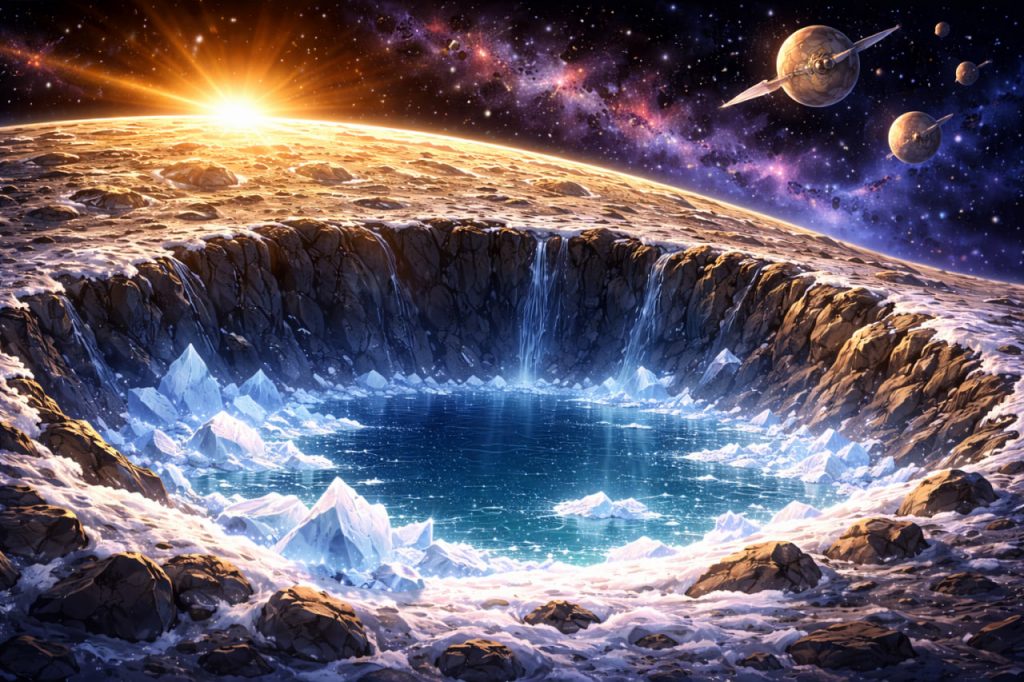
The key to Mercury’s ice lies in its polar regions, where the Sun never rises above the horizon inside certain deep craters. Mercury’s axis has only a very small tilt, meaning sunlight strikes the poles at extremely low angles. As a result, the floors of some craters remain in permanent shadow, never receiving direct sunlight. Temperatures in these shadowed areas can stay low enough to trap and preserve ice for billions of years. Planetary scientist Dr. Laura Bennett explains:
“Mercury’s polar craters act like natural freezers,
shielding ice from the Sun despite the planet’s proximity to it.”
These cold traps are among the coldest known locations in the inner Solar System.
How Did the Ice Get There?
Scientists believe Mercury’s ice likely originated from comet and asteroid impacts that delivered water to the planet’s surface. Over time, water molecules migrated across the surface and became trapped in permanently shadowed craters. Another possible source is water released from Mercury’s interior through ancient volcanic activity. Once trapped in shadow, the ice remained stable due to the extremely low temperatures. Radar observations from Earth and data from space missions confirmed the presence of bright, reflective deposits consistent with water ice mixed with organic material.
Evidence from Space Missions
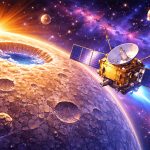
Strong evidence for ice on Mercury came from radar studies and was later confirmed by NASA’s MESSENGER spacecraft. Instruments aboard the spacecraft detected hydrogen-rich regions at the poles, a strong indicator of water ice. In some craters, the ice appears to be covered by a thin layer of darker material, possibly insulating it further from heat. These findings demonstrated that even the harshest planetary environments can preserve volatile substances under the right conditions. The discovery also influenced how scientists search for water on other airless bodies in the Solar System.
Why Mercury’s Ice Matters
The presence of ice on Mercury has broad scientific significance. It shows that water can survive close to a star when geological and orbital conditions allow it. This insight helps researchers better understand water distribution throughout the Solar System and informs future exploration strategies. Mercury’s ice also provides clues about the history of comets, planetary impacts, and the early evolution of inner planets. Studying these frozen deposits deepens our understanding of how common water may be in seemingly hostile environments.
Interesting Facts
- Some craters on Mercury have remained in permanent darkness for billions of years.
- Mercury’s polar ice exists at temperatures colder than Pluto’s surface.
- Radar reflections from Mercury’s poles were first detected from Earth-based telescopes.
- The ice is often buried under a thin layer of dark organic-rich material.
- Mercury completes three rotations for every two orbits around the Sun, creating unique lighting conditions.
Glossary
- Permanent Shadow — areas that never receive direct sunlight due to low solar angles.
- Axial Tilt — the angle between a planet’s rotational axis and its orbital plane.
- Cold Trap — a region cold enough to capture and preserve volatile substances like ice.
- MESSENGER Mission — NASA spacecraft that studied Mercury between 2011 and 2015.
- Volatiles — chemical substances that easily evaporate at low temperatures.