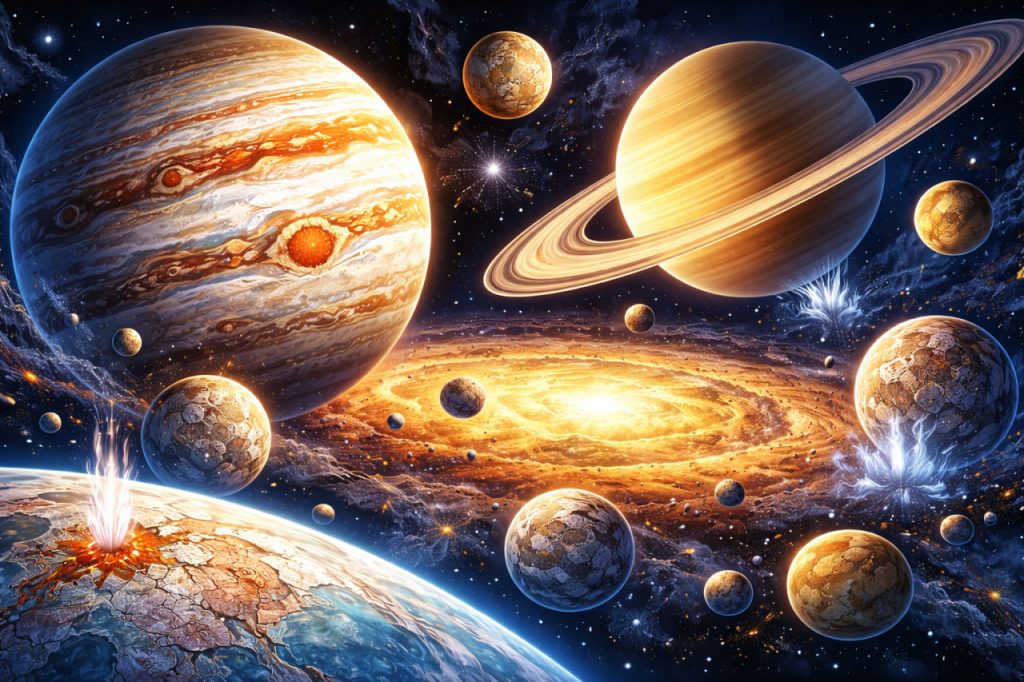
Jupiter and Saturn are not only the largest planets in the Solar System but also the centers of complex miniature planetary systems formed by their numerous moons. These satellites range from icy worlds with subsurface oceans to volcanically active bodies, each preserving clues about the early stages of planetary formation. Scientists believe that the moons of Jupiter and Saturn formed alongside their parent planets, shaped by gravity, gas dynamics, and collisions billions of years ago. Studying these moons allows researchers to reconstruct the conditions that existed in the protoplanetary disk and understand how giant planets influence their surroundings. The diversity of these satellites reveals that moon formation is a dynamic and evolving process rather than a single uniform event.
The Birth of Gas Giants and Their Circumplanetary Disks
Jupiter and Saturn formed early in the Solar System’s history, accumulating massive amounts of gas and dust from the surrounding solar nebula. During this process, each planet was surrounded by a circumplanetary disk, a rotating disk of gas and solid material similar to a miniature version of the protoplanetary disk around the Sun. Within these disks, material gradually clumped together to form moons. Planetary scientist Dr. Caroline Hughes explains:
“The moons of gas giants are born from disks that mirror planet formation itself,
offering a scaled-down laboratory of early Solar System processes.”
The temperature and composition gradients within these disks strongly influenced what types of moons could form at different distances from the planet.
Jupiter’s Moons: From Fire to Ice
Jupiter’s major moons—Io, Europa, Ganymede, and Callisto—illustrate a clear progression in formation conditions. Io, the closest, formed in a hotter region of the disk and became a rocky world shaped by intense tidal heating. Europa and Ganymede formed farther out, where ice could condense, leading to the presence of large amounts of frozen water. Callisto, the outermost of the four, appears to have formed more slowly, preserving an ancient and relatively undifferentiated structure. This gradient reflects how distance from Jupiter and disk temperature determined each moon’s composition and internal evolution.
Saturn’s Moons and the Role of Ice
Saturn’s moon system formed in a colder environment, resulting in a population dominated by icy satellites. Moons such as Enceladus, Tethys, and Rhea consist largely of water ice mixed with rock. Enceladus stands out due to its active geysers, which suggest ongoing internal heating and a subsurface ocean. Astronomer Dr. Miguel Santos notes:
“Saturn’s moons demonstrate that even icy bodies can remain geologically alive
long after their formation.”
The abundance of ice in Saturn’s system reflects both its greater distance from the Sun and the lower temperatures within its circumplanetary disk.
Orbital Resonances and Long-Term Evolution
After their formation, the moons of Jupiter and Saturn continued to evolve through orbital resonances, gravitational interactions that locked their motions into repeating patterns. These resonances generate tidal forces that heat the interiors of some moons, driving volcanic activity on Io and sustaining subsurface oceans on Europa and Enceladus. Over billions of years, such interactions reshaped the moons’ surfaces and internal structures. This ongoing evolution shows that moon formation is only the beginning of a long and active history.
What These Moons Reveal About Planetary Systems
The study of Jupiter’s and Saturn’s moons provides insight far beyond our own Solar System. Similar processes likely occur around giant exoplanets, suggesting that moons may be common throughout the galaxy. By understanding how these satellites formed and evolved, scientists gain clues about habitability, planetary migration, and the architecture of planetary systems. These moons serve as natural archives, preserving information about the earliest stages of planetary history.
Interesting Facts
- Ganymede is the largest moon in the Solar System, even bigger than Mercury.
- Io is the most volcanically active body known, driven by tidal heating.
- Enceladus ejects water-rich plumes into space from its subsurface ocean.
- Many moons formed within planetary disks, not by later capture.
- Orbital resonances can keep moons geologically active for billions of years.
Glossary
- Circumplanetary Disk — a disk of gas and dust surrounding a forming planet, where moons develop.
- Tidal Heating — internal heating caused by gravitational interactions between a planet and its moons.
- Orbital Resonance — a gravitational relationship that stabilizes or alters orbital motion.
- Differentiation — the process by which a celestial body separates into layers of different composition.
- Subsurface Ocean — a layer of liquid water beneath an icy surface.