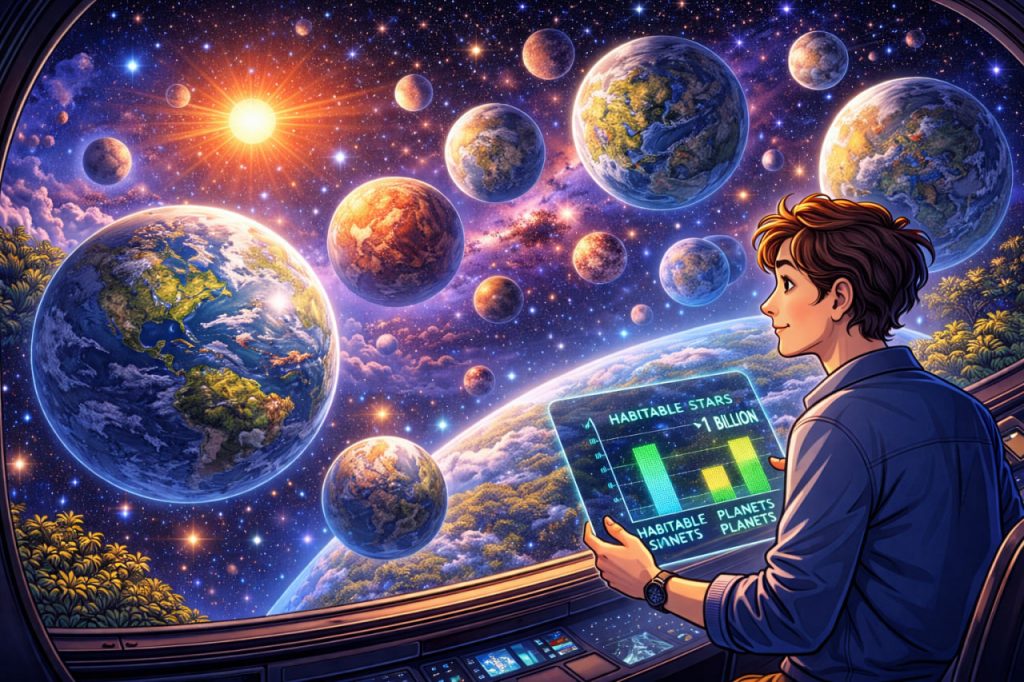
The question of how many planets in the universe might support life is one of the most profound in modern science. For centuries, humanity wondered whether Earth was unique, but recent astronomical discoveries suggest a very different picture. Advances in space telescopes and detection methods have revealed that planets are not rare exceptions, but common features of the universe. Many of these worlds orbit within conditions that could allow liquid water to exist. While the exact number remains uncertain, scientific estimates indicate that potentially habitable planets may be far more abundant than once imagined. Understanding these estimates helps place life on Earth into a broader cosmic context.
What Scientists Mean by “Potentially Habitable”
When scientists refer to a planet as potentially habitable, they do not mean that life definitely exists there. Instead, the term describes worlds that meet basic physical conditions believed to be necessary for life as we know it. These conditions usually include the possibility of liquid water, a relatively stable orbit, and a suitable energy source from a host star. Planet size also matters, as very large planets may be gas giants without solid surfaces. Importantly, habitability does not guarantee life; it simply means the environment does not immediately rule it out. This careful definition helps scientists avoid overstating conclusions while still identifying promising targets.
How Astronomers Estimate the Numbers
Astronomers estimate the number of potentially habitable planets using statistical models based on observed exoplanets. Space missions have shown that most stars host planetary systems, and many stars have multiple planets. By combining the fraction of stars with planets, the average number of planets per star, and the proportion located in habitable zones, scientists can extrapolate across the galaxy. These calculations suggest that billions of planets in the Milky Way alone may orbit within habitable zones. When extended to the observable universe, the numbers become staggering. Although these are estimates, they are grounded in real observational data rather than speculation.
The Milky Way and Beyond
Our galaxy contains hundreds of billions of stars, and even conservative estimates suggest that a significant percentage of them host planets. If only a small fraction of these stars have planets in habitable zones, that still results in tens of billions of potentially habitable worlds in the Milky Way. Beyond our galaxy lie trillions of other galaxies, each with their own stars and planetary systems. This vast scale implies that environments suitable for life may be widespread throughout the universe. However, distance and technology currently limit our ability to study most of these worlds directly.
Factors That Complicate Habitability
Habitability depends on far more than distance from a star. A planet’s atmosphere, magnetic field, geological activity, and chemical composition all influence whether life could survive. Some planets in habitable zones may be barren due to atmospheric loss or extreme radiation. Others outside traditional habitable zones may host subsurface oceans warmed by internal heat. Scientists increasingly recognize that life-friendly environments could exist in a wider range of conditions than previously thought. This complexity makes precise counting difficult, but it also expands the range of worlds considered promising.
What These Numbers Mean for the Search for Life
The possibility that life-friendly planets are common has transformed the search for extraterrestrial life. Instead of asking whether habitable worlds exist, scientists now focus on which ones are most accessible for study. Future telescopes aim to analyze planetary atmospheres for signs of water, oxygen, and other potential indicators of biological activity. While no confirmed evidence of life beyond Earth has yet been found, the growing number of candidate planets strengthens the scientific motivation to keep searching. Each new discovery brings us closer to understanding whether life is a rare accident or a natural outcome of cosmic evolution.
Interesting Facts
- Most stars in the universe are now believed to host at least one planet.
- Even conservative models suggest billions of potentially habitable planets in our galaxy.
- The observable universe contains trillions of galaxies, each with billions of stars.
- Habitability depends on many factors beyond temperature alone.
- Some potentially life-friendly environments may exist beneath icy surfaces, not just on planets.
Glossary
- Potentially Habitable Planet — a planet that may allow conditions suitable for life.
- Exoplanet — a planet orbiting a star outside our Solar System.
- Habitable Zone — the region around a star where liquid water could exist.
- Milky Way — the galaxy that contains our Solar System.
- Observable Universe — the portion of the universe that can be studied with current technology.