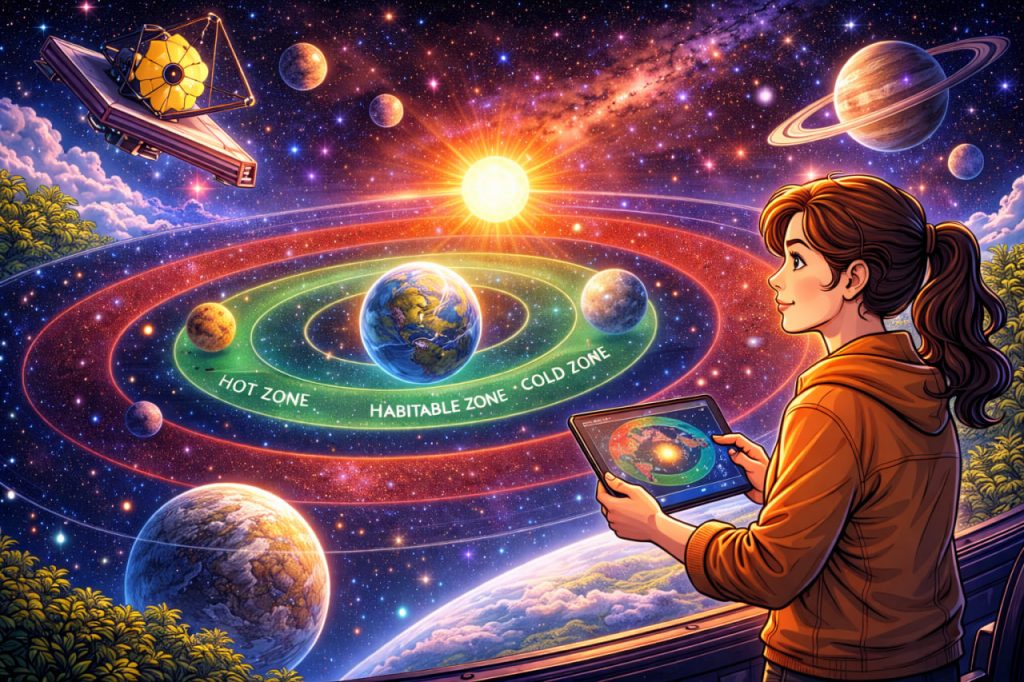
The habitable zone is one of the most important concepts in the search for life beyond Earth. It describes a region around a star where conditions may allow liquid water to exist on the surface of a planet. Because water is essential for all known forms of life, this zone is often called the “Goldilocks zone”—not too hot and not too cold. However, being in the habitable zone does not automatically mean a planet is inhabited. Instead, it identifies places where life could exist under the right conditions. Understanding the habitable zone helps astronomers narrow down the vast number of exoplanets to the most promising candidates.
What Is the Habitable Zone
The habitable zone is defined by the balance between a star’s energy output and a planet’s distance from that star. If a planet orbits too close, water would evaporate due to extreme heat. If it orbits too far away, water would freeze permanently. Within the habitable zone, temperatures may allow liquid water to remain stable on a planet’s surface. This zone varies depending on the type and size of the star. Smaller, cooler stars have habitable zones much closer in, while larger, hotter stars have zones farther out.
Types of Stars and Their Habitable Zones
Different stars create very different habitable environments. Red dwarf stars, the most common stars in the galaxy, have narrow habitable zones located very close to the star. Planets in these zones may become tidally locked, with one side always facing the star. Sun-like stars offer wider and more stable habitable zones, similar to Earth’s orbit. Massive stars, while bright, have short lifespans that may not allow enough time for life to develop. Astronomers consider stellar stability just as important as distance when evaluating habitability.
Exoplanets in the Habitable Zone
Thousands of exoplanets have been discovered, and many of them orbit within their star’s habitable zone. These planets vary widely in size, composition, and atmosphere. Some are rocky like Earth, while others are much larger and likely unsuitable for life as we know it. Atmospheric composition plays a crucial role, as greenhouse gases can warm a planet or trap heat excessively. Astrophysicist Dr. Elena Navarro explains:
“The habitable zone tells us where to look,
but planetary atmosphere tells us whether life could survive.”
This highlights why habitability is more complex than distance alone.
How Scientists Search for Habitable Exoplanets
Astronomers use several methods to detect and study exoplanets in the habitable zone. The transit method observes tiny dips in a star’s brightness when a planet passes in front of it. The radial velocity method measures a star’s wobble caused by gravitational interaction with orbiting planets. Once detected, advanced telescopes analyze planetary atmospheres for signs of water vapor, carbon dioxide, and other key molecules. These observations help scientists assess whether a planet has conditions suitable for life.
Beyond the Classical Habitable Zone
Modern research expands the idea of habitability beyond surface water alone. Some moons and planets outside the traditional habitable zone may contain subsurface oceans, warmed by internal heat rather than sunlight. Others may host thick atmospheres that trap enough heat to support liquid water. This broader view suggests that habitable environments could exist in more places than previously thought. As a result, the search for life now includes a wider range of planetary systems and conditions.
Interesting Facts
- The habitable zone is often called the “Goldilocks zone.”
- Red dwarf stars host many known exoplanets in their habitable zones.
- A planet’s atmosphere can shift the effective habitable zone inward or outward.
- Liquid water does not guarantee life, but it is a key requirement.
- Some potentially habitable worlds may exist beneath icy surfaces.
Glossary
- Habitable Zone — the region around a star where liquid water may exist on a planet’s surface.
- Exoplanet — a planet that orbits a star outside our Solar System.
- Red Dwarf Star — a small, cool, and long-lived type of star.
- Transit Method — a technique for detecting planets by observing starlight dimming.
- Atmosphere — the layer of gases surrounding a planet.