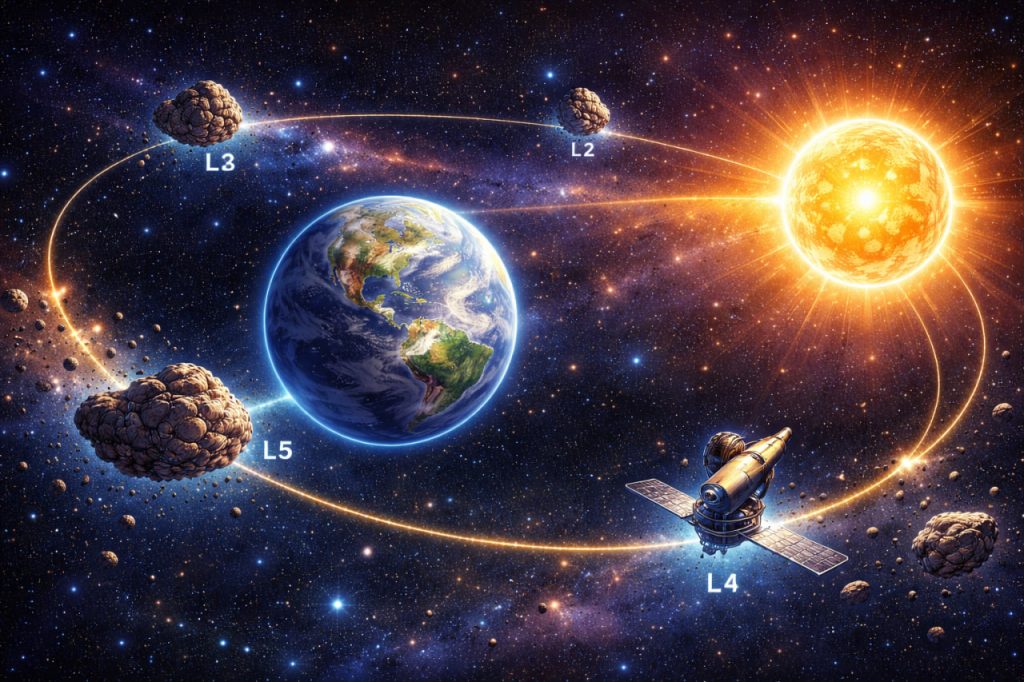
A Lagrange point is a special position in space where the gravitational forces of two large bodies, such as the Sun and a planet, balance in a way that allows a smaller object to remain stable. At these points, an object can stay in place relative to the two larger bodies with minimal energy expenditure. Lagrange points are not physical objects, but regions of gravitational equilibrium that emerge from orbital mechanics. They play a crucial role in modern astronomy, space exploration, and satellite placement. Understanding Lagrange points helps scientists and engineers use gravity as a natural tool rather than fighting against it. These invisible locations demonstrate how balance can exist even in a constantly moving universe.
How Lagrange Points Work
Lagrange points arise in a three-body system, where two massive bodies orbit each other and a third, much smaller object is influenced by their gravity. In such a system, there are five positions—named L1 through L5—where gravitational and orbital forces combine in a precise way. At these points, the smaller object orbits the larger bodies at the same rate, maintaining a stable relative position. This balance is possible because the centrifugal force of orbital motion complements gravitational attraction. While most points require small corrections to maintain position, they still offer significant stability compared to other orbital locations. These dynamics make Lagrange points extremely valuable for space missions.
The Five Lagrange Points Explained
The five Lagrange points each have distinct properties. L1 lies between the two large bodies and provides an uninterrupted view of the larger one, making it ideal for solar observation. L2 sits beyond the smaller body and offers a stable environment for space telescopes shielded from heat and light. L3 lies on the opposite side of the larger body and is rarely used due to communication challenges. L4 and L5, located 60 degrees ahead of and behind the smaller body, are the most stable points. Objects at L4 and L5 can remain there for millions or even billions of years.
Lagrange Points and Space Missions
Lagrange points are essential for modern space exploration. Many scientific satellites are placed at or near these points to take advantage of stable conditions and constant views. Space telescopes benefit from reduced fuel requirements and minimal interference from Earth’s shadow or radiation. According to astrophysicist Dr. Michael Torres:
“Lagrange points allow us to park spacecraft in space
using gravity itself as part of the engineering.”
This efficiency makes long-term missions more reliable and cost-effective.
Natural Objects at Lagrange Points
Not only spacecraft occupy Lagrange points—nature uses them too. Asteroids known as Trojan asteroids gather around the L4 and L5 points of planets, especially Jupiter. These objects are gravitationally trapped and follow the planet along its orbit. Their stability provides valuable clues about the early Solar System and planetary formation. Studying natural occupants of Lagrange points helps scientists test theories of orbital dynamics and long-term stability.
Why Lagrange Points Matter
Lagrange points reveal how gravity can create order within motion. They are practical tools for exploration, communication, and observation, but they are also profound demonstrations of cosmic balance. As space exploration advances, Lagrange points may become hubs for future observatories, space stations, or deep-space missions. Understanding these points allows humanity to expand its presence in space more efficiently and sustainably. In essence, Lagrange points show that even in the vast complexity of the universe, harmony can emerge from fundamental physical laws.
Interesting Facts
- There are five Lagrange points in every two-body orbital system.
- L4 and L5 are naturally stable and can hold objects for billions of years.
- Many space observatories are placed near L1 or L2.
- Trojan asteroids occupy Lagrange points naturally.
- Lagrange points reduce the fuel needed to maintain spacecraft position.
Glossary
- Lagrange Point — a position in space where gravitational forces create orbital balance.
- Three-Body System — a system involving two large bodies and a smaller object.
- Orbital Mechanics — the study of motion of objects in space under gravity.
- Trojan Asteroids — asteroids trapped at stable Lagrange points of planets.
- Gravitational Equilibrium — a state where forces balance and motion remains stable.