Trojan asteroids are a unique group of small celestial bodies that share an orbit with a planet while remaining locked in stable gravitational positions. Unlike typical asteroids found in the main asteroid belt, Trojans travel alongside planets, clustered around special points where gravitational forces balance perfectly. These objects are considered cosmic fossils, preserving information about the early Solar System. Studying Trojan asteroids helps scientists understand how planets formed, migrated, and interacted billions of years ago. Although they move through space at enormous speeds, their orbital relationship with planets remains remarkably stable. Trojan asteroids reveal that even in a dynamic Solar System, long-term balance is possible.
What Are Trojan Asteroids
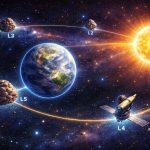
Trojan asteroids are objects that orbit the Sun near a planet’s Lagrange points, specifically the L4 and L5 points. These points lie about 60 degrees ahead of and behind a planet along its orbital path. At these locations, the gravitational pull of the planet and the Sun combine to create regions of stability. Asteroids trapped there can remain in place for millions or even billions of years. The most famous Trojan asteroids are associated with Jupiter, which hosts tens of thousands of them. However, other planets, including Mars, Neptune, and even Earth, also have known Trojans.
Lagrange Points and Orbital Stability
The stability of Trojan asteroids comes from the physics of three-body gravitational systems. In such systems, small objects can remain stable if positioned correctly relative to two massive bodies. The L4 and L5 points form gravitational “valleys” where objects oscillate gently rather than drifting away. This balance allows Trojan asteroids to follow the planet without colliding with it or escaping its orbit. Scientists view these regions as natural traps for material left over from planet formation. Understanding this stability helps refine models of orbital mechanics across the universe.
Jupiter’s Trojan Asteroids
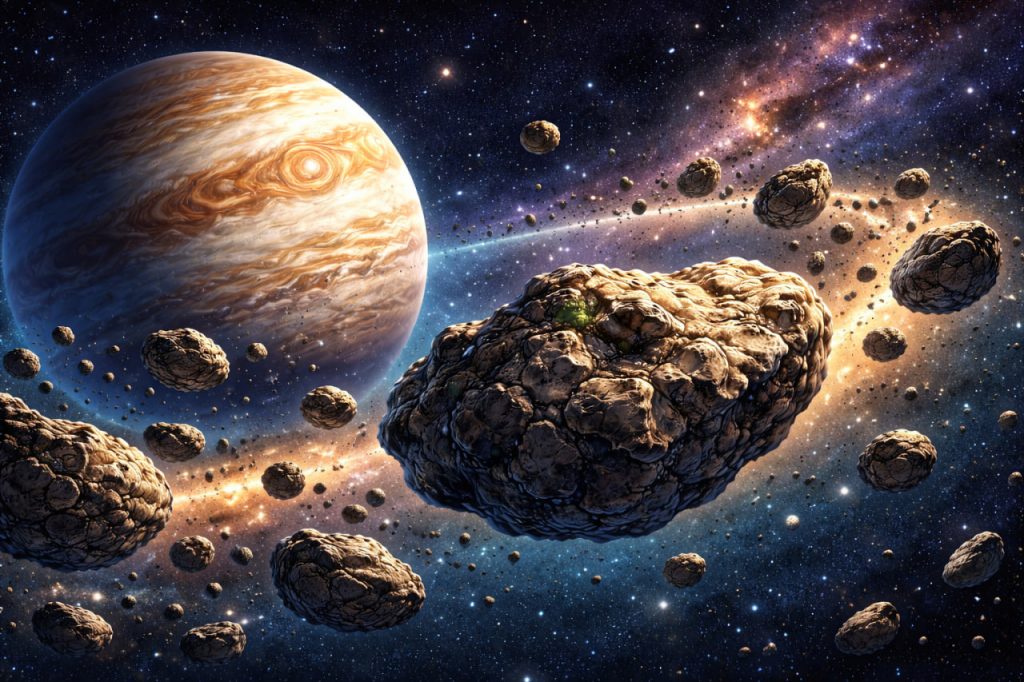
Jupiter’s Trojan population is the largest and most studied in the Solar System. These asteroids are divided into two groups, traditionally named after heroes from the Trojan War. One group leads Jupiter in its orbit, while the other trails behind. Many of these asteroids are dark, carbon-rich objects that may have formed far from the Sun. Their composition suggests that Jupiter’s migration in the early Solar System may have captured material from distant regions. Planetary scientist Dr. Helen Alvarez notes:
“Jupiter’s Trojans are time capsules.
They record conditions from the earliest stages of planetary formation.”
This makes them invaluable targets for scientific exploration.
Trojan Asteroids Beyond Jupiter
While Jupiter’s Trojans dominate in number, other planets also host Trojan companions. Neptune’s Trojans are especially interesting because their orbits appear even more stable than Jupiter’s. Mars has a small number of Trojans, and Earth has at least one confirmed Trojan asteroid. These discoveries show that Trojan systems are not rare anomalies but a common outcome of planetary dynamics. Studying non-Jovian Trojans allows scientists to compare how different planetary masses influence asteroid capture and retention.
Why Trojan Asteroids Matter
Trojan asteroids provide critical insight into the history and structure of the Solar System. Their stability makes them ideal records of ancient material that has avoided collisions and major disturbances. By analyzing their composition, scientists can test theories about planetary migration and the distribution of primordial matter. Trojan asteroids are also of interest for future space missions, both scientific and exploratory. Understanding their orbits improves navigation and long-term mission planning. Ultimately, Trojans help connect planetary motion with the broader story of cosmic evolution.
Interesting Facts
- Jupiter hosts tens of thousands of known Trojan asteroids.
- Trojan asteroids occupy the L4 and L5 Lagrange points.
- Some Trojan asteroids may have formed far beyond Jupiter’s orbit.
- Earth has at least one confirmed Trojan asteroid.
- Trojans can remain stable for billions of years.
Glossary
- Trojan Asteroids — asteroids that share a planet’s orbit around the Sun at stable Lagrange points.
- Lagrange Points — positions where gravitational forces create orbital stability.
- L4 and L5 — the two stable Lagrange points located 60 degrees ahead of and behind a planet.
- Orbital Resonance — a gravitational relationship that stabilizes orbital motion.
- Planetary Migration — movement of planets from their original formation positions.