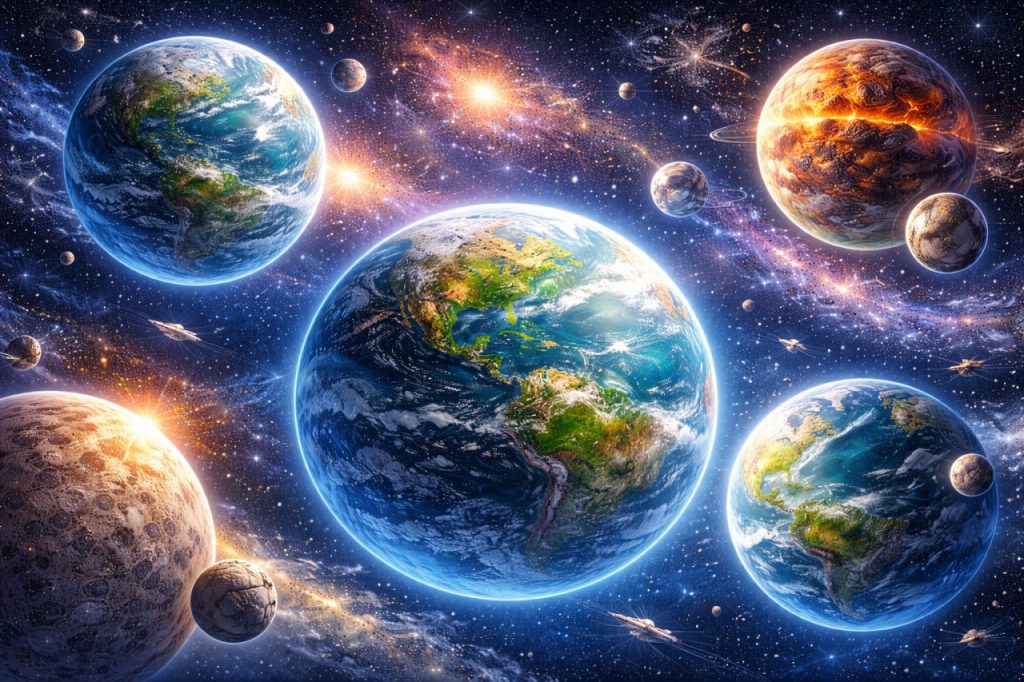
Among the thousands of exoplanets discovered so far, one class stands out for its abundance and mystery: super-Earths. These planets are more massive than Earth but lighter than ice giants like Neptune, occupying a size range that does not exist in our own solar system. Despite being the most frequently detected type of planet in the Milky Way, super-Earths are completely absent around the Sun. This paradox has made them a central focus of modern planetary science. By studying super-Earths, astronomers hope to understand not only how planetary systems form, but also why our own system appears so unusual compared to the galactic norm.
What Exactly Is a Super-Earth?
A super-Earth is typically defined as a planet with a mass between about 2 and 10 times that of Earth, though definitions vary slightly among researchers. Importantly, the term refers only to mass and size, not to habitability or Earth-like conditions. Super-Earths can be rocky, water-rich, or surrounded by thick atmospheres of hydrogen and helium. Some may resemble scaled-up versions of Earth, while others are closer to mini-Neptunes with dense gas envelopes. Planetary scientist Dr. Rafael Nguyen explains:
“‘Super-Earth’ is a structural category, not a promise of life.
These worlds can be familiar, exotic, or something entirely new.”
This diversity makes them difficult to classify using models based solely on our solar system.
Why Super-Earths Are So Common
Observations suggest that super-Earths form easily and efficiently in protoplanetary disks. Their masses allow them to grow quickly without triggering runaway gas accretion that would turn them into gas giants. In many systems, they migrate inward toward their stars, settling into close orbits that make them easier to detect. Statistical studies from space telescopes show that planets in the super-Earth size range are far more common than Earth-sized planets or Jupiter-like giants. This implies that the processes shaping planetary systems across the galaxy often favor intermediate-mass worlds.
Atmospheres and Surface Conditions
The atmospheres of super-Earths vary dramatically depending on their mass, temperature, and formation history. Lower-mass super-Earths may retain thin atmospheres and solid surfaces, while heavier ones can trap thick layers of gas, leading to extreme pressure and temperature at depth. Some super-Earths are thought to host global oceans, while others may have magma oceans or high-pressure ice phases unknown on Earth. Atmospheric studies reveal molecules such as water vapor, carbon dioxide, and methane, though clouds and hazes often obscure deeper layers. These conditions challenge traditional ideas of what a “planetary surface” even means.
Habitability: Promise and Limits
Because many super-Earths are found within or near their star’s habitable zone, they are often discussed in the context of life. A larger mass can help a planet retain an atmosphere and internal heat for longer periods, potentially stabilizing climate over geological timescales. However, higher gravity may also suppress plate tectonics or create crushing surface pressures. According to astrobiologist Dr. Elena Fischer:
“Super-Earths expand the concept of habitability,
but they also introduce constraints we don’t yet fully understand.”
As a result, scientists increasingly view habitability as a spectrum rather than a simple yes-or-no condition.
Why Our Solar System Has None
The absence of super-Earths in our solar system remains one of the biggest puzzles in planetary science. One leading hypothesis suggests that Jupiter’s early formation disrupted the inward migration of large rocky planets, preventing super-Earths from settling near the Sun. Another idea proposes that the specific mass and lifetime of the Sun’s protoplanetary disk favored smaller terrestrial planets instead. Whatever the reason, our solar system may be an outlier rather than a typical example. This realization reshapes how scientists interpret Earth’s place in the galaxy.
Interesting Facts
- Super-Earths are the most common type of planet detected in the Milky Way.
- None exist in our solar system, despite their abundance elsewhere.
- Some super-Earths orbit their stars in just a few days.
- A super-Earth’s gravity can be up to three times stronger than Earth’s.
- Many may represent a transition class between rocky planets and gas giants.
Glossary
- Super-Earth — a planet with a mass larger than Earth’s but smaller than Neptune’s.
- Exoplanet — a planet orbiting a star outside our solar system.
- Protoplanetary Disk — a rotating disk of gas and dust from which planets form.
- Habitable Zone — the region around a star where liquid water may exist on a planet’s surface.
- Planetary Migration — the process by which planets move from their original formation orbits.