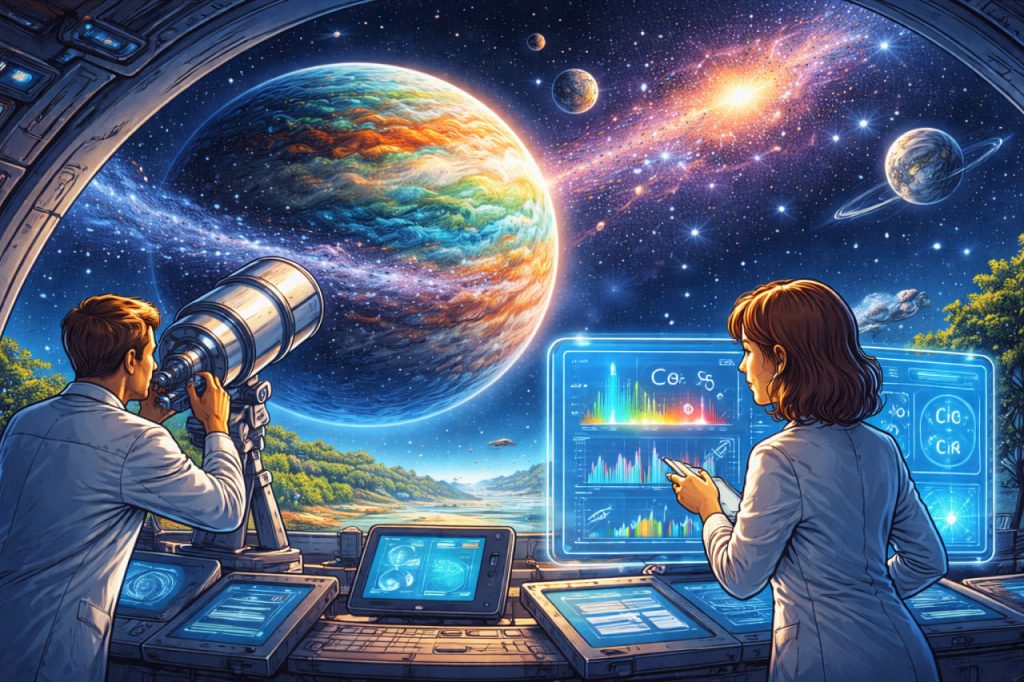
For centuries, planets beyond our solar system were purely theoretical, existing only in speculation and science fiction. Today, astronomers not only detect exoplanets, but also analyze the chemical composition of their atmospheres, despite distances measured in dozens or thousands of light-years. This remarkable achievement is possible thanks to advances in telescope technology, spectroscopy, and data analysis. By studying how starlight interacts with planetary atmospheres, scientists can identify gases, infer temperatures, and even assess whether a planet might support life. Atmospheric analysis has become one of the most powerful tools in modern astronomy, transforming exoplanets from distant dots into complex, physical worlds.
How Scientists Study Exoplanet Atmospheres
The primary method used to study exoplanet atmospheres is spectroscopy, which analyzes how light is absorbed, emitted, or scattered by matter. When an exoplanet passes in front of its host star—a phenomenon known as a transit—a small portion of starlight filters through the planet’s atmosphere. Different gases absorb specific wavelengths of light, leaving characteristic patterns known as spectral fingerprints. By comparing the star’s spectrum before, during, and after a transit, astronomers can determine which chemical compounds are present. This technique requires extreme precision, as atmospheric signals are often buried within tiny variations in light intensity.
Key Molecules and What They Reveal
Atmospheric spectra can reveal a wide range of chemical components, each offering clues about planetary conditions. Water vapor indicates the presence of hydrogen and oxygen and is often associated with potentially habitable environments. Carbon dioxide and methane provide insight into greenhouse effects and atmospheric chemistry, while sodium and potassium can signal hot, extended atmospheres. In some cases, scientists detect clouds or hazes made of exotic materials, such as silicates or metal oxides. Astrophysicist Dr. Lena Hoffman explains:
“An exoplanet’s atmosphere is a chemical autobiography.
Every molecule tells part of the planet’s formation and evolution story.”
Together, these signals allow researchers to build detailed models of alien worlds.
Thermal Structure and Atmospheric Dynamics
Beyond chemistry, atmospheric observations also reveal temperature profiles and circulation patterns. By studying how infrared radiation is emitted at different wavelengths, scientists can determine whether an atmosphere heats up or cools with altitude. Some exoplanets show extreme temperature contrasts between their day and night sides, especially those tidally locked to their stars. High-speed winds, sometimes exceeding several kilometers per second, redistribute heat across these planets. Understanding these dynamics helps researchers explain why some atmospheres remain stable while others escape into space over time.
Biosignatures and the Search for Life
One of the most exciting goals of atmospheric analysis is the detection of biosignatures—chemical combinations that may indicate biological activity. On Earth, the coexistence of oxygen and methane is maintained by living organisms, making this pairing particularly intriguing. However, scientists are cautious: many gases can be produced by non-biological processes under the right conditions. According to astrobiologist Dr. Samuel Ortiz:
“A single molecule is never proof of life.
Context, balance, and planetary environment matter just as much.”
As a result, researchers focus on entire atmospheric systems rather than isolated signals.
Limits, Challenges, and Future Missions
Despite major breakthroughs, atmospheric studies face significant limitations. Stellar activity, instrumental noise, and vast distances can obscure or distort signals. Most detailed measurements currently focus on large exoplanets with thick atmospheres, as smaller Earth-like planets are harder to analyze. However, next-generation observatories promise dramatic improvements. Advanced space telescopes and ground-based instruments will offer higher resolution, broader wavelength coverage, and longer observation times. These advancements may soon allow scientists to study temperate, rocky worlds with unprecedented detail.
Interesting Facts
- The first exoplanet atmosphere was detected in 2002, marking a major milestone in astronomy.
- Some exoplanets have clouds made of glass or molten rock droplets.
- Hot exoplanets can lose their atmospheres, forming comet-like tails of gas.
- Atmospheric studies rely on detecting changes as small as one part in 10,000 in starlight.
- Future telescopes aim to analyze atmospheres of planets similar in size to Earth.
Glossary
- Exoplanet — a planet that orbits a star outside our solar system.
- Spectroscopy — the study of how matter interacts with light to reveal chemical composition.
- Transit — the passage of a planet in front of its star as seen from Earth.
- Biosignature — a chemical or physical indicator that may suggest biological activity.
- Spectral Fingerprint — a unique pattern of light absorption or emission produced by specific molecules.