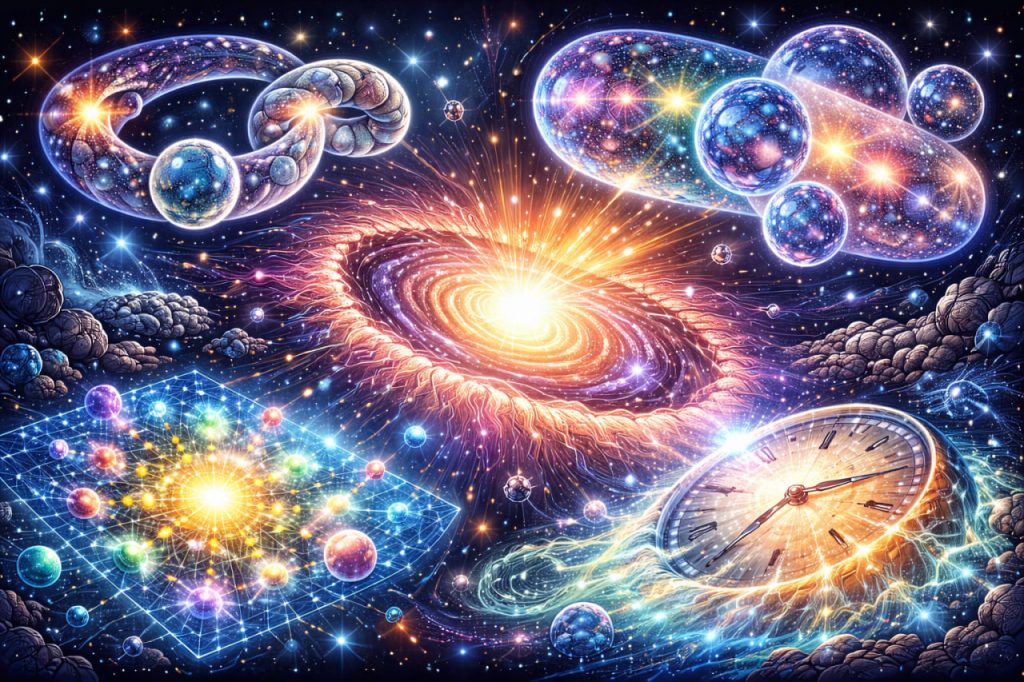
The Big Bang theory successfully describes the early expansion of the universe, but it does not fully answer one of the most profound questions in science: what, if anything, existed before it? While the term “Big Bang” is often imagined as an explosion in space, modern cosmology treats it as the beginning of spacetime itself. This raises a fundamental challenge—if time began with the Big Bang, the concept of “before” may not apply in a conventional sense. Nevertheless, physicists have proposed several hypotheses that attempt to describe conditions preceding or replacing the classical Big Bang scenario. These ideas remain speculative but are grounded in mathematics, theoretical physics, and observations of the universe.
The Limits of the Big Bang Model
The Big Bang theory explains how the universe evolved from an extremely hot, dense state, but it does not describe the initial singularity itself. At this point, known physical laws—especially general relativity—break down. Temperature, density, and curvature become infinite, making meaningful calculations impossible. This limitation suggests that the Big Bang is not a complete theory of origins, but rather a boundary where current models stop working. Many physicists believe a deeper theory of quantum gravity is required to understand what happened at or before this boundary.
The Quantum Vacuum Hypothesis
One widely discussed idea is that the universe emerged from a quantum vacuum, not from absolute nothingness. In quantum physics, even empty space is filled with fluctuating energy fields. According to this hypothesis, a tiny quantum fluctuation could have triggered the expansion of spacetime. In this view, the universe is a natural outcome of quantum processes rather than a singular creation event. Importantly, this “vacuum” is not empty—it obeys physical laws and contains structure, even without particles or radiation.
Cyclic and Bouncing Universes
Another class of theories proposes that the universe did not begin once, but undergoes repeated cycles of expansion and contraction. In these models, the Big Bang represents a transition from a previous contracting phase to the current expanding one—a cosmic “bounce” rather than an absolute beginning. Each cycle may erase most information from the previous universe, while still allowing spacetime to continue indefinitely. These ideas attempt to avoid the singularity problem by replacing it with a smooth transition governed by new physics.
Eternal Inflation and the Multiverse
Some cosmological models suggest that inflation—the rapid expansion that occurred shortly after the Big Bang—never truly ends. Instead, it continues in other regions of spacetime, constantly generating new universes. In this eternal inflation scenario, our universe is just one bubble within a much larger multiverse. If this idea is correct, the Big Bang was not the beginning of everything, but a local event within a vast cosmic structure. While mathematically consistent, this hypothesis remains difficult to test experimentally.
Timeless or Emergent Time Models
A more radical possibility is that time itself is emergent, not fundamental. In such models, the universe exists in a timeless quantum state, and what we perceive as time arises from changes in physical relationships. If time is emergent, asking what came “before” the Big Bang may be meaningless, similar to asking what is north of the North Pole. These ideas challenge everyday intuition but are taken seriously in some approaches to quantum gravity.
Interesting Facts
- The Big Bang does not describe an explosion in space, but the expansion of space itself.
- Quantum physics allows fluctuations even in regions considered “empty.”
- Some models suggest the universe has no true beginning or end.
- The concept of “before time” may not be physically meaningful.
- Many hypotheses about pre–Big Bang conditions are mathematically valid but untestable so far.
Glossary
- Big Bang — the theory describing the early expansion of the universe from a hot, dense state.
- Singularity — a point where physical quantities become infinite and known laws fail.
- Quantum Vacuum — the lowest-energy state of a quantum field, not empty space.
- Inflation — a rapid expansion phase in the early universe.
- Emergent Time — the idea that time arises from physical processes rather than existing fundamentally.