When scientists search for life beyond Earth, they begin with a fundamental question: what conditions are required for life to exist at all? While life on our planet offers only one example, it provides valuable clues about the chemistry and environments that make biology possible. Among these clues, carbon stands out as the central building block of all known living organisms. This has led to the widespread assumption that extraterrestrial life, if it exists, is also likely to be carbon-based. Exploring why carbon is so important—and whether alternatives are possible—helps define the boundaries of life as we understand it.
What Conditions Life Requires
Life, as observed on Earth, depends on a combination of physical and chemical conditions. These include a stable source of energy, a medium that allows molecules to interact (such as a liquid), and elements capable of forming complex structures. Temperature must remain within a range that allows chemical reactions without destroying molecular bonds. Time is also essential, as biological complexity emerges gradually. While different forms of life may tolerate extreme environments, these core requirements appear consistently across all known organisms.
Why Carbon Is So Special
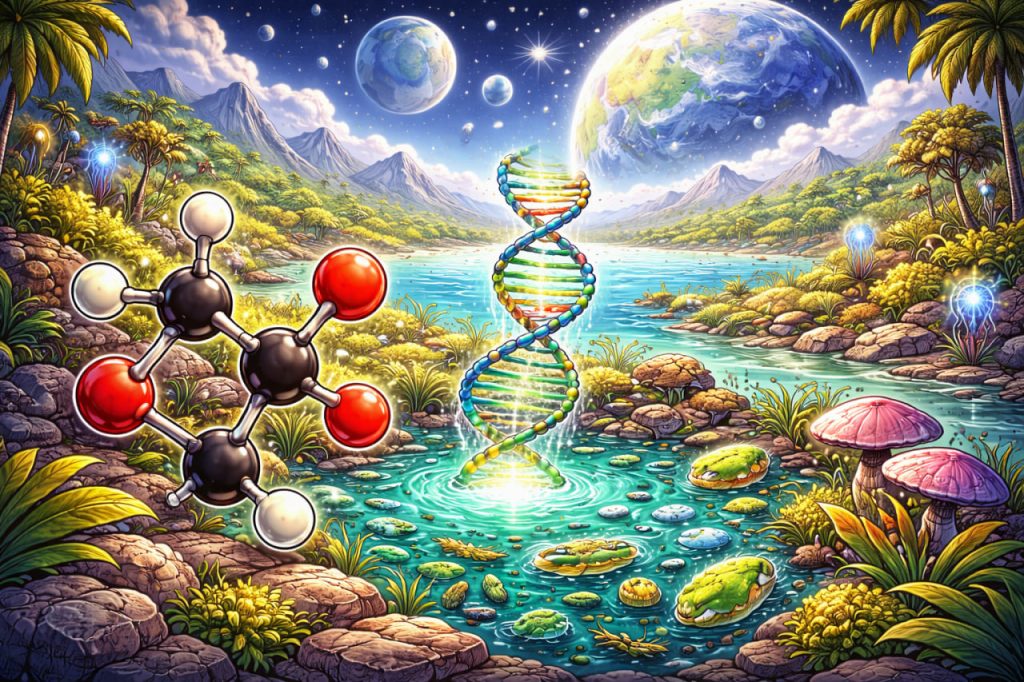
Carbon is uniquely suited for building complex life because of its chemical flexibility. Each carbon atom can form four strong bonds with other atoms, allowing it to create long chains, rings, and three-dimensional structures. These structures can store information, perform chemical reactions, and replicate with variation—key features of living systems. Carbon compounds are stable across a wide range of temperatures and environments, yet reactive enough to support metabolism. According to astrobiochemist Dr. Helen Carter:
“Carbon occupies a perfect balance between stability and versatility,
making it unmatched as a foundation for complex chemistry.”
This balance is why carbon-based molecules dominate biology on Earth.
The Role of Water and Carbon Chemistry
Carbon-based life on Earth is deeply linked to liquid water, which acts as a solvent enabling molecules to move, collide, and react. Water supports carbon chemistry exceptionally well, allowing organic compounds to dissolve and interact efficiently. It also helps regulate temperature and transport nutrients and waste. Because of this strong partnership, scientists often search for planets with both carbon chemistry and liquid water when assessing habitability. However, this does not necessarily mean water is the only possible medium—only that it is the most proven one.
Could Life Be Based on Something Else
Scientists have explored theoretical alternatives to carbon-based life, most notably silicon-based chemistry. Silicon can form multiple bonds and is abundant in the universe, but its chemical behavior is far more limited. Silicon compounds are generally less flexible, less stable in water, and struggle to support the diversity of reactions required for life as we know it. While alternative biochemistries cannot be completely ruled out, they remain speculative and unsupported by empirical evidence. As a result, carbon remains the most plausible foundation for life in the universe.
What This Means for the Search for Life
The assumption that life is carbon-based shapes how scientists design telescopes, missions, and experiments. Atmospheric searches focus on carbon-containing molecules such as methane, carbon dioxide, and complex organic compounds. While this approach may bias the search toward Earth-like life, it is currently the most practical strategy based on known chemistry. As technology advances, researchers may broaden their search criteria, but carbon-based life remains the most scientifically grounded expectation.
Interesting Facts
- Carbon can form millions of different compounds, more than any other element.
- All known life on Earth is carbon-based, from bacteria to humans.
- Carbon-based molecules can store information, as seen in DNA.
- Water enhances carbon chemistry but is not chemically required by carbon itself.
- Many organic molecules form naturally in space without life.
Glossary
- Carbon-Based Life — life that relies on carbon-containing molecules as structural and functional components.
- Astrobiology — the scientific study of life in the universe beyond Earth.
- Organic Compounds — carbon-containing molecules, often associated with life processes.
- Solvent — a substance that allows molecules to dissolve and interact chemically.
- Habitability — the potential of an environment to support life.