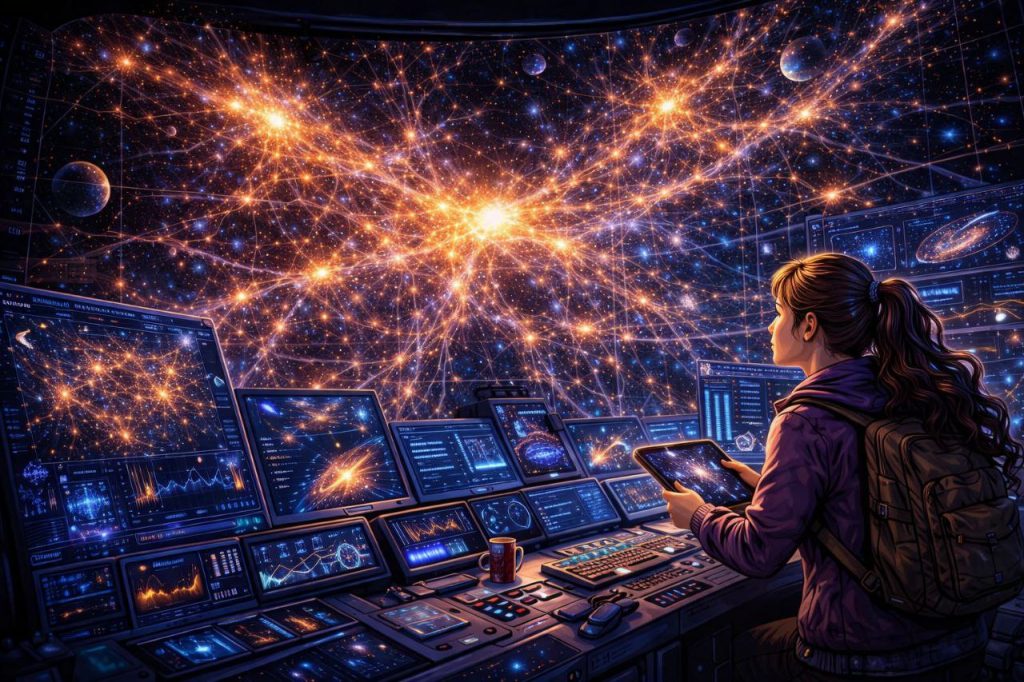
When we look at the universe on its largest scales, galaxies are not scattered randomly through space. Instead, they form an immense, interconnected structure known as the cosmic web. This web-like pattern stretches across hundreds of millions of light-years and represents the largest known organization of matter in the universe. Filaments of galaxies weave through vast empty regions, intersecting at dense nodes where galaxy clusters form. Understanding the cosmic web allows scientists to see how gravity shaped the universe from its earliest moments to the present day.
How the Cosmic Web Formed
The cosmic web began with tiny density fluctuations in the early universe, left behind shortly after cosmic inflation. These slight irregularities were amplified over billions of years by gravity. Regions that were just slightly denser than average attracted more matter, growing into filaments and clusters, while less dense regions became vast cosmic voids. Dark matter played a crucial role in this process by forming invisible scaffolding that guided the motion of ordinary matter. According to cosmologist Dr. Priyamvada Natarajan:
“The cosmic web is gravity made visible,
tracing the growth of structure from the universe’s earliest seeds.”
Without these initial fluctuations, large-scale structure would not exist.
Filaments, Nodes, and Voids
The cosmic web is composed of three main elements. Filaments are long, thread-like structures rich in galaxies and gas, stretching across enormous distances. Nodes occur where multiple filaments intersect, forming dense clusters of galaxies bound tightly by gravity. Between these structures lie voids, vast regions containing very few galaxies at all. Although voids appear empty, they still contain dark matter and diffuse gas. This contrast between dense filaments and empty voids gives the universe its characteristic sponge-like appearance.
The Role of Dark Matter
Dark matter makes up the majority of the universe’s matter content and is essential to the formation of the cosmic web. While invisible to telescopes, its gravitational influence shapes how galaxies move and cluster. Simulations show that dark matter collapses into filamentary structures first, with normal matter following afterward. Gas flows along these filaments, feeding galaxy growth over cosmic time. In this way, dark matter acts as the hidden framework of the universe’s large-scale structure.
Gas, Galaxies, and Intergalactic Medium
Beyond galaxies themselves, the cosmic web contains enormous amounts of hot, diffuse gas, often called the intergalactic medium. Much of this gas lies within filaments and is heated as it falls into gravitational wells. Astronomers detect this material indirectly through its interaction with light from distant quasars. This gas supplies galaxies with the raw material needed to form new stars, linking the cosmic web directly to galaxy evolution.
Why the Cosmic Web Matters
The cosmic web is not just a visual pattern—it encodes information about the universe’s composition, age, and fundamental laws. By studying its shape and distribution, scientists test models of gravity, dark matter, and cosmic expansion. The web also explains why galaxies evolve differently depending on their environment, with dense regions fostering frequent interactions and mergers. In essence, the cosmic web is the universe’s structural backbone, connecting the smallest galactic processes to the largest cosmic scales.
Interesting Facts
- The cosmic web spans hundreds of millions of light-years.
- Most galaxies reside within filaments rather than isolated regions.
- Voids can be tens of millions of light-years across.
- Dark matter shapes the web long before galaxies form.
- Computer simulations reproduce the cosmic web with remarkable accuracy.
Glossary
- Cosmic Web — the large-scale structure formed by galaxy filaments, clusters, and voids.
- Filament — a long, dense structure connecting galaxy clusters.
- Void — a vast, low-density region with few galaxies.
- Dark Matter — invisible matter that interacts primarily through gravity.
- Intergalactic Medium — diffuse gas located between galaxies.