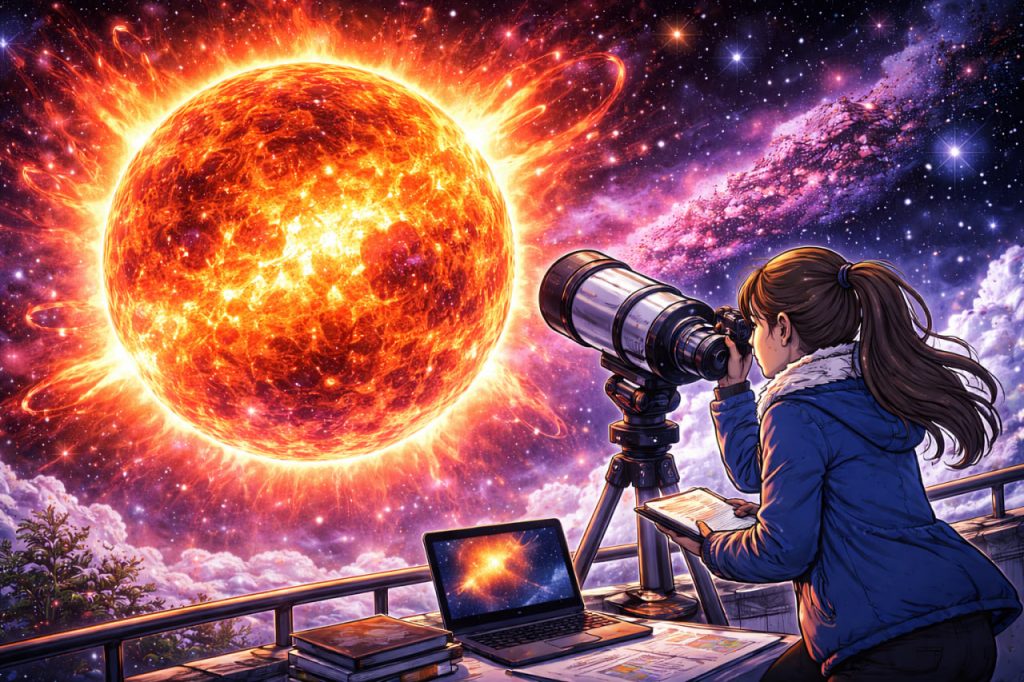
Betelgeuse is one of the most famous and closely studied stars in the night sky, easily recognizable by its reddish glow and enormous size. Located in the constellation Orion, it is a red supergiant—a rare and short-lived stage in stellar evolution. Unlike stable stars such as the Sun, Betelgeuse is highly variable, constantly changing in brightness, size, and surface structure. These fluctuations make it an exceptional natural laboratory for understanding how massive stars age and die. For astronomers, Betelgeuse offers a rare opportunity to observe stellar processes that usually unfold far beyond human timescales.
Size, Distance, and Extreme Scale
Betelgeuse is vast by any standard. If placed at the center of our solar system, its outer layers would extend beyond the orbit of Mars and possibly approach Jupiter’s orbit. Despite this immense size, the star is relatively light for a supergiant because its outer layers are extremely diffuse. Betelgeuse lies roughly 600–700 light-years from Earth, close enough for modern telescopes to resolve details on its surface. This proximity makes it one of the few stars whose disk can be directly imaged rather than treated as a point of light.
An Unstable and Dynamic Star
Unlike smaller stars, Betelgeuse does not burn fuel steadily. Its interior hosts multiple nuclear fusion processes occurring in layers, producing elements heavier than hydrogen and helium. These processes generate powerful convection currents that cause the star’s surface to rise and fall. As a result, Betelgeuse regularly changes brightness and shape. Large bubbles of hot gas can be comparable in size to the Sun itself. According to astrophysicist Dr. Andrea Dupree:
“Betelgeuse is not a calm sphere,
but a boiling, pulsating stellar atmosphere.”
This instability is a hallmark of stars nearing the end of their lives.
The Great Dimming Event
In late 2019 and early 2020, Betelgeuse unexpectedly dimmed dramatically, losing a significant portion of its visible brightness. This event sparked widespread speculation about an imminent supernova. Subsequent research showed that the dimming was likely caused by a massive ejection of material from the star, which cooled and formed dust that temporarily blocked light. Although the event did not signal an immediate explosion, it revealed how violently Betelgeuse sheds mass. Such episodes play a crucial role in shaping the star’s final fate.
Will Betelgeuse Explode as a Supernova
As a red supergiant, Betelgeuse is destined to end its life in a core-collapse supernova. When its core can no longer support nuclear fusion, gravity will cause it to collapse, triggering a powerful explosion. This event could happen tomorrow or tens of thousands of years from now—astronomers cannot predict the exact timing. When it does occur, the supernova will be visible from Earth even in daylight for a short period, but it will pose no danger to our planet.
Why Betelgeuse Matters
Betelgeuse helps scientists understand how massive stars enrich the universe with heavy elements. Supernovae seed space with the materials that later form planets, moons, and even life. By studying Betelgeuse now, astronomers gain insight into processes that shaped the cosmic environment long before Earth existed. In this sense, Betelgeuse is not just a distant star, but a preview of one of the universe’s most important creative events.
Interesting Facts
- Betelgeuse is one of the largest known stars visible to the naked eye.
- Its surface temperature is much cooler than the Sun’s, giving it a red color.
- The star loses mass continuously through powerful stellar winds.
- Betelgeuse’s brightness varies over months and years.
- Its eventual supernova will be one of the brightest stellar events in human history.
Glossary
- Red Supergiant — a massive, evolved star with a cool surface and enormous size.
- Stellar Convection — movement of hot and cool material inside a star.
- Mass Loss — the process by which a star ejects material into space.
- Supernova — a powerful explosion marking the death of a massive star.
- Light-Year — the distance light travels in one year.