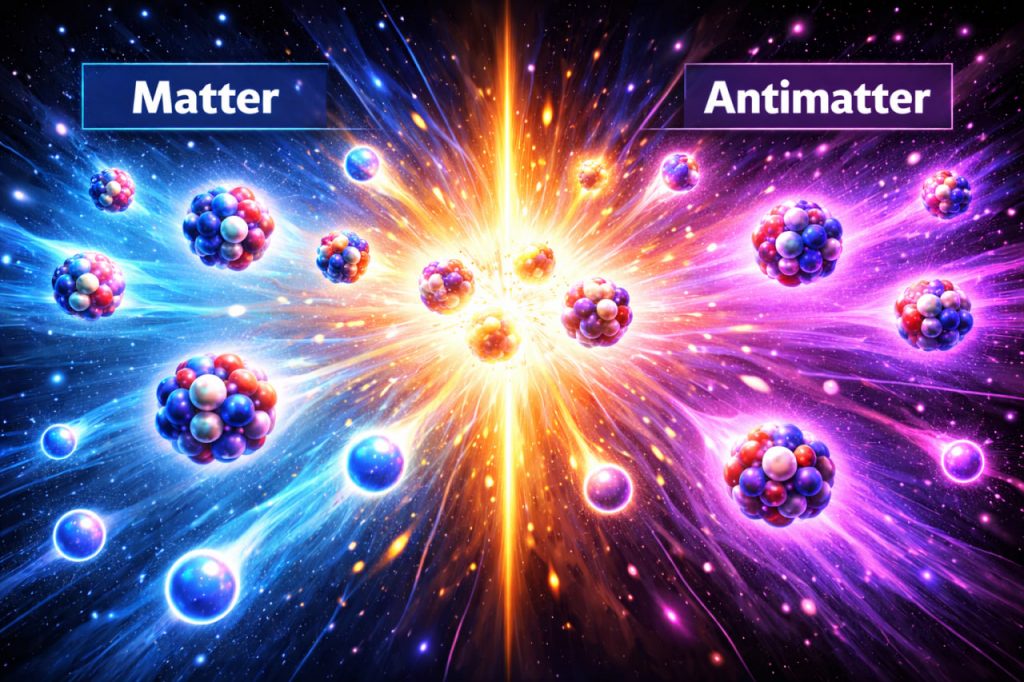
According to the known laws of physics, the Big Bang should have produced matter and antimatter in equal amounts. If that symmetry had remained perfect, particles and antiparticles would have annihilated each other completely, leaving behind a universe filled mostly with radiation. Yet the observable universe is clearly dominated by matter: stars, planets, galaxies, and life itself exist because matter survived. This imbalance is known as baryon asymmetry, one of the most profound unsolved problems in modern physics. Understanding why matter won over antimatter is essential for explaining why the universe exists in its current form.
What Is Baryon Asymmetry
Baryon asymmetry refers to the observed excess of baryons—particles such as protons and neutrons—over their corresponding antibaryons. For every billion antimatter particles in the early universe, there appears to have been roughly one extra particle of matter. Although this imbalance is extremely small in relative terms, it was enough to determine the fate of the cosmos. After most matter and antimatter annihilated, that tiny surplus became all the matter we observe today. Without baryon asymmetry, galaxies and stars could never have formed.
Why Symmetry Should Have Existed
In fundamental physics, matter and antimatter are treated almost symmetrically. Many interactions obey charge–parity (CP) symmetry, meaning physical laws remain nearly the same when particles are replaced with antiparticles and spatial coordinates are reversed. Early-universe conditions were extremely hot and energetic, favoring particle–antiparticle pair production. Under such conditions, perfect symmetry would be expected. The fact that symmetry was broken suggests that some physical processes behaved slightly differently for matter and antimatter.
Sakharov Conditions
In 1967, physicist Andrei Sakharov identified three necessary conditions for baryon asymmetry to arise. First, physical processes must violate baryon number conservation, allowing the number of baryons to change. Second, CP symmetry must be violated, so matter and antimatter do not behave identically. Third, these processes must occur out of thermal equilibrium, preventing symmetry from being restored. These conditions are widely accepted as the theoretical foundation for explaining matter dominance. However, identifying real processes that satisfy all three conditions remains a major challenge.
What the Standard Model Explains—and What It Cannot
The Standard Model of particle physics does include some CP violation, observed in certain particle decays. However, calculations show that this violation is far too weak to explain the observed baryon asymmetry. This gap between theory and observation strongly suggests the existence of new physics beyond the Standard Model. According to particle physicist Dr. Maria Gonzalez:
“The imbalance between matter and antimatter
is one of the clearest signs that our current theories are incomplete.”
This makes baryon asymmetry a key motivation for future experiments.
Leading Hypotheses and Open Questions
Several theoretical mechanisms have been proposed to explain baryon asymmetry. These include electroweak baryogenesis, leptogenesis, and scenarios involving unknown particles or forces. Some models suggest that asymmetry originated first in leptons and later transferred to baryons. Others invoke physics at energy scales far beyond current experimental reach. While these ideas are mathematically consistent, none have yet been confirmed. As a result, baryon asymmetry remains an open question at the intersection of cosmology and particle physics.
Interesting Facts
- Matter exceeds antimatter by only about one particle per billion.
- Without baryon asymmetry, the universe would contain almost no matter at all.
- CP violation has been observed, but not at sufficient levels.
- The problem connects cosmology with particle accelerator experiments.
- Solving baryon asymmetry may require discovering new fundamental particles.
Glossary
- Baryon — a particle composed of three quarks, such as protons and neutrons.
- Antimatter — matter composed of antiparticles with opposite charge and properties.
- CP Violation — a difference in behavior between matter and antimatter.
- Sakharov Conditions — theoretical requirements for generating matter–antimatter asymmetry.
- Standard Model — the current theoretical framework describing fundamental particles and forces.