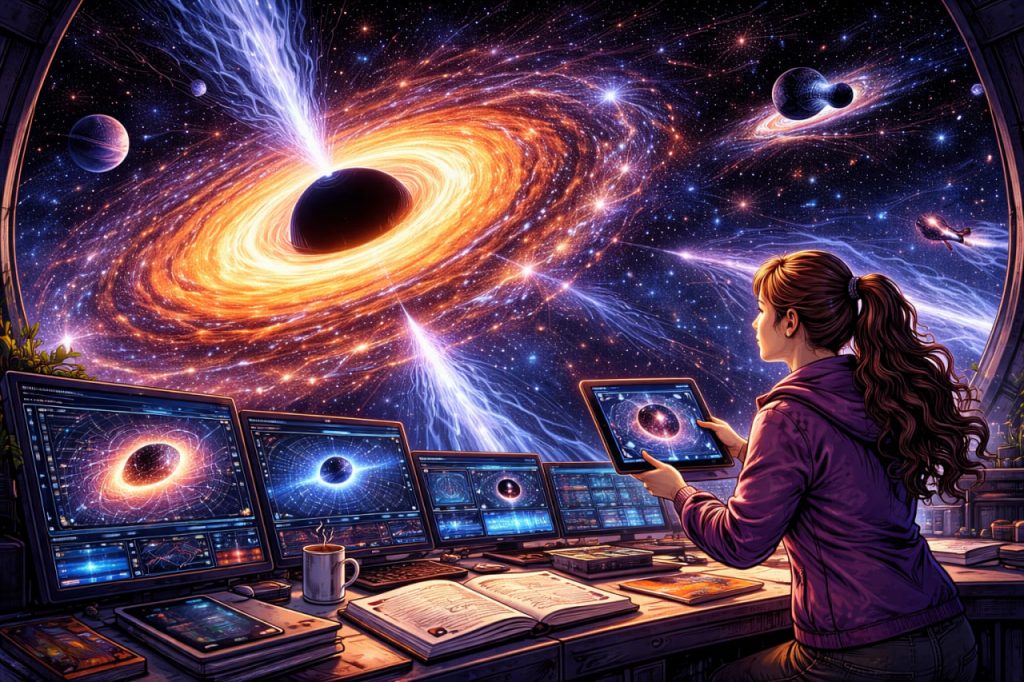
Black holes are among the most extreme and fascinating objects in the universe, once considered purely theoretical and now firmly established by observation. They represent regions of spacetime where gravity becomes so intense that nothing—not even light—can escape beyond a certain boundary. Modern astronomy no longer asks whether black holes exist, but instead focuses on understanding their properties, behavior, and role in cosmic evolution. At the same time, black holes sit at the boundary between known physics and unresolved questions, forcing scientists to distinguish clearly between what is supported by evidence and what remains theoretical. This balance between certainty and speculation defines current black hole research.
What Science Knows for Certain
Observational evidence for black holes is now extensive and robust. Astronomers have detected stellar-mass black holes through their gravitational influence on nearby stars and gas, as well as supermassive black holes residing at the centers of galaxies. The motions of stars near galactic centers, powerful X-ray emissions from accretion disks, and gravitational wave signals from black hole mergers all confirm their existence. The Event Horizon Telescope has even produced images of the shadow cast by a black hole against surrounding radiation. These observations align closely with predictions made by general relativity, reinforcing confidence in our theoretical understanding at large scales.
Event Horizons and Spacetime Behavior
One of the defining features of a black hole is the event horizon, a boundary beyond which escape is impossible. From the outside, objects falling toward a black hole appear to slow down and fade, while from their own perspective, they cross the horizon without noticing anything locally unusual. Near this boundary, spacetime becomes extremely curved, and time dilation effects grow dramatic. These effects have been measured indirectly and match theoretical models with remarkable precision. Importantly, the event horizon is not a physical surface, but a geometric feature of spacetime itself.
What Happens Inside a Black Hole
Inside the event horizon lies the greatest uncertainty. According to classical general relativity, matter collapses toward a singularity, a point of infinite density and curvature. However, infinities usually signal that a theory has reached its limits. Because general relativity does not include quantum effects, scientists believe the true internal structure of black holes requires a theory of quantum gravity, which does not yet exist in a complete form. As a result, statements about the interior remain hypothetical rather than confirmed.
Hawking Radiation and Black Hole Evolution
One of the most important theoretical results in black hole physics is Hawking radiation, which predicts that black holes are not perfectly black. Quantum effects near the event horizon allow black holes to emit tiny amounts of radiation over extremely long timescales. This implies that black holes can slowly lose mass and eventually evaporate. While Hawking radiation has not been observed directly, it is mathematically well-supported and widely accepted by physicists. If correct, it means black holes are dynamic objects with lifecycles rather than permanent cosmic traps.
Open Questions and Modern Hypotheses
Many profound questions about black holes remain unanswered. Scientists debate how information behaves when matter falls into a black hole, known as the information paradox. Other hypotheses explore whether black holes could connect to other regions of spacetime, or whether their cores avoid singularities altogether. These ideas arise from attempts to unify gravity with quantum mechanics, but currently lack experimental confirmation. According to theoretical physicist Dr. Leonard Susskind:
“Black holes are not just astronomical objects —
they are laboratories for testing the deepest laws of nature.”
Until new observations or theories emerge, such ideas remain informed speculation.
Interesting Facts
- Every large galaxy appears to host a supermassive black hole at its center.
- Black holes can collide and merge, producing detectable gravitational waves.
- Time slows dramatically near a black hole compared to distant observers.
- Hawking radiation suggests black holes may eventually disappear.
- Black holes play a major role in shaping galaxy evolution.
Glossary
- Black Hole — a region of spacetime where gravity prevents anything from escaping.
- Event Horizon — the boundary beyond which escape is impossible.
- Singularity — a point where density and curvature become infinite in classical theory.
- Hawking Radiation — theoretical radiation emitted by black holes due to quantum effects.
- Information Paradox — the unresolved question of whether information is lost in black holes.