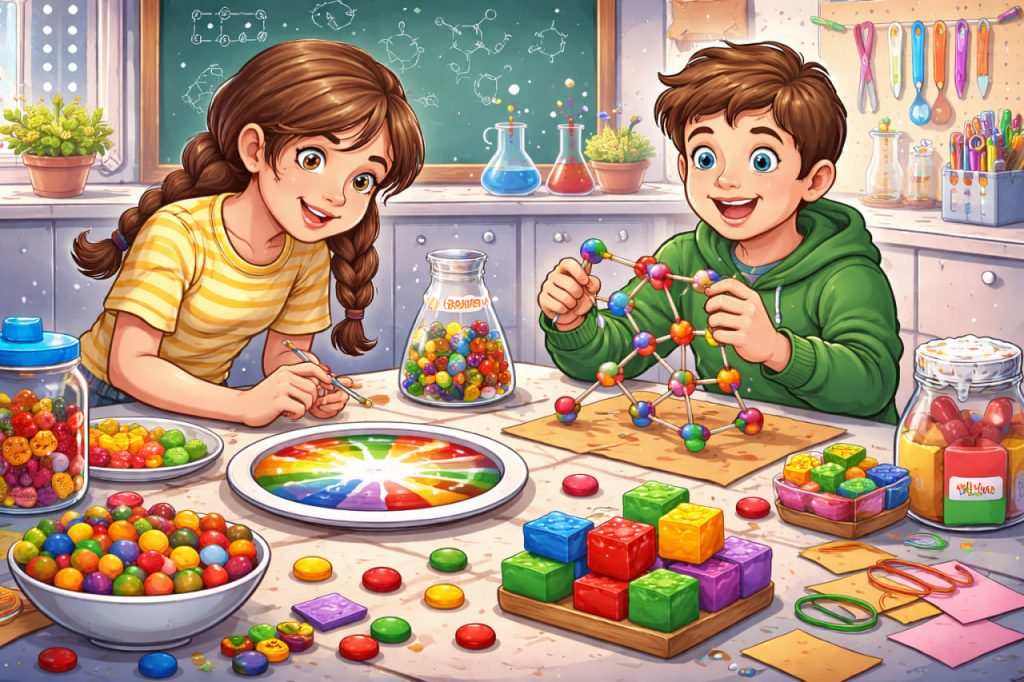
Candy is usually associated with taste, pleasure, and nutrition-free indulgence, but its usefulness does not end with consumption. Because candies are made from sugar, colorants, flavor compounds, and packaging materials, they can be repurposed in creative, educational, and practical ways. Throughout history, sugary substances have been used not only as food but also as tools, materials, and signals. When viewed from a non-culinary perspective, candy becomes a surprisingly versatile object. Exploring these alternative uses highlights how everyday items can serve functions beyond their original intent.
Candy as a Learning and Demonstration Tool
Candies are frequently used in education and science demonstrations. Their predictable shapes, colors, and solubility make them ideal for illustrating basic principles such as diffusion, crystallization, and chemical reactions. For example, placing colored candies in water visually demonstrates concentration gradients and molecular movement. In mathematics and statistics, candies are used for counting, sorting, probability experiments, and pattern recognition. According to education specialist Dr. Laura Bennett:
“Simple objects like candy make abstract concepts visible,
turning theory into something students can immediately grasp.”
This makes candy a powerful teaching aid rather than just a treat.
Creative and Artistic Applications
Candy is often repurposed as a temporary art material. Artists and designers use it to create installations, mosaics, sculptures, and visual experiments that explore color, decay, and consumer culture. Because candy melts, dissolves, or degrades over time, it can symbolize impermanence and transformation. In crafts, candies are used for decorative projects, models, and playful design prototypes. These applications rely on candy’s visual appeal rather than its taste.
Practical Uses Based on Physical Properties
Sugar-based candies have physical characteristics that allow limited practical use. Sticky candies can temporarily hold lightweight objects together, functioning as short-term adhesives in non-critical situations. Hard candies can be used as simple weights, spacers, or markers in tabletop experiments and games. Dissolvable candies help demonstrate moisture levels or temperature effects, as their texture changes quickly with environmental conditions. While these uses are not industrial solutions, they illustrate how material properties can be repurposed creatively.
Social and Psychological Uses
Candy can also serve non-edible roles in behavioral and social contexts. It is often used as a reward token, motivational tool, or symbolic gesture rather than a snack. In group activities, candy acts as a neutral currency for games, decision-making, or participation incentives. The psychological association with reward and color makes candy effective even when it is not consumed. This highlights how meaning can be separated from function.
Limits and Responsible Use
Not all candies are suitable for repurposing, and hygiene, waste, and environmental considerations matter. Using candy for non-food purposes should avoid unnecessary disposal or contamination. Packaging materials often outlast the candy itself and should be handled responsibly. Ultimately, candy’s usefulness outside of eating lies not in efficiency, but in creativity and context—using what is available in imaginative ways.
Interesting Facts
- Sugar crystals were studied scientifically long before modern chemistry.
- Candy is commonly used in classroom science experiments.
- Some artists deliberately let candy melt as part of their work.
- Bright colors make candy useful for visual demonstrations.
- Candy often functions as a symbolic reward rather than food.
Glossary
- Diffusion — the movement of particles from high to low concentration.
- Crystallization — the process by which solids form structured patterns.
- Temporary Adhesion — short-term sticking caused by surface properties.
- Symbolic Reward — an object representing encouragement or achievement.
- Material Property — a physical characteristic that determines how something behaves.