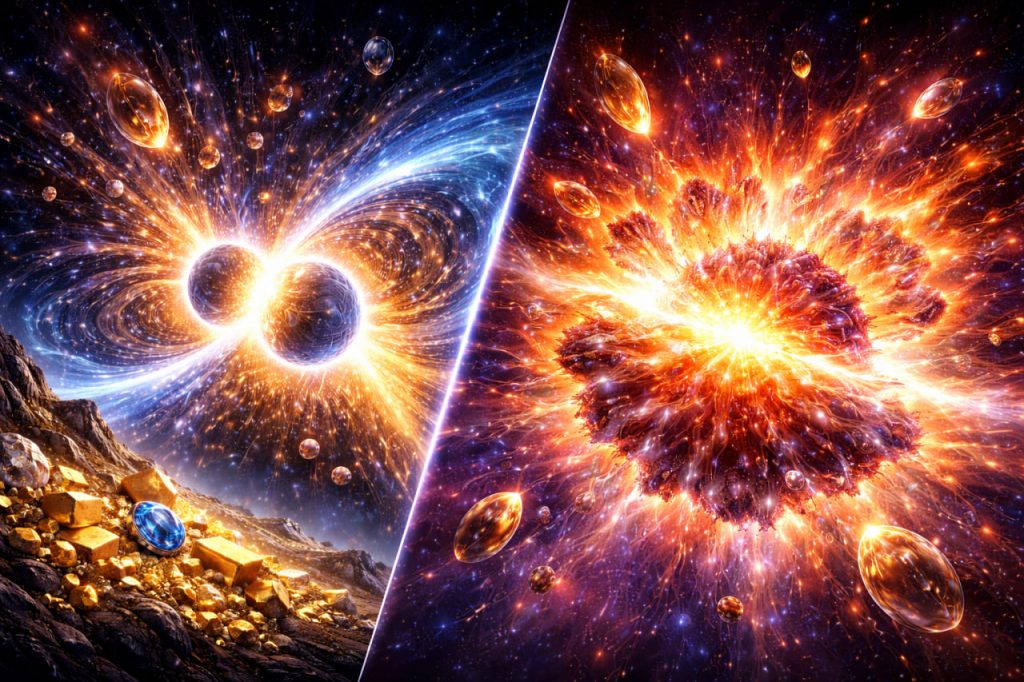
Explosive events play a central role in shaping the universe, redistributing matter and energy across galaxies. Among the most powerful of these events are supernovae and kilonovae, which are often confused due to their dramatic nature and similar names. Despite superficial similarities, they arise from very different physical processes and have distinct consequences for cosmic evolution. Understanding the differences between kilonovae and supernovae helps clarify how stars die, how elements are created, and how modern astronomy observes the violent side of the cosmos.
What Is a Supernova
A supernova is the explosive death of a star. It occurs when a massive star exhausts its nuclear fuel and its core collapses, or when a white dwarf gains too much mass and undergoes a runaway nuclear reaction. In both cases, the explosion releases an enormous amount of energy, briefly outshining entire galaxies. Supernovae are responsible for creating and dispersing many elements up to iron and slightly beyond. They also generate shock waves that trigger new star formation in surrounding regions.
What Is a Kilonova
A kilonova is a much rarer event that occurs when two neutron stars, or a neutron star and a black hole, merge. Unlike supernovae, kilonovae are not driven by core collapse or thermonuclear runaway. Instead, they result from the violent collision of ultra-dense stellar remnants. During the merger, neutron-rich matter is ejected into space and undergoes rapid nuclear reactions. These conditions allow the formation of very heavy elements such as gold, platinum, and uranium.
Energy Output and Brightness
Supernovae are generally brighter and longer-lasting than kilonovae in visible light. They can remain luminous for weeks or months and are visible across vast cosmic distances. Kilonovae, by contrast, are shorter-lived and dimmer, typically fading within days. However, kilonovae emit strongly in infrared wavelengths due to the presence of heavy elements that absorb visible light. Their true power is revealed not by brightness alone, but by the extreme physics involved.
Element Production
The two events differ fundamentally in the elements they create. Supernovae are efficient factories for lighter and intermediate elements, playing a major role in building the periodic table up to iron. Kilonovae dominate the production of heavy elements beyond iron through the rapid neutron-capture process. This distinction explains why precious metals on Earth are relatively rare—they originate from rare cosmic events rather than common stellar deaths.
How Scientists Observe Them
Supernovae have been observed for centuries using visible-light astronomy. Kilonovae, however, were confirmed only recently through the combined detection of gravitational waves and electromagnetic signals. This multi-messenger approach allows scientists to link ripples in spacetime with bursts of light, providing a more complete picture of cosmic events. Kilonovae have become a cornerstone of this new era of astronomy.
Why the Difference Matters
Distinguishing between kilonovae and supernovae is essential for understanding cosmic chemistry and the life cycle of matter. Each event contributes differently to galaxy evolution, element distribution, and astrophysical environments. Together, they demonstrate that the universe relies on multiple types of stellar catastrophes to build complexity. These explosions are not merely destructive—they are creative forces that shape the material foundation of planets and life.
Interesting Facts
- Supernovae can outshine entire galaxies for a short time.
- Kilonovae were confirmed only after gravitational waves were detected.
- Most gold in the universe likely comes from neutron star mergers.
- Supernova remnants can persist for tens of thousands of years.
- Kilonova light fades rapidly as heavy elements form.
Glossary
- Supernova — the explosive death of a star due to core collapse or nuclear runaway.
- Kilonova — a transient explosion caused by a neutron star merger.
- Neutron Star — an extremely dense stellar remnant.
- r-Process — rapid neutron capture that creates heavy elements.
- Multi-Messenger Astronomy — observation using both light and gravitational waves.