For a long time, black holes were thought to be perfect cosmic traps—objects from which nothing could ever escape. This view changed in the 1970s when physicist Stephen Hawking showed that quantum effects alter this picture in a subtle but profound way. According to his work, black holes are not completely black: they emit a faint form of radiation and gradually lose mass over time. This process, now known as Hawking radiation, links gravity, quantum mechanics, and thermodynamics in a single framework. Although extremely weak for astrophysical black holes, the concept has deep implications for our understanding of the universe.
Why Classical Black Holes Should Not Radiate
In classical general relativity, a black hole is defined by its event horizon, a boundary beyond which no signal can return. Light emitted inside this boundary cannot escape, and light emitted outside can. From this perspective, a black hole at rest should emit no radiation at all. Its temperature would be exactly zero, and it would remain unchanged forever. This classical picture is internally consistent—but incomplete, because it ignores quantum effects.
Quantum Effects Near the Event Horizon
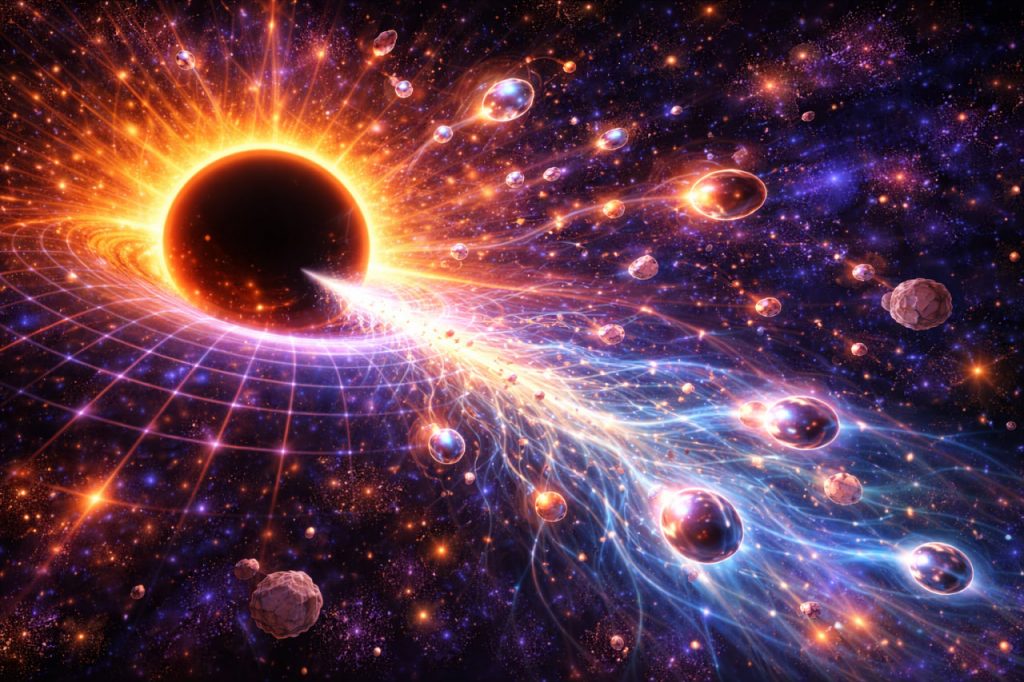
Hawking radiation arises when quantum field theory is applied to curved spacetime near the event horizon. In quantum physics, empty space is not truly empty; it is filled with temporary fluctuations in energy. Near the horizon, these fluctuations are distorted by extreme gravity. As a result, radiation can emerge that appears to originate just outside the black hole. Importantly, this radiation does not come from inside the black hole, and nothing crosses outward through the horizon.
Black Hole Temperature and Mass Loss
Hawking showed that black holes have a well-defined temperature that depends on their mass. The smaller the black hole, the higher its temperature and the stronger its radiation. As radiation carries energy away, the black hole loses mass—a process known as evaporation. For stellar-mass and supermassive black holes, this effect is extraordinarily slow, taking far longer than the current age of the universe. Nevertheless, in principle, a black hole can eventually evaporate completely.
Why Hawking Radiation Is So Hard to Detect
The radiation emitted by astrophysical black holes is incredibly weak, far weaker than background radiation in space. This makes direct detection currently impossible. Hawking radiation has never been observed experimentally, but it is widely accepted because it arises naturally from combining well-tested theories. Analog systems in laboratories have reproduced similar effects in non-gravitational settings, lending indirect support to the idea.
Why Hawking Radiation Matters
Hawking radiation has consequences far beyond black hole lifetimes. It implies that black holes obey the laws of thermodynamics, possessing temperature and entropy. It also leads directly to the black hole information paradox, raising the question of what happens to information as a black hole evaporates. Any final theory of quantum gravity must explain how Hawking radiation fits into a consistent description of nature. In this sense, Hawking radiation is not just about black holes—it is about the foundations of physics.
Interesting Facts
- Hawking radiation is strongest for the smallest black holes.
- Large black holes are colder than the cosmic background radiation.
- A solar-mass black hole would take vastly longer than the age of the universe to evaporate.
- Hawking radiation connects gravity with quantum mechanics.
- The idea reshaped how physicists think about black holes.
Glossary
- Hawking Radiation — theoretical radiation emitted by black holes due to quantum effects.
- Event Horizon — the boundary beyond which escape from a black hole is impossible.
- Quantum Fluctuations — temporary energy changes in empty space predicted by quantum theory.
- Black Hole Evaporation — gradual mass loss due to emitted radiation.
- Thermodynamics — the physics of energy, heat, and entropy.