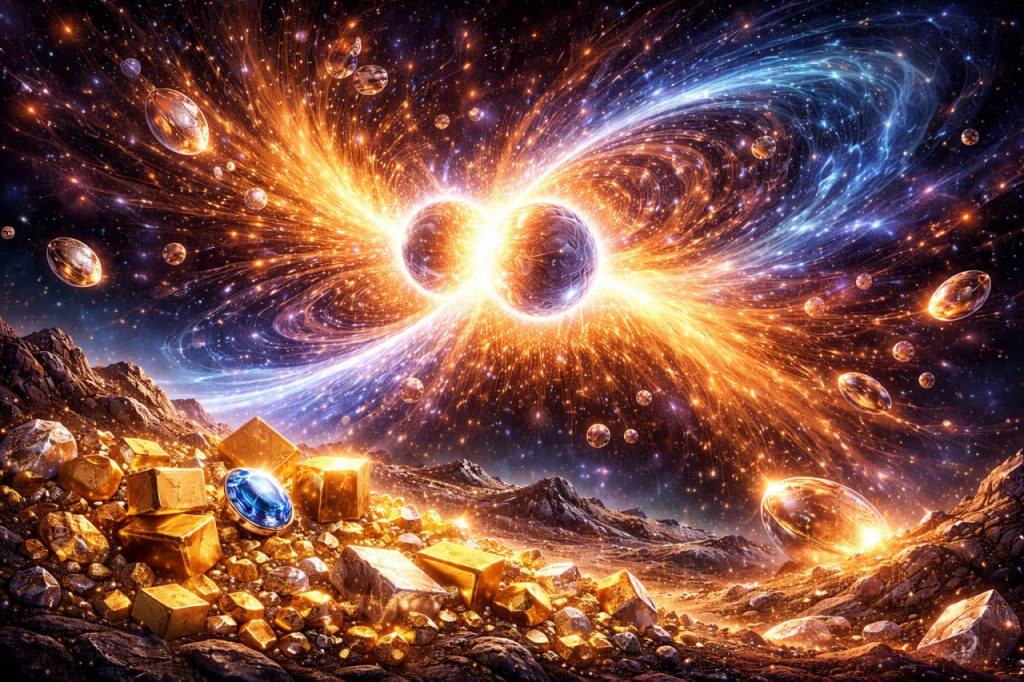
For much of the twentieth century, the origin of the heaviest elements in the universe remained an open question. While stars are known to forge elements like carbon and iron, they cannot easily explain the existence of large quantities of gold, platinum, and other heavy metals. The solution emerged only recently with the observation of neutron star mergers—violent cosmic collisions that create conditions unlike anything else in the universe. These rare events act as natural element factories, producing and dispersing heavy elements across space. Understanding neutron star mergers has fundamentally changed how science explains the chemical richness of the cosmos.
What Are Neutron Stars
Neutron stars are the ultra-dense remnants left behind after massive stars explode as supernovae. They pack more mass than the Sun into a sphere only about 20 kilometers across. Inside a neutron star, matter is compressed to such an extreme degree that atomic nuclei collapse, leaving a dense sea of neutrons. Gravity at the surface is immense, and magnetic fields can be trillions of times stronger than Earth’s. These exotic objects represent one of the final stages of stellar evolution.
Why Mergers Are So Powerful
When two neutron stars orbit each other in a binary system, they slowly lose energy through gravitational waves, spiraling inward over millions or billions of years. As they finally collide, enormous amounts of energy are released in a fraction of a second. Temperatures rise to billions of degrees, and matter is violently ejected into space. This environment is uniquely suited for extreme nuclear reactions that cannot occur in ordinary stars. According to astrophysicist Dr. Brian Metzger:
“Neutron star mergers create conditions
that push nuclear matter far beyond normal stellar limits.”
These conditions are essential for forming the heaviest elements.
The r-Process: Making Heavy Elements
The key mechanism behind gold and platinum production is the rapid neutron-capture process, known as the r-process. In the merger’s ejecta, atomic nuclei are bombarded by vast numbers of free neutrons in an extremely short time. This allows nuclei to grow rapidly into very heavy, unstable forms before they decay into stable elements. Gold, platinum, uranium, and many rare-earth elements are created through this process. Neutron star mergers provide the perfect balance of neutron density, energy, and time required for the r-process to operate efficiently.
Observational Breakthroughs
The connection between neutron star mergers and heavy element production was confirmed in 2017, when scientists observed both gravitational waves and electromagnetic signals from the same event. The resulting glow, known as a kilonova, displayed spectral signatures consistent with newly formed heavy elements. This marked the first time humans directly witnessed the creation of gold and platinum in real time. The discovery linked nuclear physics, astronomy, and cosmology into a single coherent explanation.
Why These Events Matter for the Universe
Although neutron star mergers are rare, each event produces enormous quantities of heavy elements—often equivalent to several Earth masses of gold alone. Over cosmic timescales, these mergers enrich galaxies with the raw materials needed to form planets, technologies, and life as we know it. The gold in jewelry and electronics on Earth likely originated from one or more such ancient collisions. In this sense, neutron star mergers connect the most extreme events in the universe to everyday human experience.
Interesting Facts
- Neutron stars are so dense that a teaspoon of their material would weigh billions of tons.
- A single merger can produce more gold than all the gold mined on Earth.
- Gravitational waves allow scientists to “hear” neutron star collisions.
- Kilonovae are much brighter than novae but dimmer than supernovae.
- Many heavy elements on Earth likely formed outside our galaxy.
Glossary
- Neutron Star — an ultra-dense stellar remnant formed after a supernova.
- Gravitational Waves — ripples in spacetime caused by accelerating massive objects.
- r-Process — rapid neutron capture responsible for forming heavy elements.
- Kilonova — a luminous explosion produced by a neutron star merger.
- Heavy Elements — elements heavier than iron on the periodic table.