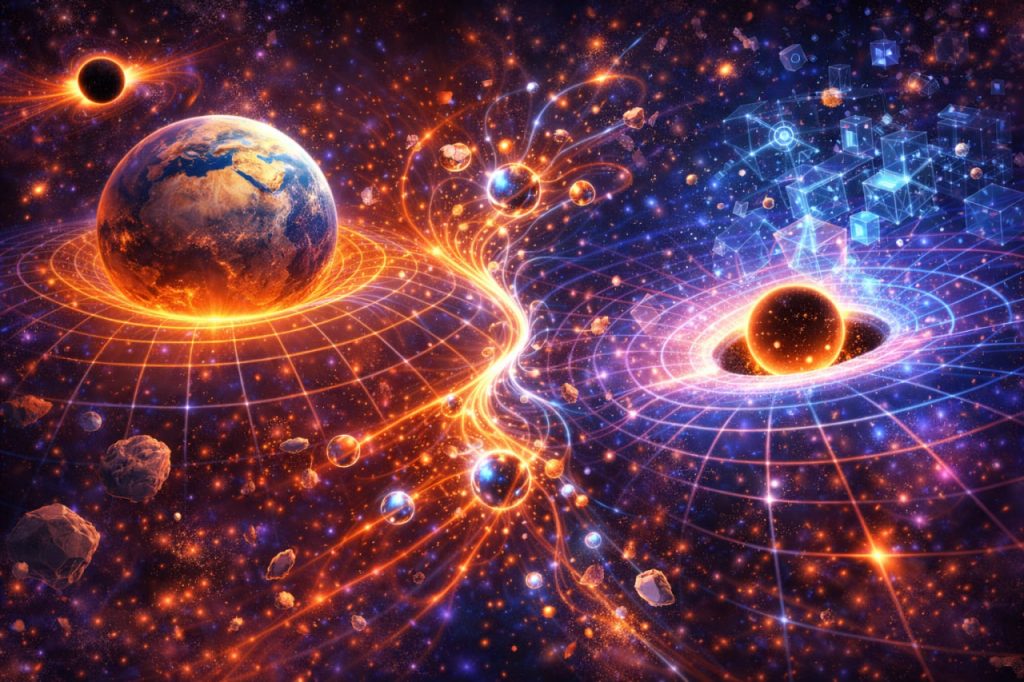
Gravity is the most familiar of the fundamental forces, shaping everything from falling objects to the motion of galaxies. At everyday and astronomical scales, it is described with extraordinary accuracy by classical physics. Yet when gravity is examined at extremely small distances or extreme energies, the classical description breaks down. This mismatch reveals a deep conflict between gravity and quantum mechanics. Quantum gravity is the name given to the unfinished effort to resolve this conflict and describe gravity within a quantum framework.
Gravity in Classical Physics
In classical physics, gravity is best described by general relativity, which treats gravity not as a force but as a curvature of spacetime caused by mass and energy. Objects follow paths determined by this curvature, producing the motion we interpret as gravitational attraction. This theory has been confirmed by countless observations, including gravitational lensing, time dilation near massive bodies, and gravitational waves. At large scales, general relativity is one of the most successful theories ever developed. However, it assumes spacetime is smooth and continuous.
Why Gravity Resists Quantization
Quantum mechanics describes nature at the smallest scales, where energy and matter behave in discrete units. All other fundamental forces have been successfully described using quantum theories. Gravity, however, behaves differently. When physicists attempt to apply quantum rules to gravity, calculations produce infinities that cannot be resolved using standard methods. This suggests that gravity may require a fundamentally different treatment or that spacetime itself behaves differently at quantum scales.
What Quantum Gravity Tries to Explain
Quantum gravity seeks to describe how gravity operates when quantum effects cannot be ignored. This includes conditions near black hole singularities, the earliest moments of the universe, and potentially the structure of spacetime at the smallest possible scales. A key question is whether spacetime is continuous or made of discrete elements. Another is how information and causality behave when gravity and quantum effects are equally strong. These questions go beyond refining existing theories and challenge their foundations.
Leading Theoretical Approaches
Several major approaches attempt to construct a theory of quantum gravity. Some models suggest spacetime has a granular or discrete structure, while others treat gravity as emerging from more fundamental quantum interactions. These theories are mathematically sophisticated and internally consistent but remain difficult to test experimentally. Because quantum gravity effects are expected to appear only at extreme energies, direct evidence remains out of reach for current technology.
Why Quantum Gravity Matters
Although quantum gravity has little direct impact on everyday life, it is crucial for understanding the universe at its most fundamental level. Without it, physics lacks a complete description of black holes, the origin of spacetime, and the earliest moments after the Big Bang. The search for quantum gravity is not about replacing existing theories, but about connecting them into a unified framework. This pursuit continues to guide theoretical physics, even in the absence of experimental confirmation.
Interesting Facts
- Gravity is far weaker than the other fundamental forces.
- General relativity treats gravity as spacetime curvature, not a force.
- Quantum gravity effects are expected only at extreme energies.
- Black holes highlight the conflict between gravity and quantum theory.
- No experimental test of quantum gravity currently exists.
Glossary
- Gravity — the interaction associated with spacetime curvature caused by mass and energy.
- General Relativity — the classical theory describing gravity as geometry.
- Quantum Mechanics — the framework governing physics at microscopic scales.
- Quantum Gravity — the attempt to unify gravity with quantum theory.
- Spacetime — the combined structure of space and time.