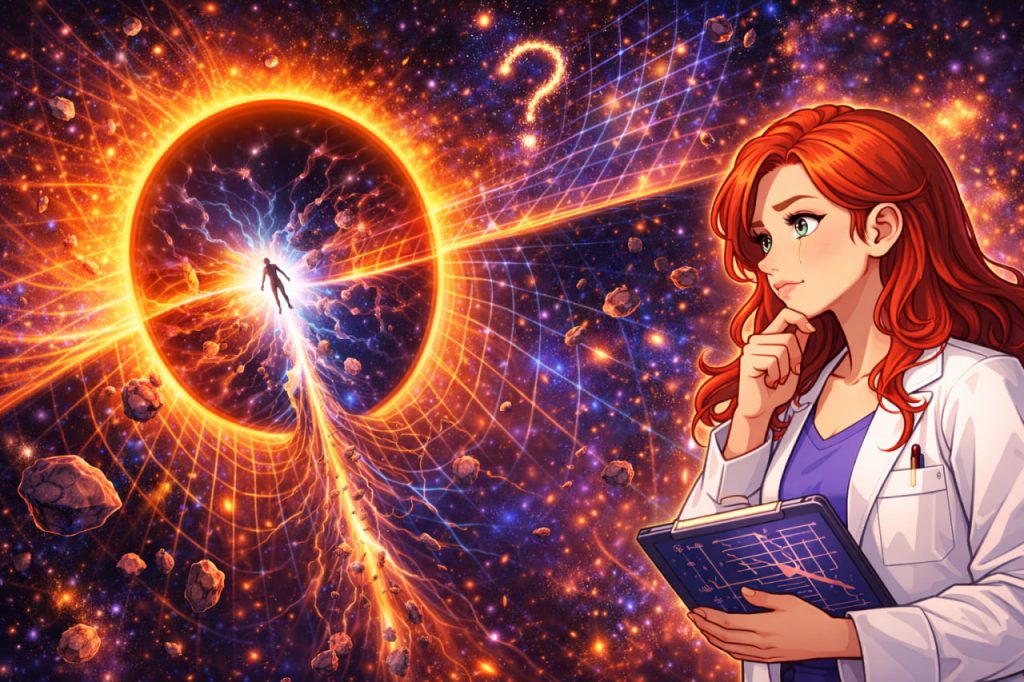
Black holes are among the most extreme objects in the universe, yet what happens inside them remains one of the greatest unanswered questions in physics. While modern science can describe black holes with remarkable precision from the outside, their interiors lie beyond direct observation and experimental testing. This limitation is not due to technological weakness alone, but to the fundamental structure of spacetime itself. The question is therefore not only what happens inside a black hole, but also why physics struggles to answer it. Understanding this distinction is crucial for separating knowledge from speculation.
What We Know with Confidence
From the outside, black holes are described extremely well by general relativity. Their mass, spin, and electric charge determine all observable external properties. Astronomers can measure how black holes bend light, affect nearby stars, produce gravitational waves, and shape accretion disks. The existence of an event horizon is a firm theoretical prediction supported by observation. Everything outside this boundary follows known physical laws with high accuracy.
Why the Interior Is Fundamentally Hidden
The event horizon creates a one-way boundary for information. Once matter or light crosses it, no signal can return to the outside universe. This means that no direct measurement of the interior is possible, even in principle. Unlike distant stars or galaxies, the problem is not distance but causality. Physics relies on observation and testable prediction, and the black hole interior is causally disconnected from us.
What Classical Theory Predicts
According to classical general relativity, matter falling into a black hole continues inward until it reaches a singularity—a region of infinite density and curvature. However, infinities are widely regarded as signs that a theory has broken down. General relativity does not include quantum effects, which become essential at extremely small scales. As a result, the singularity prediction is considered mathematically consistent but physically incomplete.
Why Quantum Physics Complicates the Picture
Quantum mechanics insists that information cannot be destroyed, while classical black hole models appear to erase it at the singularity. This contradiction leads to unresolved problems such as the information paradox. Any accurate description of a black hole interior likely requires a theory of quantum gravity, which does not yet exist in a complete and testable form. Without such a theory, all descriptions of the interior remain provisional.
What Physics Can Reasonably Hypothesize
Scientists explore multiple hypotheses about black hole interiors, including quantum-corrected cores, exotic states of matter, or spacetime structures that avoid true singularities. Some models suggest that spacetime undergoes a radical transformation inside, while others propose that classical concepts like space and time lose meaning entirely. These ideas are constrained by mathematics but not confirmed by evidence. According to theoretical physicist Dr. Carlo Rovelli:
“Inside a black hole,
our current concepts of space and time may simply stop applying.”
Such statements reflect theoretical caution rather than certainty.
Why This Ignorance Is Not a Failure
Not knowing what happens inside a black hole is not a weakness of science—it is a clear boundary of what can currently be tested. Physics advances by identifying such boundaries and developing better frameworks to cross them. Black holes act as stress tests for our theories, revealing where existing models must evolve. In this sense, ignorance is not a dead end, but a guide pointing toward deeper laws of nature.
Interesting Facts
- No signal from inside a black hole can reach an outside observer.
- General relativity predicts singularities, but quantum theory challenges them.
- The interior cannot be studied experimentally with current physics.
- Black holes expose conflicts between major physical theories.
- Solving this problem may require redefining spacetime itself.
Glossary
- Event Horizon — the boundary beyond which information cannot escape.
- Singularity — a region where classical equations predict infinite density.
- General Relativity — Einstein’s theory describing gravity as spacetime curvature.
- Quantum Gravity — a hypothetical theory unifying gravity and quantum mechanics.
- Causality — the principle that effects cannot precede causes.